
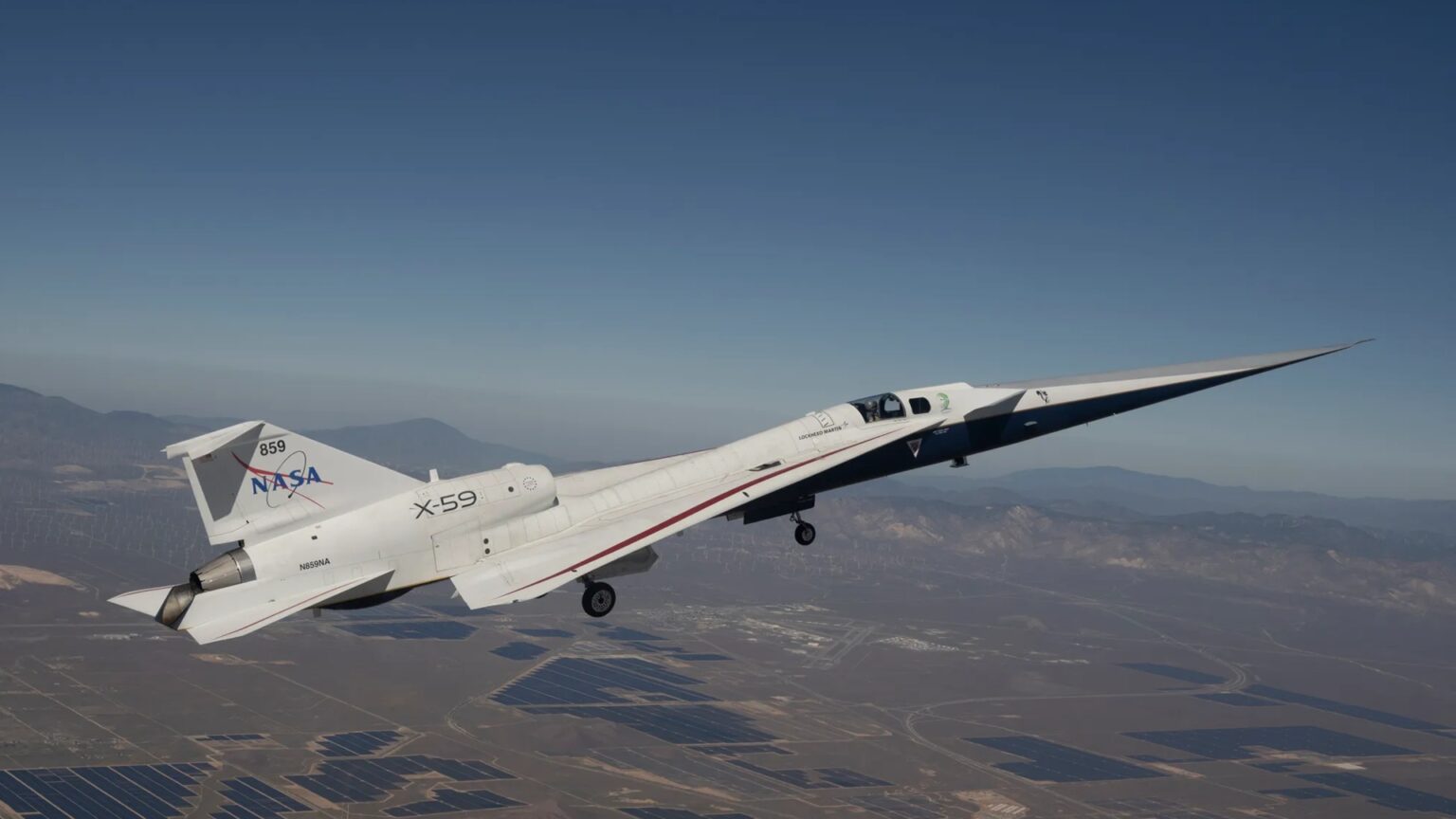
NASA’s quiet supersonic X-59 aircraft completed its second test flight, marking the start of an expanded flight campaign aimed at reshaping the future of high-speed travel.
The experimental jet, part of NASA’s Quesst mission, is designed to fly faster than the speed of sound while producing only a soft sonic thump instead of a disruptive boom. The latest flight took place from Edwards Air Force Base.
The aircraft lifted off at 10:54 a.m. PDT and remained airborne for several minutes before a cockpit warning prompted an early return. Pilot Jim “Clue” Less followed standard procedures and safely landed the jet at 11:03 a.m.
Despite the shortened flight, engineers were able to gather valuable data that will guide upcoming tests as the program ramps up in 2026.
Early return, useful data
“Despite the early landing, this is a good day for the team. We collected more data, and the pilot landed safely,” said Cathy Bahm, project manager for NASA’s Low-Boom Flight Demonstrator at Armstrong Flight Research Center in Edwards, California.
During the flight, a vehicle system warning appeared in the cockpit, triggering a return-to-base decision. The issue has not been detailed, but such events are expected during early-stage testing of experimental aircraft.
“As we like to say, it was just like the simulator – and that’s what we like to hear,” Less said. “This is just the beginning of a long flight campaign.”
The X-59 is central to NASA’s effort to reduce the noise impact of supersonic travel. Traditional supersonic aircraft generate loud sonic booms that have long restricted commercial flights over land.
The aircraft’s elongated nose and carefully shaped airframe are designed to disperse shockwaves, preventing the sharp pressure spikes that create disruptive booms.
The single-engine jet, developed with Lockheed Martin under NASA’s Skunk Works program, is expected to cruise at around Mach 1.4, or roughly 925 mph, at an altitude of about 55,000 feet.
These design choices are aimed at producing a sound level closer to a car door closing than a thunder-like boom.
Toward quieter supersonic flight
Instead of a boom, the X-59 is engineered to produce a quieter “thump,” potentially allowing regulators to revisit long-standing restrictions on overland supersonic travel.
Beyond flight testing, NASA plans to conduct community overflight studies, where the aircraft will fly over populated areas to measure how people perceive the reduced noise signature.
The data will be shared with regulators like the Federal Aviation Administration and international bodies to help shape future supersonic flight rules.
The aircraft will now enter a phase known as envelope expansion, where it will gradually fly higher and faster to test its performance limits. This process is critical for validating the aircraft’s safety and aerodynamic behavior before it reaches full supersonic speeds.
NASA plans dozens of test flights through 2026 as part of this phase. The data collected will help determine whether low-boom supersonic flight can be safely integrated into commercial aviation.
If successful, the X-59 could pave the way for faster cross-country travel without the disruptive noise that grounded earlier supersonic ambitions.