
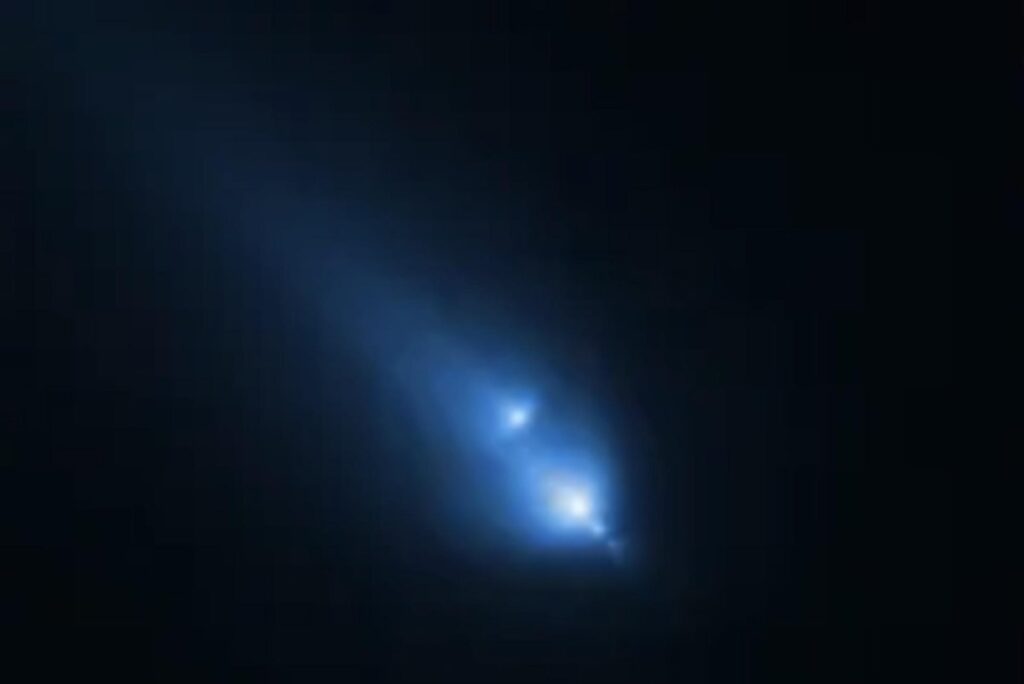
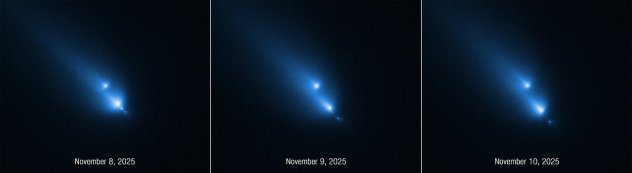
 This series of Hubble Space Telescope images of the fragmenting comet C/2025 K1 (ATLAS), or K1 for short, was taken over the course of three consecutive days: November 8, 9, and 10, 2025. Captured by Hubble&rsquos STIS instrument. Photos courtesy of NASA, ESA, D. Bodewits (Auburn). Image processing: J. DePasquale (STScI)
A chance change in plans helped the Hubble Space Telescope capture an uncommon event in November 2025: a comet breaking apart.
Researchers said Comet C/2025 K1 (ATLAS) was not the original target for the Hubble observations however, plans changed after the original comet they wanted to observe was no longer viewable due to technical constraints.
“Sometimes the best science happens by accident,” said co-investigator John Noonan, a research professor in the Department of Physics at Auburn University in Alabama.
Hubble’s images, taken on Nov. 8, 9 and 10, 2025, showed K1 had broken into at least four distinct pieces, each surrounded by its own coma, the fuzzy envelope of gas and dust that surrounds a comet’s icy nucleus. Before it fragmented, the team said K1 was likely around 5 miles across.
The comet is now a collection of fragments about 249 million miles from Earth, heading out of the solar system and not likely to return.
The researchers said observations like this can help explain why some long-period comets split apart, and they noted ESA’s planned Comet Interceptor mission is designed to study a long-period comet up close later this decade.
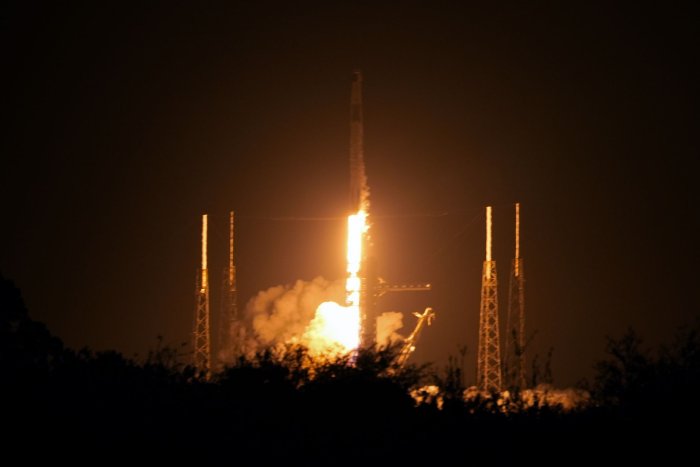
SpaceX’s Falcon 9 rocket with NASA’s Crew-12 aboard lifts off from Launch Complex 40 at Cape Canaveral in Florida on February 13, 2026. Photo by Kate Benic/UPI | License Photo