
Scientists have searched the skies for alien radio signals for more than 60 years, but all they’ve heard so far is what Search for Extraterrestrial Intelligence, or SETI, researchers call “the Great Silence.” A recent study suggests that even if there are aliens out there sending messages, stellar wind and flares from their own home stars may be distorting the signals long before they reach Earth.
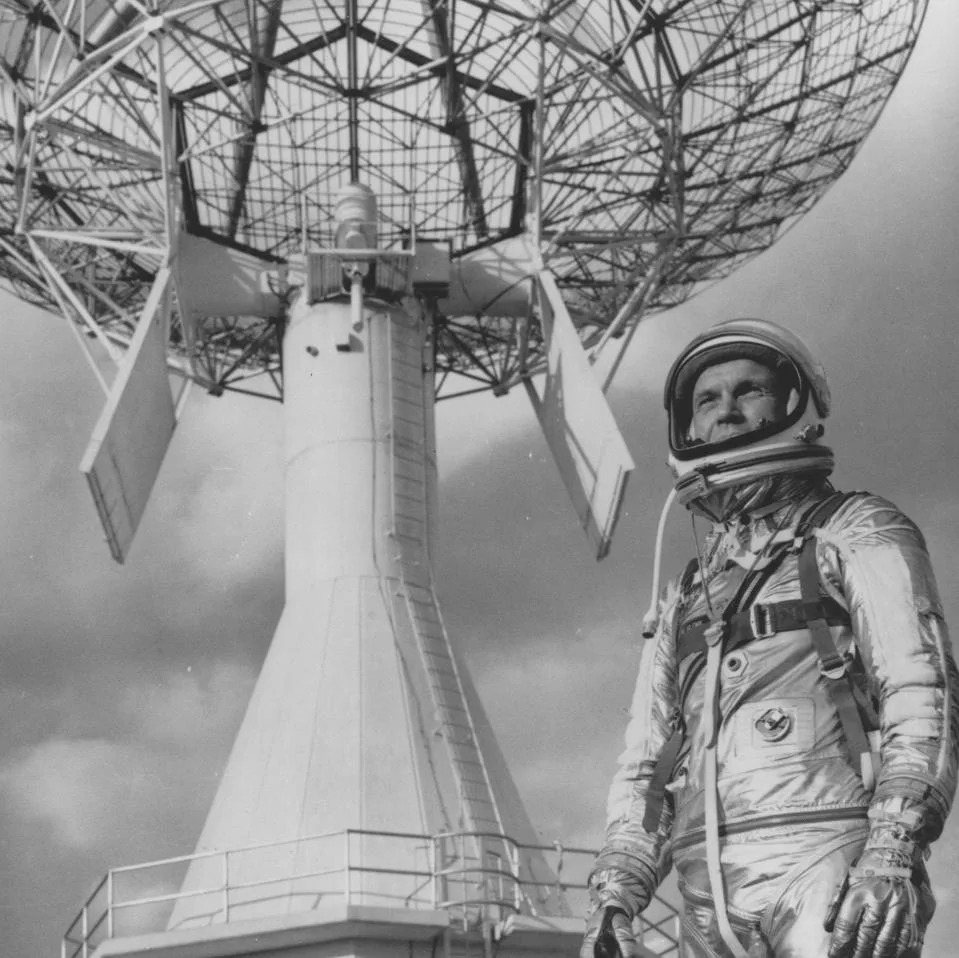
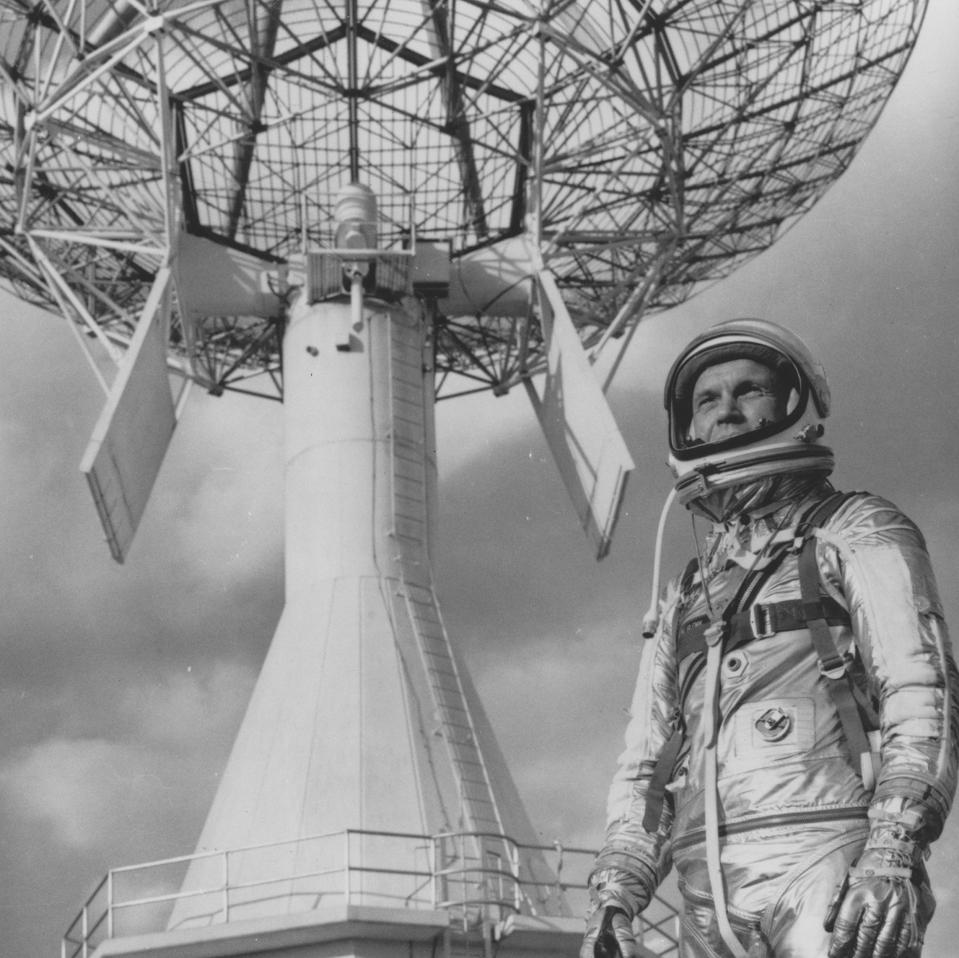
US astronaut John Glenn, wearing his spacesuit gloves and helmet standing in front of a large radio antenna. (Photo by Camerique/Getty Images)
Getty Images
SETI Institute astronomer Vishal Gajjar and his colleagues published their work in The Astrophysical Journal.
Radio Check: Earthlings, Do You Read?
Based on how our Sun slightly warps radio signals from spacecraft here in our Solar System, Gajjar and his colleagues simulated how other types of stars might affect radio signals broadcast from the planets around them. Their results suggest that space weather could blur and weaken extraterrestrial radio signals long before they reach us.
Our Sun is a sedate middle-aged star, but it still exhales an endless stream of electrically-charged particles, called solar wind, out into space – and occasionally, it belches out a blob of plasma or a burst of intense X-ray and ultraviolet energy. The result is what scientists call “space weather,” and at its most intense, it can disrupt signals from GPS satellites and even black out shortwave radio traffic here on Earth. But even fairly mild space weather has an effect on radio signals from spacecraft. A radio signal passing through a dense cloud of charged particles can end up like a headlight in the fog: spread out and dimmed.
Spacecraft trying to send a radio signal across the void usually concentrate all their power on broadcasting on a single channel, or frequency (which just means broadcasting radio waves of a particular wavelength). But when that signal passes through, say, an especially intense gust of solar wind, some of its waves get shortened while others get stretched out, so the signal ends up with its power spread across several frequencies. That means the signal is weaker on whichever frequency its would-be receivers are listening to – and that it looks less like an intentional, focused signal in the first place.
The effects are small enough that it’s not much of a problem for communicating within our Solar System. But if we were trying to broadcast a signal from Earth orbit to – for example – TRAPPIST-1, the way our own Sun distorts the radio signal might make our message undetectable to (hypothetical) radio telescopes on TRAPPIST-1e. Unfortunately for SETI researchers, the reverse is also true.
Distortion “May Offer a Compelling Explanation” for the Great Silence
Scientists listening for the latest data from the twin Voyager spacecraft know which frequencies to listen to, but SETI researchers hoping to catch a signal from an alien spacecraft just have to hope they’re listening to the right frequency at the right moment. Mostly, so far, scientists have focused on narrow-band signals because they’re easiest to tell apart from the broader, messier signals that come from natural astrophysical phenomena, like the accretion disk around Sagittarius A*, the supermassive black hole at the center of our galaxy.
In particular, SETI researchers have focused on the range between 1420 and 1663 megahertz. Hydrogen and hydroxyl (a molecule made of a hydrogen atom and an oxygen atom) in interstellar gas absorb most radio waves at these frequencies, so there’s not much background noise from distant stars and black holes. A powerful, narrow-band signal in these wavelengths could pierce through the interstellar gas (losing part of its strength, but with enough left to be detectable on the other end), and listeners could be reasonably sure that the signal wasn’t coming from anything natural.
But if SETI researchers are only listening for strong signals in a narrow range of frequencies, they may be missing some calls, Gajjar and his colleagues suggest. The algorithms that SETI researchers use to analyze their data already make allowances for the kinds of garbling that happen when a signal passes through interstellar space, but not for the effects of a star close to the source.
Red Dwarfs Are Surprising Culprits
Some of the stars most likely to host life (or at least life that we have a chance of detecting) may also be the most likely to garble a radio signal into faint, incomprehensible noise.
Red dwarf stars like TRAPPIST-1 are prime targets in the search for habitable worlds and intelligent life. That’s partly because they’ve got sheer numbers in their favor; about 75% of the stars in our galaxy are red dwarfs. Enormous stars like VY Canis Majoris are actually relatively rare.
Not only are red dwarfs common, they’re also the longest-lived stars in the universe. These small stars also burn cooler and slower than our Sun (let alone a giant star), which means that intelligent, technology-using life has more time to potentially evolve and start sending out radio messages. And for astronomers, rocky planets orbiting close to small stars offer the best chance of measuring the chemical makeup of a planets atmosphere – and potentially spotting signs of life, or at least habitability.
Although red dwarfs are smaller and cooler than our Sun, they’re also much more active and prone to stellar flares, which means they’re also potentially some of the biggest culprits when it comes to garbling (hypothetical) alien radio signals.
The solution, according to Gajjar and his colleagues, is knowing what to look for and how to look for it.
“By quantifying how stellar activity can reshape narrow-band signals, we can design searches that are better matched to what actually arrives at Earth, not just what might be transmitted,” said SETI Institute astronomer Grace Brown, a co-author of the study, in a press release.