
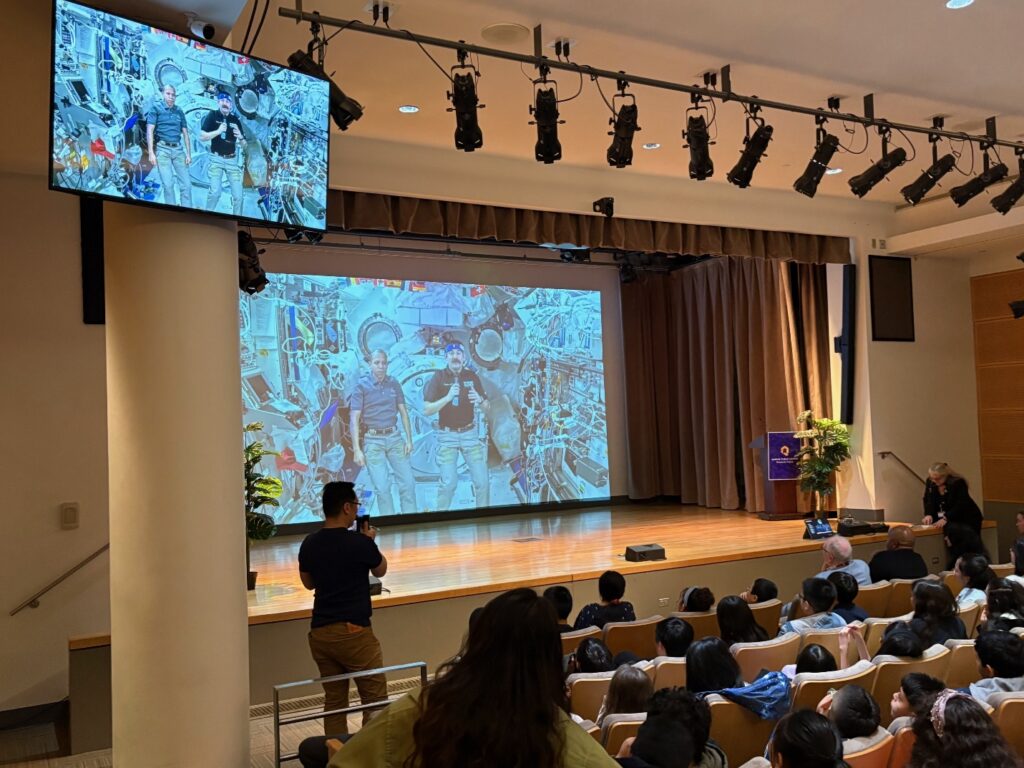
The International Space Station (ISS) made a brief “landing” at Queens Public Library’s Flushing branch auditorium at 41-17 Main Street, where astronauts aboard the station spoke to 200 fifth graders from P.S. 24 about their experiences through a live broadcast feed. Students asked questions on behalf of children from across Queens, and the conversation can be viewed on NASA’s YouTube channel.
Participating astronauts included Chris Williams, a NASA astronaut and flight engineer for Expedition 74, and Jack Hathaway, a U.S. Navy commander and NASA astronaut who serves as pilot for NASA’s SpaceX Crew-12 mission.
“This event was an amazing opportunity for students to speak live with astronauts aboard the International Space Station and learn firsthand what life in outer space is really like,” said Queens Public Library President and CEO Dennis M. Walcott. “Our role is to open new worlds for everyone, and we are thrilled to partner with NASA as these astronauts carry out their mission in space, while we carry out ours here on Earth.”
The event was part of QPL’s ongoing STEM education programming. For the past year, branches across the system have hosted programs focusing on life aboard the ISS in a microgravity environment, where astronauts are nearly weightless. With support from Arm Education, Queens Public Library has installed 52 “ISS Above” video screens at library locations and on QPL bookmobiles. The device tracks when the ISS will pass overhead, shows its real-time orbital position and current crew, and streams live views of Earth from the station’s external cameras.
QPL’s STEM education efforts are designed to inspire young people to explore science and technology, with a focus on space and discovery. Last year, QPL launched its first annual Space Month for children and teens, featuring immersive planetarium experiences, miniature Nano Rover design workshops, and conversations with former NASA astronauts.
The International Space Station (ISS) is a large research laboratory orbiting Earth that provides a unique environment for scientific experiments in microgravity and human spaceflight. Built through international collaboration, the ISS is jointly operated by space agencies from the United States, Russia, Japan, Europe, and Canada. Equipped with laboratories, living quarters, solar arrays, and robotic arms, the ISS enables vital research in biology, physics, and the effects of space on the human body, while helping advance technologies for future missions to the Moon and Mars. Program sponsors include ISS Above, Arm Education, and The Explorers Club.
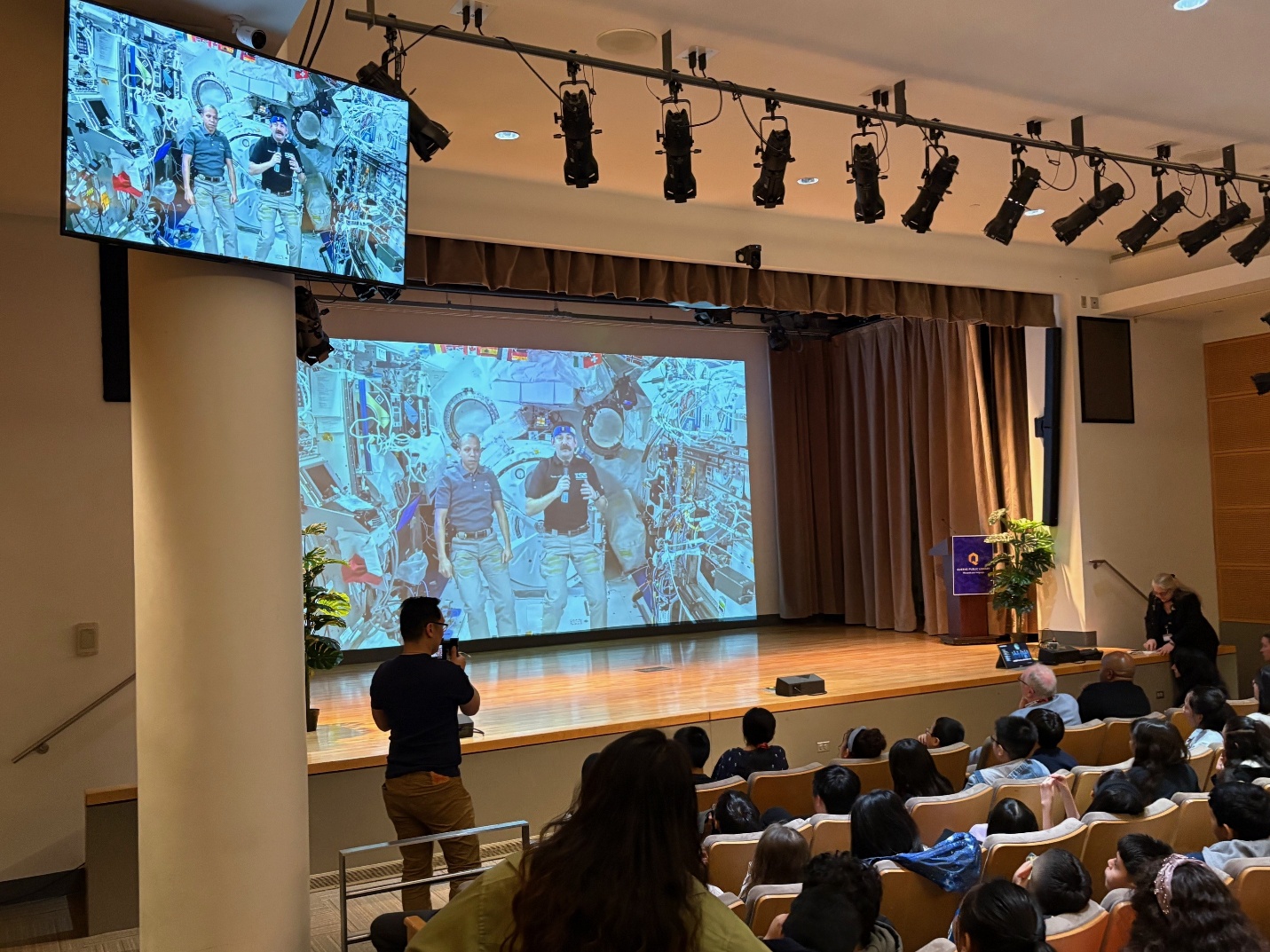
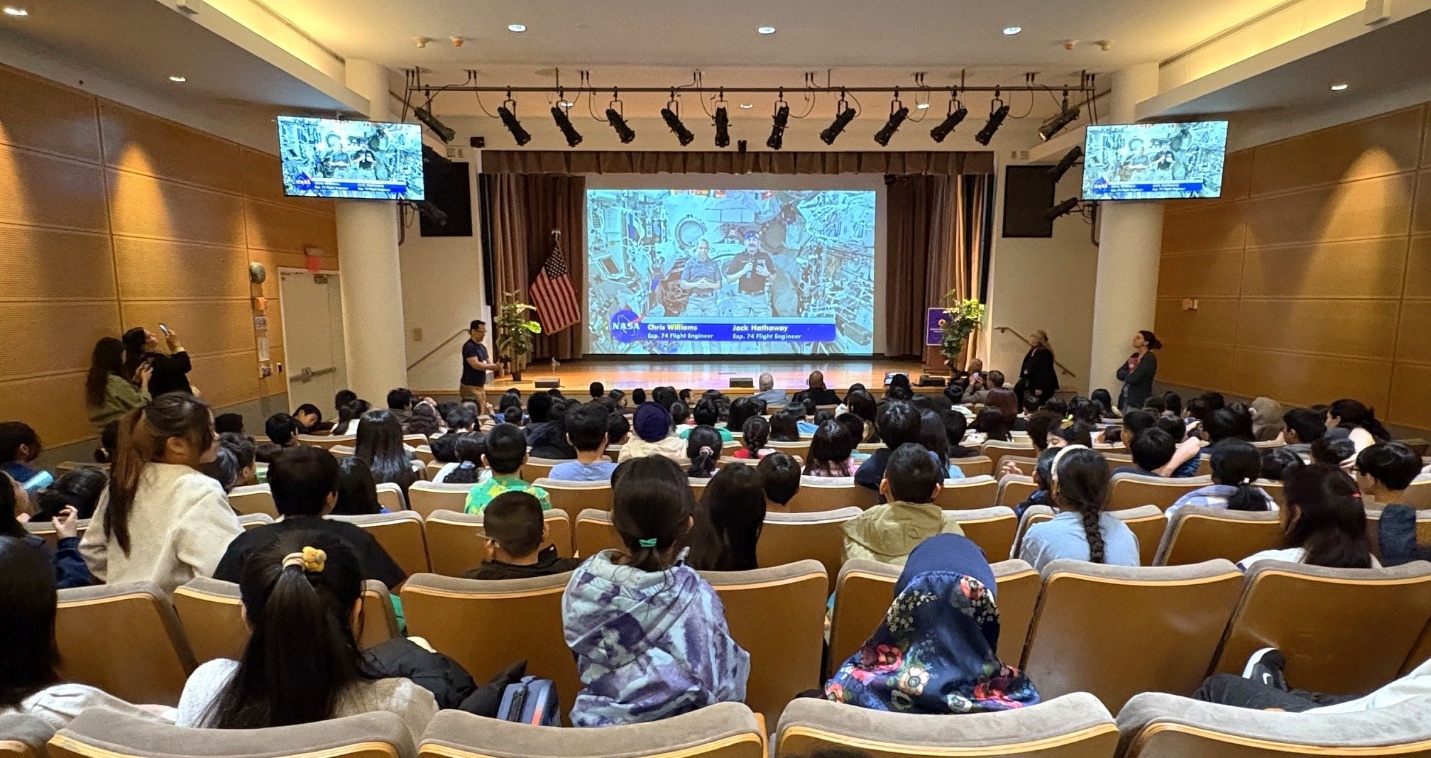
Astronauts aboard the International Space Station talked about their experiences through a live broadcast feed.
Students asked questions on behalf of children from across Queens.