
The NASA OSIRIS-REx mission unexpectedly revealed Bennu’s surface as rugged and boulder-strewn, directly contradicting prior Earth-based observations suggesting smooth terrain. This physical reality challenged previous assumptions about its composition.
“When OSIRIS-REx got to Bennu in 2018, we were surprised by what we saw,” said Andrew Ryan, a scientist with the University of Arizona’s Lunar and Planetary Laboratory in Tucson, who led the mission’s sample physical and thermal analysis working group. “We expected some boulders, but we anticipated at least some large regions with smoother, finer regolith that would be easy to collect. Instead, it looked like it was all boulders, and we were scratching our heads for a while.”
A boulder-sized mystery
Moreover, Bennu’s rugged topography conflicted with thermal readings. NASA’s Spitzer Space Telescope measured low thermal inertia, typical of rapidly cooling surfaces. However, OSIRIS-REx found large boulders, which normally retain heat. This created a significant discrepancy.
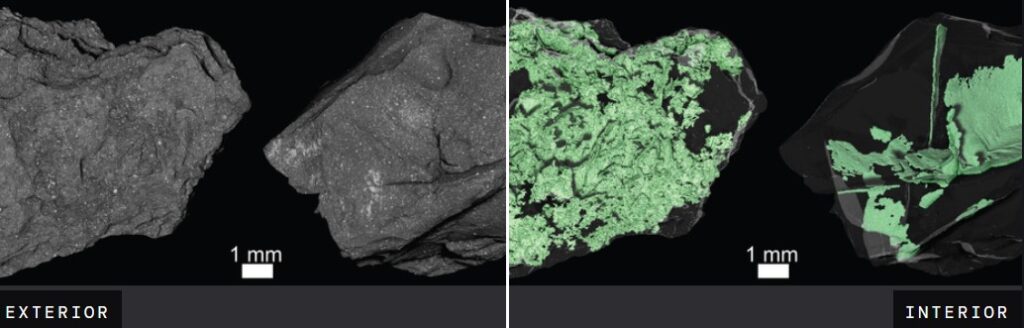
Initial OSIRIS-REx data suggested boulder porosity. Lab analysis of returned samples confirmed some porosity, contributing to heat loss, but this didn’t fully resolve the thermal paradox. Crucially, samples also revealed extensive internal crack networks.
To assess the cracks’ specific role, a Nagoya University team used lock-in thermography on Bennu material. Lab-measured thermal inertia proved substantially higher than spacecraft values, a finding corroborated by JAXA’s Hayabusa-2 mission.
“That’s when things became really interesting,” Ryan said. “The thermal inertia measured in the lab samples turned out to be much higher than what the spacecraft’s instruments had recorded, echoing similar findings obtained by the team of OSIRIS-REx’s partner mission, JAXA’s (Japan Aerospace Exploration Agency) Hayabusa-2.”
Bridging the scale difference was critical. Researchers used X-ray computed tomography (XCT) for 3D imaging. This XCT data fed computer simulations modeling heat flow. Scaled to Bennu’s boulders, these simulations matched spacecraft measurements.
In short, analysis clarified Bennu’s materials and construcfion. While porosity contributed, extensive internal cracking proved pivotal in explaining its thermal properties.
“It turns out that they’re really cracked too, and that was the missing piece of the puzzle,” Ryan said.
This discovery fundamentally refines how scientists interpret asteroid composition from remote thermal observations, validating telescopic assessments through direct sample analysis.
“We can finally ground our understanding of telescope observations of the thermal properties of an asteroid through analyzing these samples from that very same asteroid,” said Ron Ballouz, a scientist with the Johns Hopkins University Applied Physics Laboratory in Laurel, Maryland, and the paper’s second author.
 Published by James Hydzik
James Hydzik is a technology geek focused on the junction of engineering, writing, and coffee. He joined Orbital Today in 2020 to help make sense of the Johnson government’s decision to buy OneWeb. Since then, he has taken on interviewing and editor-in-chief roles. James learned the ropes of editing and writing with Financial Times magazines, The World Bank, PwC, and Ericsson. Thus far, interviewing New Space movers has put the biggest smile on his workaday face. The son of an Electrical Engineer, James understands the value of putting complex topics into clear language for those with a lay person’s understanding of the subject. James is a European transplant from the United States, and as ex-KA3LLL, he now holds European amateur radio licenses. His next radio project is a portable 10GHz EME (moonbounce) station, as it combines his childhood interests in antennas and space.