
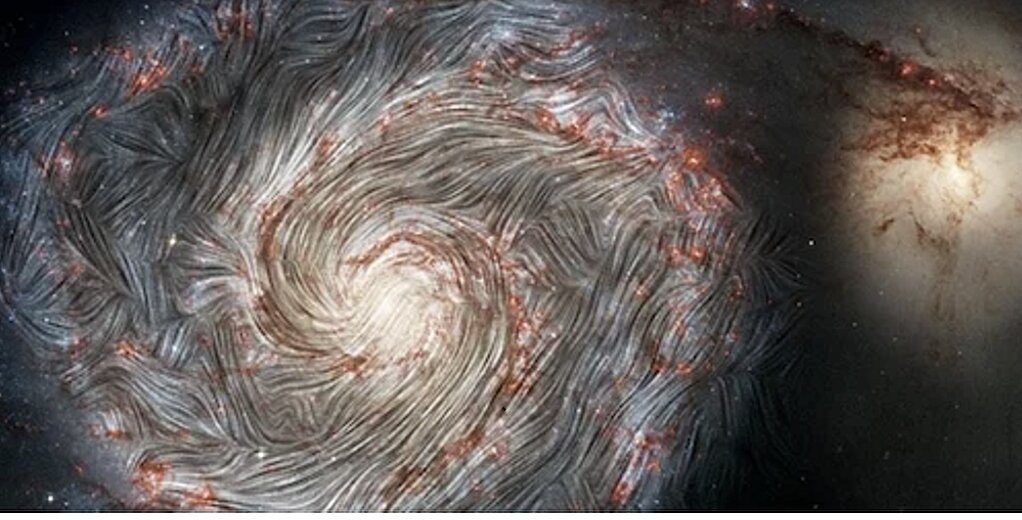
How quickly can a galaxy generate ordered magnetic fields spanning thousands of light-years? Existing theories suggest several billion years, but observations of galaxies in our Universe point to shorter time frames. In a new study, scientists propose an explanation that resolves this contradiction.
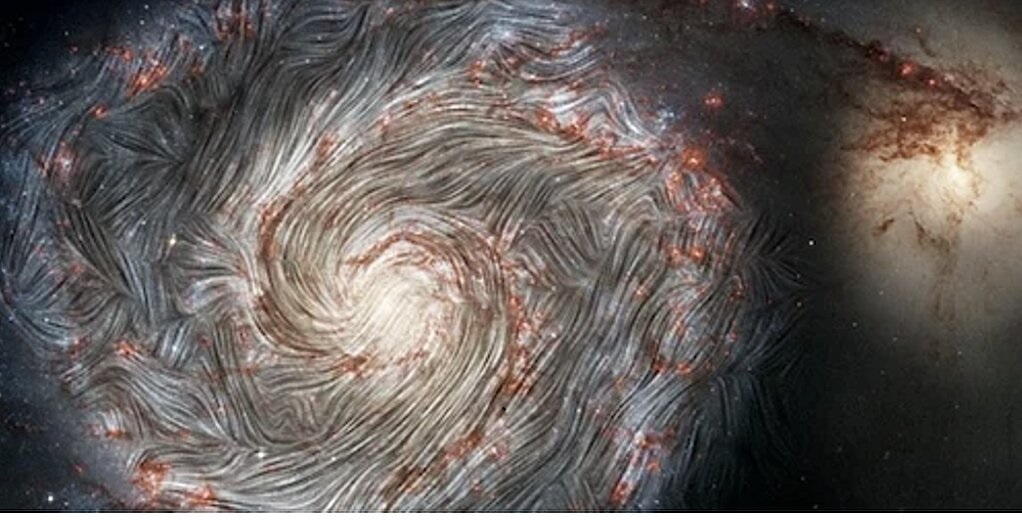 How do young galaxies form magnetic fields? Source: phys.org
Limitations of the dynamo theory
Virtually all visible matter in our Universe exists in the form of plasma, which can be stirred by forces related to gravity, temperature gradients, and rotation. If this leads to turbulent flow, the theory predicts that the existing magnetic fields in the plasma will intensify. The dynamo theory is the foundation of our understanding of the origin of cosmic magnetic fields.
Pallavi, an associate professor at the International Center for Theoretical Sciences (ICTS) and the author of the study, argues that the dynamo theory has its limitations. In particular, it struggles to explain observations of young galaxies with powerful magnetic fields spanning thousands of light-years.
How collapsing clouds amplify the dynamo
A new study examines how the dynamo might function differently during galaxy formation. It examines an ionized gas cloud collapsing under the influence of gravity—the stage during which galaxies form. “When the galaxy is forming, gravity itself can stir the plasma, which can amplify magnetic fields,” says Irshad, a graduate student at ICTS and the lead author of the paper.
Using analytical calculations, the team was able to demonstrate that the plasma mixing that occurs during the collapse can accelerate the formation of magnetic fields. As a result, the observed magnetic fields may have formed much more quickly than previously thought.
According to them, the reason for this lies in the change in the turbulent plasma flow during the collapse. One characteristic of turbulent flows is eddies, similar to those we see in streams. The growth rate of the magnetic field depends on the “rotational frequency” of these eddies.
The team found that this rotation rate increases as the cloud collapses, leading to an accelerated “super-exponential” growth of magnetic fields, which explains how magnetic fields could have formed more rapidly in young galaxies. Using numerical analysis, the team also demonstrated that the field generated in this way is stronger than would be expected based on standard dynamo theory.
Mathematical structures for explaining the collapse
In their study, the team employs a mathematical framework used in cosmology to account for the expansion of the Universe. “These coordinates essentially make the equations of a collapsing galaxy the same as a static galaxy, making the calculations very straightforward,” says Irshad. “This works well for a uniformly collapsing spherical system, but we would need to extend this study for more realistic cases.”
Pallavi says that there is still much to learn about this “fundamental issue of order that you raise regarding temporal boundaries.” For example, there have been attempts to create computer models of the formation of structures in the Universe. This research may shed light on how quickly magnetic fields form in the Universe, enabling scientists to test and refine their models.
Although magnetic forces typically play a much smaller role than gravity in the formation of cosmic structures, a new study suggests that powerful, ordered magnetic fields may have emerged earlier and influenced the evolution of the Universe for a longer period than previously thought.
According to phys.org