
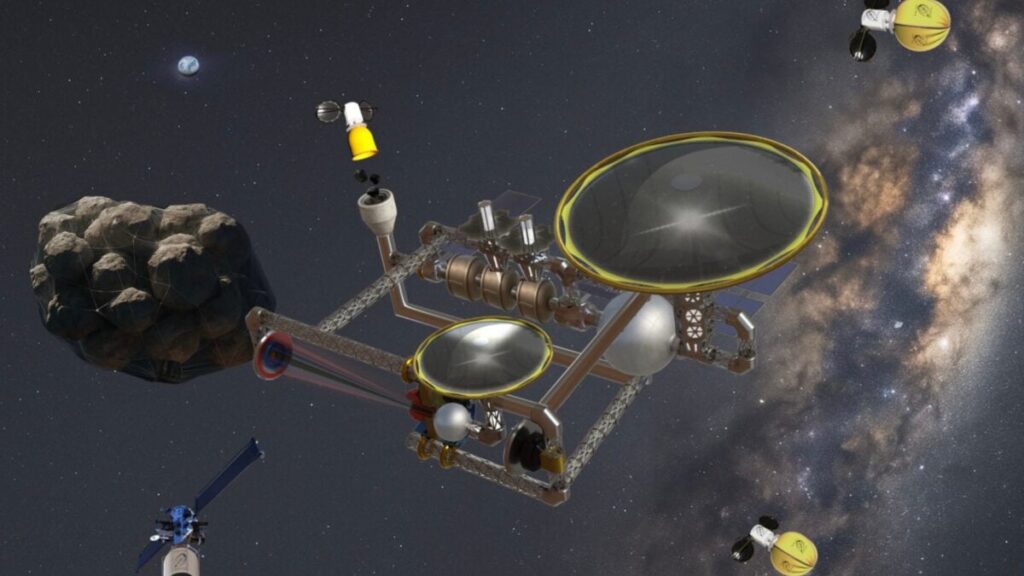
There are roughly 250 small, near-Earth asteroids teeming with precious resources that are ripe for extraction. Mining asteroids for water and metals has the potential to be extremely lucrative, but companies have so far struggled to come up with the means to extract resources from the flying space rocks. A Los Angeles-based company just revealed a wild new plan that could bring asteroid mining closer to home: bagging the rocky objects and moving them to a stable orbit near Earth.
This week, TransAstra revealed its proposed New Moon mission, launching a spacecraft to capture asteroids using a large inflatable bag and relocating them to a gathering point near our planet. From there, the company can begin processing the asteroids and extracting material.
The idea sounds a bit like a space heist, sneaking up on asteroids and dragging them to an orbital safe house to extract resources. If successful, however, the company envisions having a nearby outpost to pull resources from and use them to build infrastructure in space.
Bag it
TransAstra has already tested part of its mission on the International Space Station (ISS). Under a $2.5 million contract for NASA’s Commercial Research and Products program, the company developed an inflatable 32-foot (10-meter) Capture Bag. A smaller, 3-foot (1-meter) version of its asteroid bag was inflated on board the ISS in October 2025.
“We demonstrated that we can deploy and retrieve the bag multiple times in a microgravity vacuum environment,” Joel Sercel, TransAstra founder and CEO, told SpaceNews. “This was a critical de-risking milestone—the first time our core inflatable capture technology has operated in space—laying the foundation for operational orbital debris remediation and asteroid capture.”
The company plans on testing its full-sized Capture Bag at NASA’s Jet Propulsion Laboratory Spacecraft Assembly Facility High Bay.
TransAstra’s first asteroid retrieval mission could launch as early as 2028, with plans for several follow-up missions to rendezvous with the space rock at its new orbit and begin its processing.
Unsuspecting victims
NASA’s asteroid sample return mission, OSIRIS-REx, has proven that we can extract material from a space rock and bring it back to Earth. Asteroid mining on a large scale, however, remains uncharted territory.
A few space startups are developing ways to mine asteroids for material. AstroForge launched its first mission in April 2023 to demonstrate its ability to refine asteroid material in orbit. Unfortunately, the company lost contact with its spacecraft shortly after.
The potential of unlocking a new business model in space means that efforts by the private industry will continue to persist. Asteroids are rich in water, precious metals, and other materials that can support space exploration.
In addition to the asteroids we already know of, TransAstra estimates that around 260 more objects that are around 65 feet wide (20 meters) or less will be discovered using the Vera C. Rubin Observatory in Chile and other recently commissioned telescopes.
With all those unsuspecting rocks flying around, TransAstra will be on the hunt for the best samples to drag closer to Earth.