
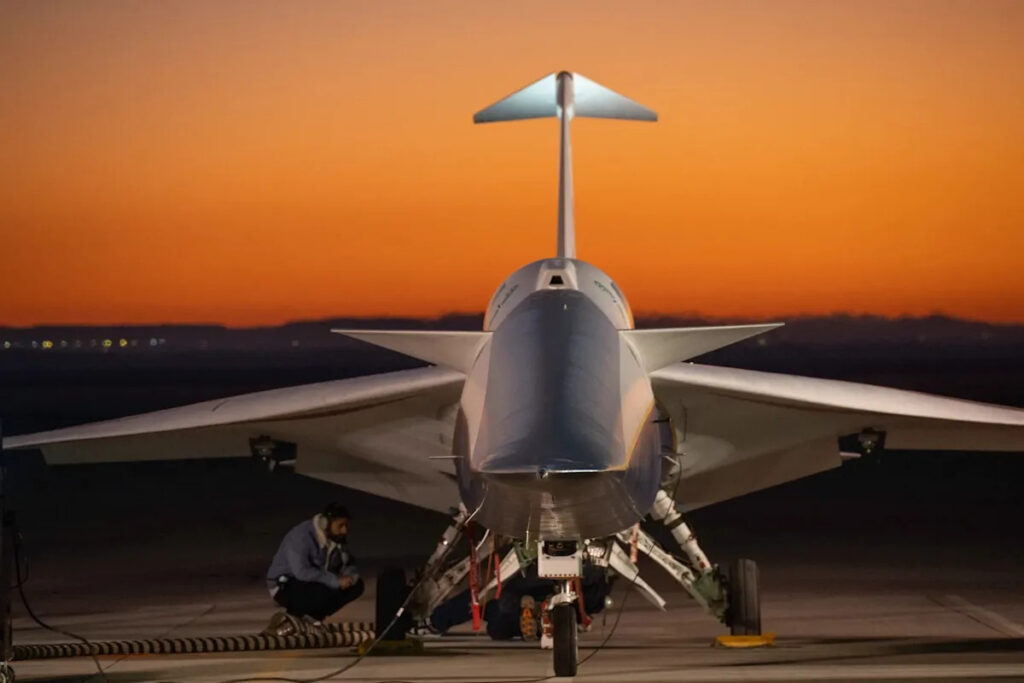
NASA is getting ready to go supersonic.
The U.S. space agency’s experimental X-59 jet designed to eventually travel faster than the speed of sound is preparing for its second flight from California. The upcoming test flight will be the latest of many in the coming months as NASA aims to prove that supersonic flight could one day be a viable option for commercial airlines.
Built by aerospace contractor Lockheed Martin, X-59 is designed to not only break the sound barrier by surpassing Mach-1 speeds, but to do it quietly. That means those loud, explosive sounds known as sonic booms could be reduced to a softer thump.
Following the X-59’s inaugural flight in October 2025, each demonstration is intended to fly it faster and higher until it can safely surpass speeds of 900 mph, according to NASA.
2025 spaceflight in photos. See images of Blue Origin, SpaceX missions
1 of 13
Firefly’s Blue Ghost lunar lander captures its shadow on the moon’s surface after completing a successful landing March 2 near a volcanic feature on the moon called Mons Latreille. The vehicle became the first of two landers manufactured by a U.S. company to reach the moon is 2025 in crucial missions to lay the groundwork for NASA to return humans to the lunar surface in the years ahead.
Here’s everything to know about NASA’s supersonic jet and its next test flight.
NASA to launch supersonic jet for 2nd time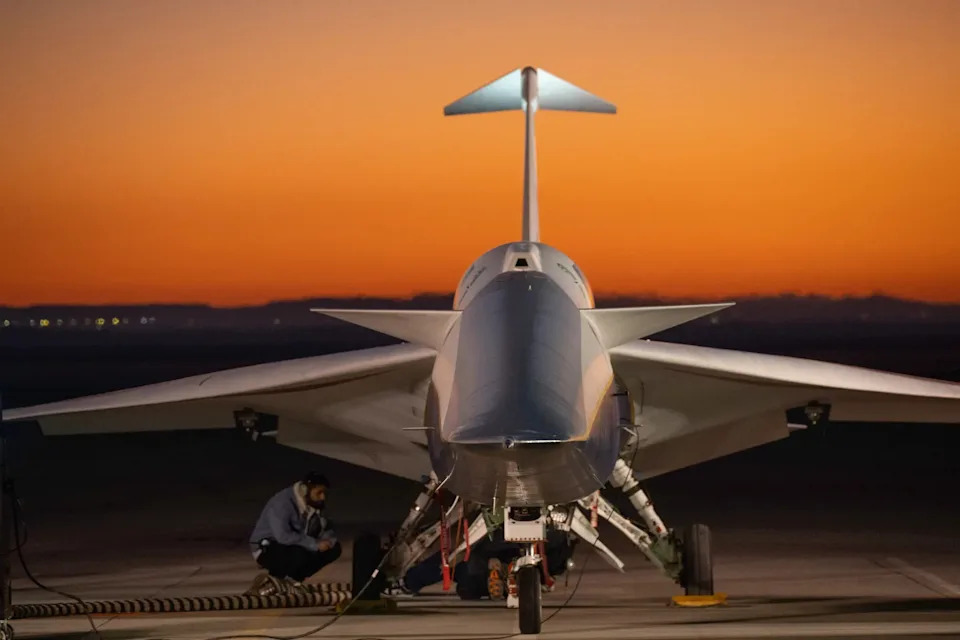
As its team prepared for second flight, NASA’s X-59 quiet supersonic aircraft underwent engine run testing on Thursday, March 12, at NASA’s Armstrong Flight Research Center in Edwards, California.
NASA’s X-59 experimental supersonic jet is due to take off and land Thursday, March 19, at the Edwards Air Force Base in central California.
After it taxis from the nearby hangar at NASA’s Armstrong Flight Research Center, the X-59 is due to replicate and build on its first test flight nearly five months ago, the agency said.
That maiden flight came Oct. 28, 2025, followed by “extensive” post-flight maintenance and inspections, NASA said.
What does supersonic mean?
Any object that travels faster than the speed of sound is supersonic.
Supersonic speeds are ubiquitous for spaceflight, as spacecraft have to surpass the speed of sound in order to reach orbit after a rocket launch. However, commercial passenger jets typically travel below 600 mph, which is not fast enough to break the sound barrier and become supersonic.
2025 was a year of cosmic discoveries. Here’s a look back at 6
1 of 11
NASA’s Hubble Space Telescope last observed come 3I/ATLAS on Nov. 30, about four months after Hubble’s first look at the interstellar comet. 3I/ATLAS became one of the biggest cosmic stories of the year when astronomers deemed it to be the third-ever discovered interstellar object in our solar system originating from an entirely different part of the galaxy.
What is NASA’s X-59 aircraft?
NASA is looking to change that paradigm with its X-59 aircraft.
The supersonic jet is the centerpiece of the space agency’s Quesst mission, which seeks to reduce air travel time in the U.S. by making commercial supersonic flights over land possible. The X-59 jet was developed to fly quietly at supersonic speeds without generating sonic booms – the brief, thunder-like noises that occur when anything surpasses the speed of sound.
The second flight aims to be the first in a series of phase 1 test missions that NASA refers to as “envelope expansion,” meaning the agency will gradually fly the X-59 at faster speeds while taking it to higher altitudes. Ultimately, NASA aims for the jet to be capable of hitting top speeds of 925 mph, or Mach 1.4, at 55,000 feet high.
For phase 2, NASA will validate the jet’s acoustic performance by evaluating how the X-59 “disperses the shock waves that typically merge into a sonic boom,” according to the agency. The aircraft will also in the future be flown over some U.S cities so NASA can gather data on how people on the ground react to “its quieter sound signature.”
Those results will be shared with U.S. and international regulators, NASA said.
What to expect after takeoff
NASA test pilot Jim “Clue” Less took the X-59 through its engine run test on Thursday, March 12, at NASA’s Armstrong Flight Research Center in Edwards, California. Less will pilot the aircraft for its second flight.
NASA test pilot Jim “Clue” Less will be in the X-59 cockpit for the second test flight, which will not even come close to reaching supersonic speeds during a roughly one-hour mission. Instead, the jet is expected to reach a cruising speed of 230 mph at 12,000 feet before accelerating to 260 mph at 20,000 feet, NASA said.
“Once we’re airborne, we can increase speed and increase altitude in small, measured chunks, looking at things as we go and not getting ahead of ourselves,” Less said in a statement.
Less will be accompanied by NASA test pilot Nils Larson, who will be flying in a NASA F/A-18 aircraft to keep an eye on the X-59.
Eric Lagatta is the Space Connect reporter for the USA TODAY Network. Reach him at elagatta@usatodayco.com
This article originally appeared on USA TODAY: NASA to launch supersonic X-59 jet for 2nd time. What to expect