
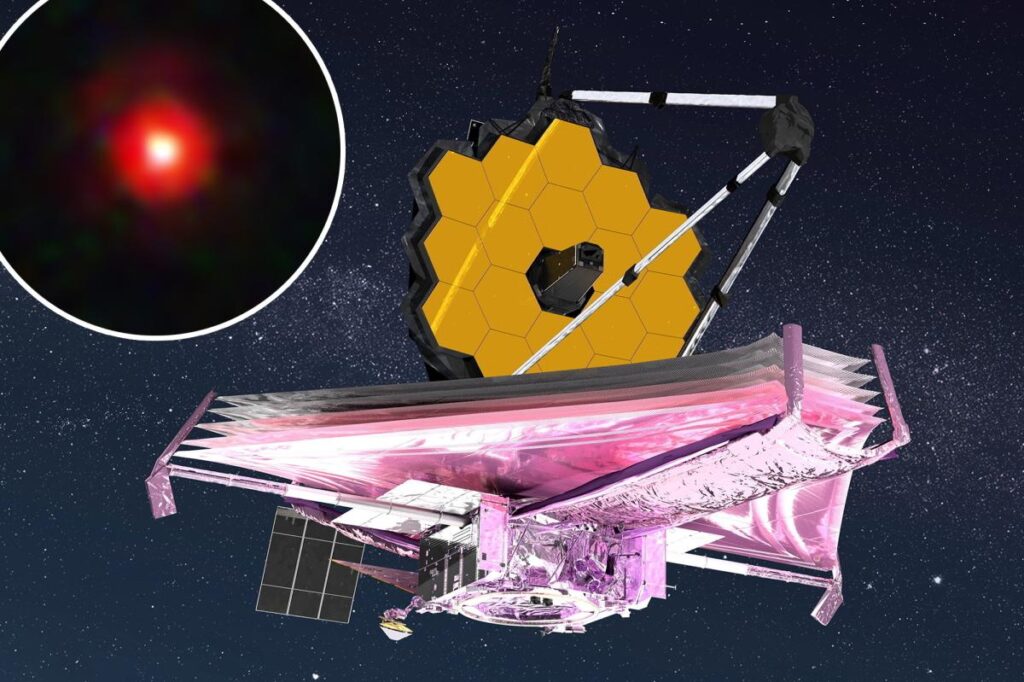
They’re struggling to connect the dots.
Scientists are baffled over mysterious dots captured by the James Webb Space Telescope — with some suggesting they could be giant stars from the origins of the Universe.
“This is the first time in my career that I have studied an object where we truly do not understand why it looks the way it does,” Jenny Greene, a professor of astrophysical sciences at Princeton University, told CNN. “I think it’s fair to call them a mystery.”
An artist’s impression of the James Webb Telescope, which first captured the objects when it began scanning the cosmos four years ago. NASA / SWNS
The spacely speckles first started showing up in data recorded by the James Webb Space Telescope when it began scanning the cosmos four years ago.
Scientists observed that the dots were ubiquitous in the early universe — within the first two billion years following the Big Bang — but their identity has remained a mystery, the BBC’s Sky At Night magazine reported.
They initially theorized that the celestial freckles could be massive galaxies powered by black holes that are amassing matter. However, there were some holes in this theory, namely that the dots seemed smaller than expected for a typical galaxy and that they didn’t display a clear X-ray emission typical of actively feeding black holes, LiveScience reported.
While scientists still think they could be powered by these gigantic cosmic vortexes, there might be another explanation, such as “some kind of very massive star dying,” according to Greene.
Astronomers compiled one of the largest surveys of red dots to date. NASA, ESA, CSA, STScI, Dale Kocevski (Colby College)
In a paper published last month in “The Astrophysical Journal,” Devesh Nandal and Avi Loeb of the Harvard and Smithsonian Center for Astrophysics (CfA) proposed that the red dots could be supermassive stars.
Growing to a million times the mass of the sun, these primordial bright spots formed mainly from hydrogen and helium in the early part of the Universe, and morphed into supermassive black holes when they died.
Jorryt Matthee, an Austrian astrophysicist who coined the term “red dot,” believes that these mysterious dots “might turn out to be some kind of missing link.”
“We know that galaxies, like our own Milky Way, have supermassive black holes in their center, and while this is very common, it’s basically a mystery how these supermassive black holes formed,” he said. “The LRDs may actually be the birth phase, or the baby phase, of this formation, and we might be observing that for the first time.”
Astronomers theorized that the red light could be caused by hydrogen gas wreathing a black hole. vaalaa – stock.adobe.com
A breakthrough in the cosmic caper came in 2023, when a team of researchers led by Anna de Graaff, a Clay Fellow at the Harvard–Smithsonian Center for Astrophysics, used the Webb telescope to analyze thousands of red and bright objects over 60 hours.
“It was really the first program to go after these red sources systematically, observing all sorts of strange objects — not just little red dots — but among them, also 40 or so LRDs,” said de Graaf.
They found a new object called The Cliff, which seemed to disprove earlier theories that the dots were either a regular galaxy or a dust-wreathed black hole.
The cliff was named after its light spectrum’s sharp transition from weak ultraviolet to brilliant red, which is caused by “very dense hydrogen gas that is somewhat warm in temperature,” de Graaff said.
This means that LRDs are crimson because light is being absorbed by the gas surrounding a central engine and not due to cosmic dust as previously thought. This central engine is believed to be a black hole.
If true, this would a phenomenon that “has never been observed before,” according to de Graaff.
Some scientists have compared them to Quasi-stars, theoretical objects powered by a black hole, that is luminous due to the cloud of gas that wreaths it.
Pierluigi Rinaldi, a postdoctoral research fellow at the Space Telescope Science Institute (STSci), told the BBC’s Sky At Night magazine that in this scenario, the “little red dots are envisioned as black holes embedded within extremely dense cocoons of gas.”
“Radiation produced near the black hole can become trapped inside this envelope, scattering many times before escaping,” he said. “This idea remains speculative, but if correct, it would significantly change how we think black holes grew in the early Universe.”
Mitch Begelman, an astrophysicist at the University of Colorado Boulder who predicted the quasi-star phenomenon, believes they don’t have a “smoking gun” but doesn’t see a problem with this explanation for little red dots.
However, others have urged caution about being so quick to label these dots quasi-stars, as it would suggest they were some star-black hole hybrid.
“It could well be that LRDs are quasi-stars, but in my view, we have not yet fully ruled out other scenarios,” Matthee said. “I would definitely love this to be true, as it would imply we discovered a new type of astrophysical phenomena that bridges stars and supermassive black holes, but it’s too early to tell, in my view.”