
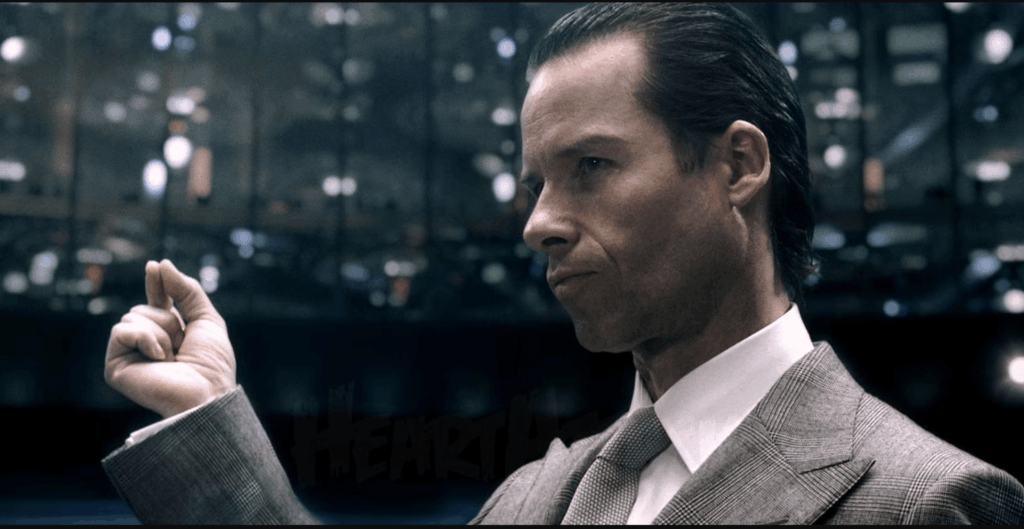
Evan Dossey has long been a fan of Guy Pearce, whose penchant for taking on small but meaningful roles has created one of the most diverse and surprising résumés for an actor of his caliber. Each week in My Guy, Evan will review one of Pearce’s films, exploring just how wild his career has been. But this special installment of My Guy comes to you from Aly Caviness — who blames Guy Pearce for her marriage to Evan (in the most loving sense of the word) and also once procured as a gift for Evan arguably the greatest Guy Pearce shirt ever made. As such, he is Her Guy, too.
To bestow on your fellow man is a Godlike attribute–So indeed it is and as such not one fit for mortality;–the giver, like Adam and Prometheus, must pay the penalty of rising above his nature by being the martyr to his own excellence.
— Mary Shelley, Mathilda
I have, understandably, had Frankenstein on my mind lately. I re-read the novel a month ago to prepare for Guillermo del Toro’s adaptation (hi, nice to meet you, I’m a dork). But the themes and ideas within Mary Shelley’s masterpiece were already reanimating themselves in my brain a month before that, as I was watching the latest installment of the Alien franchise.
This essay is not about Alien: Earth, though it easily could be. Created by Noah Hawley, the FX television show weaves a fascinating web between the concept of artificial life hybridized with human consciousness and, of all things, Peter Pan. The creator of these hybrids is a young trillionaire who calls himself Boy Kavalier (Samuel Blenkin) and his creations the Lost Boys. He renames the terminally ill children he transfers into adult synthetic bodies after characters from the novel — Tootles, Smee, Slightly, Curly, Nibs and Wendy (his first and his favorite). He reads excerpts from Peter Pan to them over an intercom on his own private Neverland before they rest in their charging stations each night. Boy Kavalier takes the metaphor a smidge too far. It’s terrible. It’s great. And this is all before the xenomorph drops in to make things even worse.
And yet, throughout Alien: Earth’s eight episode run, I kept asking myself: If Peter Pan exists in the Alien universe — if, of all things, ICE AGE also exists — does Frankenstein? And if it does, why haven’t any of these genius trillionaire fuckboy capitalists ever actually read it?
The answer is fairly obvious. When you have that much money, you don’t engage with anything you don’t want to hear. You can afford to ignore inconvenient truths and pay other people to learn those lessons the hard way.
Until you can’t.
I’ve always been an apologist for Prometheus (2012), defending it when it wasn’t popular to do so and handing out I-told-you-so’s when people finally realized I was right. But strangely, I’d never watched the supplemental material until recently, which I now realize was a mistake. One component in particular — I hesitate to call it a deleted scene as it’s more like a self-contained prologue — is vital to understanding this maligned film’s core theme. It also explains why, in a movie with a stacked cast, Guy Pearce inexplicably has third billing.
How funny in retrospect that it only takes Pearce eight minutes to sum up the entirety of Prometheus, in a speech designed to shame a cowardly race of humans still afraid of shadows on the walls of their cave to worship the bravest among them as he steals fire for himself and creates something new. Nothing a billionaire does is anything other than self-serving, and Pearce’s performance makes it clear that Peter Weyland is not asking permission to become a god. He already is one. The rest of the world just needs to catch up.
It’s safe to assume that in the 70 years between the TED Talk and the events of Prometheus that Weyland got exactly what he wanted. It also becomes abundantly clear that it wasn’t enough. Humans are greedy little things, always wanting more, more, more. What Weyland wants at the end of his life in 2093 is something he can’t pay for: time.
When Weyland first appears in Prometheus, he’s a droopy old man in a hologram who immediately tells his audience he’s dead. (Spoiler: He’s lying.) He provides some convenient exposition about David (Michael Fassbender), his beloved robot son who monitors the ship Prometheus while its human crew is in cryosleep. At first blush, David is precious, entertaining himself any way he can. He checks on the crew and watches their dreams (only a little creepy), he has a snack while he does his homework, he watches Lawrence of Arabia and loves it so much that he touches up his roots to look more like Peter O’Toole. He is so very nearly human.
And the very first thing Weyland does in the film is remind us that he’s not.
David may be the closest thing Weyland has to a son. But, as he tells the crew, David will never grow old, he will never die and he has no soul. It’s a harsh reminder, especially considering David is right there, unless you perhaps consider it a reminder to Weyland himself. No aging. No death. No soul. This thing he’s created is everything Peter Weyland wants to be.
Since 2012, I’ve delighted in the fact that David is a synthetic being with aesthetic preferences. It physically hurt me to watch the TED Talk and realize that Weyland programmed his own tastes into David. The quotes in Prometheus, the song he sings to himself in the follow-up (Alien: Covenant) trimming his hair to match Walter’s, even the posh accent. None of it is David’s choice. It’s all fucking Weyland.
What happens when a Creation surpasses his Creator? When that Creator is jealous of his Creation? Nothing good, that’s for sure. In the little of Weyland we get across the two movies, we learn he is just a man who thinks he’s big but knows deep down he’s small, and growing smaller and more irrelevant every day. Even buried under pounds of old-man makeup, Pearce wields that self-hatred like a knife and uses it to cut down anyone who gets too close. And there’s no one closer to a father than his children.
It’s hard to say which of his progeny Peter Weyland hates more. In Prometheus, he relies on David more than he cares for him, and in Covenant, director Ridley Scott chooses to open the film with a sequence showing that it only took moments for Weyland to realize his creation was more than he bargained for. Bold of David to point out his obvious superiority over his mortal father mere seconds after his birth; cold of Weyland to respond by putting David in his place and ordering him to serve the tea he could easily pour for himself. Minutes before, Weyland called himself David’s father yet did not acknowledge David as his son. (“The trick, William Potter, is not minding that it hurts.”) David’s very first lesson. One imagines the indignities only mounted from there.
Also worth noting here that David chose his name for himself, after gazing upon Michelangelo’s David, hanging out in Weyland’s living room for some reason. A powerful thing for a Creature to name himself, considering Mary Wollstonecroft Godwin Shelley only ever bore the names of her creators. John Logan gets it.
And then there is Meredith Vickers (Charlize Theron), a plot twist in plain sight — Weyland’s flesh-and-blood daughter who follows him on his wild goose chase in space just to make sure he dies like he’s supposed to and she gets the crown she’s been waiting for her entire life. Vickers is underutilized, but Pearce and Theron together are so very good at what they do that everything we need to know about their relationship burns through the screen. She hates that he refuses to die. He hates that she exists. A vicious circle only made worse by the brother-who-isn’t and the rivalry for the affection of a man who will never give it.
Both of Weyland’s children are reminders of his mortality. David, inhuman but eternal. Vickers, hereditarily ambitious and all too human. When he stands next to them (or, rather, props himself up with braces and robosuits), his feebleness both in mind and body is glaring compared to their youth and cunning. Weyland’s foolish mission to find the Engineers to save himself from dying is laughable on the surface and deeply pathetic underneath. Really, he wants to find them because he cannot allow his children to out-achieve him. “A king has his reign, and then he dies,” Vickers snarls at her father, but she must not have watched that TED Talk from 70 years before. Weyland never believed himself a king. He always thought he was a god.
Gods don’t need a legacy. Gods don’t die. Gods also don’t beg. But that’s exactly what Weyland does when he meets the Engineer. Desperation makes beggars of us all, but Weyland’s fall is hard, fast and earned. When David tells Walter — a new and improved synthetic with David’s face but fewer disturbing idiosyncrasies — that he was with Weyland when he died, Walter asks, “What was he like?” David responds with palpable condescension, “He was human. I pitied him at the end.”
Of course, David doesn’t mention that he engineered Weyland’s end. David holds in reserve the monster his father created him to be until after he is free of him, Prometheus fully unbound. (“Doesn’t everyone want their parents dead?”) Still, when you think about it, maybe David acted too quickly. It’s almost sad that Weyland died before he met his grandchildren. Maybe he could have even been their mother.
“Big things have small beginnings” and all that.
Alien: Covenant is my favorite Alien movie. I can’t help it. I love precisely one (1) demented robot and I love that his mean daddy is my favorite piece of shit. Pearce is never better than when he plays a charming narcissist with acid for blood, turning his wounds into weapons and disintegrating anyone he thinks deserves it. The Count of Monte Cristo, The Brutalist — take your pick. The degrees of cruelty vary, but the performance is always deeply satisfying in its ugliness.
Pearce’s screen time across the two Alien movies can’t be more than 10 minutes, but the impression he makes is undeniable. There’s no David without Weyland. There’s no xenomorph without Weyland. If Scott ever gets a chance to finish his Prometheus trilogy, I can only offer up my hopes that it would conclude David’s story while also giving us more of Weyland and his original sins. David could even answer my question and misattribute Frankenstein to Percy Shelley. That would be very Meta of him.
Like this:
Like Loading…