
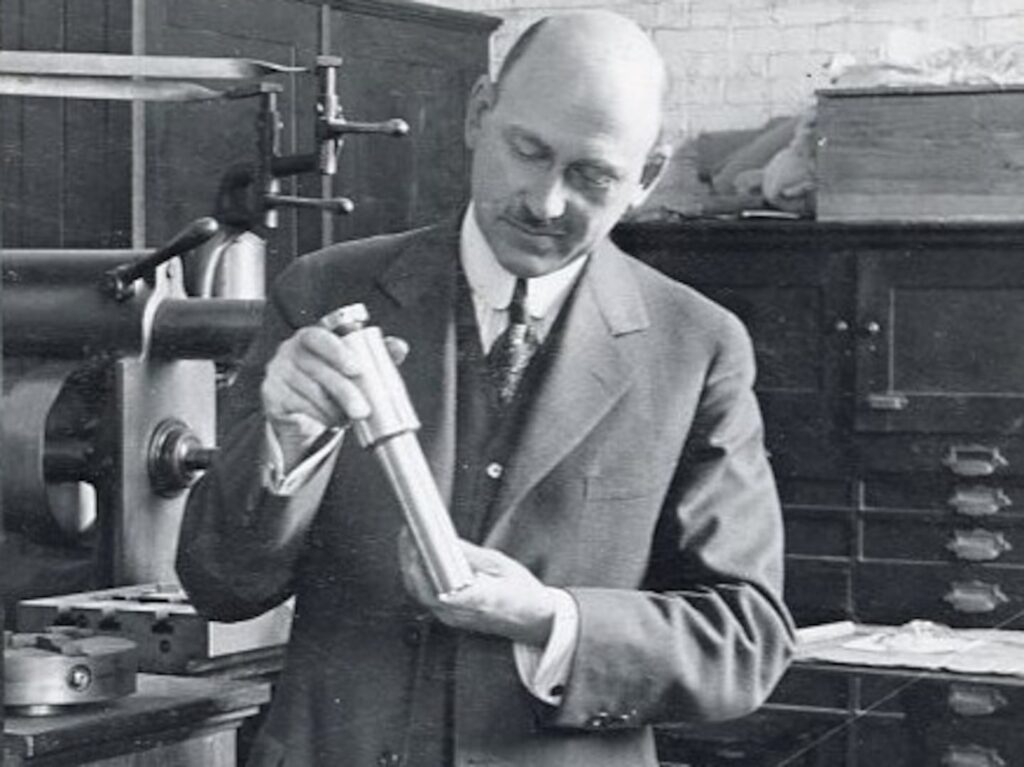
Few 20th century inventors have had a greater impact. So why isn’t Goddard more famous?
This week he will be, at least in his hometown. Worcester Polytechnic Institute, where Goddard did his undergraduate degree in physics, and Clark University, where he earned his doctorate and taught, are each hosting celebrations of a local hero.
Get Starting Point
A guide through the most important stories of the morning, delivered Monday through Friday.
“Goddard had developed pretty much all the basic ingredients that modern rockets have,” said Nikolaos Gatsonis, professor of aerospace engineering at Worcester Polytechnic, “from the metered and controlled combustion, but also gyroscopes and controllability of the rockets, also turbo pumps for managing propellants.”
For instance, nearly all space rockets use multiple stages to achieve orbit; Goddard patented the idea in 1914. And by the late 1930s, Goddard was experimenting with gimbaling — the now-standard method of steering rockets by moving the exhaust nozzles.
He thought of using electricity rather than burning liquids to move through space. He patented the concept in 1917, and today countless satellites use small electric thrusters to adjust their orbits. Around the same time, he developed a prototype handheld rocket launcher for the US Army, the precursor of the “bazooka” antitank rockets of World War II.
Goddard was born in 1882, the son of a bookkeeper and machine shop owner. Like many another modern innovator, Goddard’s fascination with space travel was spawned by reading science fiction, in his case H.G. Wells’ novel “The War of the Worlds”, and Jules Verne’s “From The Earth to the Moon.”
Goddard earned a general science degree from WPI in 1908. Along the way he tried to work out a practical method for humans to travel between planets, even submitting an article on the subject to Scientific American magazine.
Goddard knew that Verne’s idea of firing people into space from a giant gun would be fatal to the passengers. He figured the best bet would be a rocket that could accelerate gradually and travel great distances.
Goddard continued his rocket research as he attended nearby Clark University, where he earned a doctorate in physics in 1911. Much of his work focused on solid-fueled rockets, but he was well aware of their limitations.
Solid fuels produced less thrust than liquid fuels. In addition, solid fuels burn at full power until the fuel runs out. “It’s almost like a controlled explosion, but a barely controlled explosion,” said Charles Agosta, a Clark University professor of physics.
But a liquid rocket can be throttled up or down like an airplane engine, or even turned off and restarted. A liquid-fueled ship could not only fly to the moon, it could re-ignite the rocket motor and fly home again.
Still, Goddard focused on solid-fuel rockets in a paper he published in 1920, that suggested using multistage solid-fuel rockets to lift scientific instruments into space, and possibly fly to the moon.
An article in the New York Times ridiculed Goddard, saying that in space there was no air for the rocket exhaust to push against. Of Goddard, the Times wrote, “he only seems to lack the knowledge ladled out daily in high schools.”
For years thereafter, Goddard received insulting letters mocking his research. A naturally shy man, he became even more reclusive, filing over 200 patents, but rarely speaking publicly about his research.
“In the end, he isolated himself,” said Michael Neufeld, retired curator of space history at the Smithsonian Institution’s National Air and Space Museum. “He wouldn’t work with people.”
The day Goddard’s first rocket went aloft, only a handful of colleagues were present. Launched on an Auburn farm owned by Goddard’s aunt Effie, the rocket’s brief trip was reminiscent of the Wright brothers’ first flight, which lasted just 12 seconds. But Goddard had proved that liquid-fueled rockets would work.
Despite his isolation, Goddard attracted high-profile supporters, including aviation legend Charles Lindbergh, the first to fly solo across the Atlantic Ocean. Lindbergh helped Goddard arrange research funding from the Smithsonian Institution and the Daniel Guggenheim Foundation. With their backing, Goddard built bigger and better rockets at a testing range in Roswell, N.M., long before the place was famous for (alleged) flying saucers.
But apart from filing patents, Goddard kept his own counsel. Only in 1936, a decade after his first rocket launch, did he publish a report on his research on liquid fuels. Unlike his 1920 effort, this report drew little public attention in the United States, but rocket buffs in Germany devoured every word.
For years, Goddard corresponded with members of a German rocketry club who peppered him with technical questions. In time, Goddard stopped responding to the queries. But his answers, the details of his patents and his two published reports proved immensely valuable to Germany’s development of the V-2 rocket. It was not only a devastating weapon, but also the first man-made object to travel into space, if only for a few seconds.
“Goddard’s experiments in liquid fuel saved us years of work, and enabled us to perfect the V-2 years before it would have been possible,” said German scientist Wernher von Braun, who later designed the Saturn V moon rocket for NASA.
Von Braun’s achievements underscore another reason for Goddard’s relative obscurity. For better and for worse, von Braun’s rockets got the job done. His V-2s rained destruction on England; his Saturn V delivered people to the moon.
By contrast, Goddard’s rockets never made an impact on Mars or the moon, or even a battlefield on Earth. The highest they ever got was 9,000 feet. The furthest they ever traveled was a few miles.
But for Neufeld, Goddard matters anyhow.
“His most important influence,” said Neufeld, “turned out to be the somewhat unintentional one of convincing people that spaceflight was technologically possible. It wasn’t science fiction. It wasn’t crazy.”
In short, even if Goddard never sent people into space, he proved that we could get there.
Hiawatha Bray can be reached at hiawatha.bray@globe.com. Follow him @GlobeTechLab.