
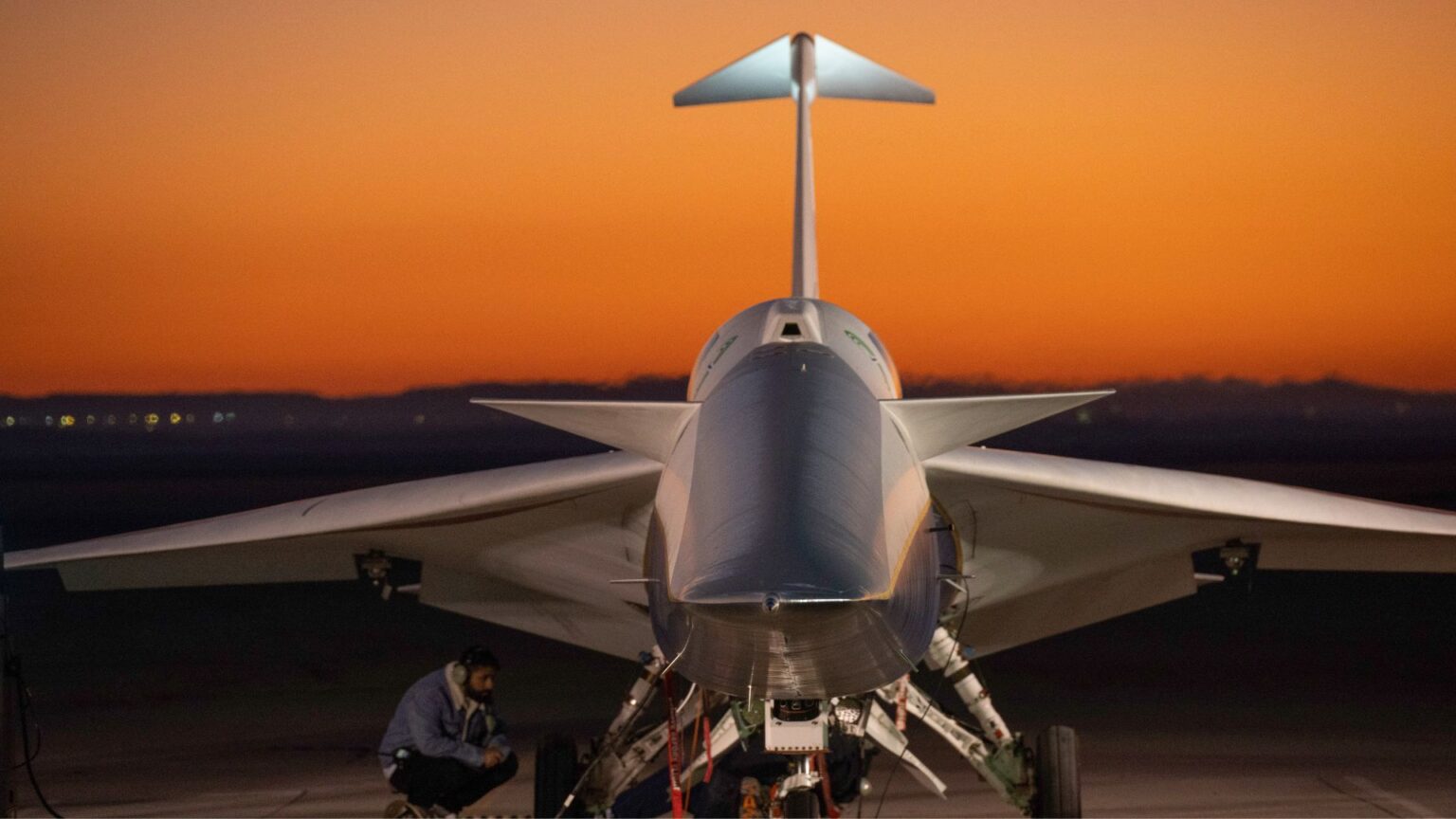
NASA is officially ready to put its X-59 experimental aircraft back in the sky for its second flight on March 19.
For the X-59’s second flight, pilot Jim “Clue” Less takes the stick. The mission will stage out of Edwards Air Force Base in California, just a stone’s throw from the jet’s home base at NASA Armstrong Flight Research Center.
This testing phase is important to bring supersonic travel back to the masses.
While the first flight in October 2025 proved the quiet supersonic jet could fly, this next mission is about proving it can stretch.
It is the beginning of envelope expansion, a high-stakes phase where pilots gradually push the jet faster and higher to see exactly what it can handle.
Envelope expansion phase
The X-59 is entering the envelope expansion phase, a methodical testing process that builds on the success of its initial takeoff.
Starting with functional checks at 230 mph at 12,000 feet, the team will incrementally push the jet’s limits toward its ultimate cruising target: a supersonic 925 mph (Mach 1.4) at 55,000 feet.
“From here on out, once we’re airborne, we can increase speed and increase altitude in small, measured chunks, looking at things as we go and not getting ahead of ourselves,” Less said.
“Eventually we get to supersonic flight – a few more steps – and we’re out to Mach 1.4 at about 55,000 feet,” said Less.
For Less, this isn’t just another day at the office; it’s his first time piloting an X-plane.
“I think I’ll mostly be focused on getting the test cards done and getting them done correctly,” Less remarked with the characteristic cool of a test pilot. “It’ll probably sink in later that I was in the X-59.”
Meanwhile, Nils Larson, who piloted the X-59’s historic first flight in October 2025, will now transition to an observer role.
For the second flight, he will fly alongside the experimental jet in a NASA F/A-18 chase plane to monitor its performance.
Incremental progress
The road to this second flight wasn’t short. Since its maiden voyage, the aircraft has been stripped down and scrutinized.
Engineers from NASA and Lockheed Martin removed the engine, the tail section, and over 70 access panels just to ensure every bolt was perfect.
Now, the jet is back together and hungry for altitude.
The X-59’s flight path is a ladder of incremental steps.
At first, the performance will be re-verified at 230 mph and 12,000 feet, then it will climb to 20,000 feet and hit 260 mph. The ultimate goal is reaching Mach 1.4 at 55,000 feet.
The X-59 is the primary technology demonstrator for the Quesst mission. The commercial supersonic flight over land has been banned because of the window-rattling “sonic boom” created when an aircraft breaks the sound barrier.
The X-59 is built differently. Its long, thin nose and unique engine placement are designed to prevent shock waves from merging.
Instead of a boom that sounds like an explosion, people on the ground should hear nothing more than a soft “thump” — similar to a car door closing down the street.
Once the envelope is expanded and the safety checks are signed off, NASA will move into Phase 2: Acoustic Validation.
Eventually, the jet will fly over real American communities to see if the public even notices it passing by.