
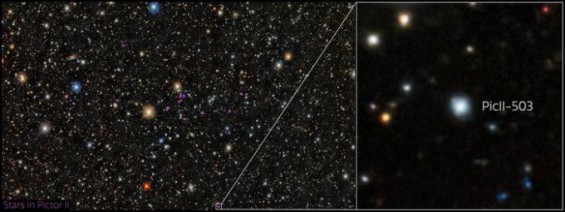
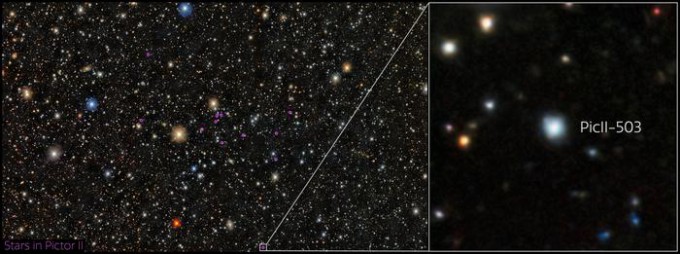
The ultra-faint dwarf galaxy Pictor II, home to the star ‘PicII-503’ which preserves traces of a first-star explosion. This galaxy, composed of several thousand stars, is over 10 billion years old. Courtesy of CTIO, NOIRLab, DOE, NSF, AURA
A star has been discovered that preserves the material scattered by one of the universe’s first exploding stars.
An international research team, including Anirudh Chiti of Stanford University, announced in the international journal ‘Nature Astronomy’ on the 16th (local time) the discovery of the star ‘PicII-503’ in the ultra-faint dwarf galaxy Pictor II, located about 45,700 light-years from Earth. The star preserves the remnants of an explosion from one of the universe’s first stars.
The first stars in the universe are believed to have been born in an environment composed only of hydrogen and helium right after the Big Bang. When these stars exploded, they seeded the universe with heavy elements like iron, calcium, and carbon for the first time, from which the next generation of stars was formed. The way the first stars exploded can be traced back by analyzing the composition of subsequent generations of stars. Until now, however, it has been difficult to know the environment in which these stars were formed.
The research team selected candidate stars from the Pictor II dwarf galaxy using data from a survey of about 5% of the southern sky with special filters. They then analyzed the composition of the star ‘PicII-503,’ which was expected to have the lowest iron and calcium content, through detailed spectroscopic observations using the 6.5m Magellan Telescope at Las Campanas Observatory in Chile and the European Southern Observatory’s 8.2m Very Large Telescope (VLT).
The analysis revealed that PicII-503 has the lowest iron and calcium content of any star observed outside the Milky Way. Its iron content was 1/43,000th that of the Sun, and its calcium content was 1/160,000th. Its carbon content, however, was more than 3,000 times higher than the Sun’s. This chemical composition perfectly matches the pattern produced when a first-generation star undergoes a low-energy supernova.
A powerful explosion’s energy is so great that its debris escapes the gravity of a small galaxy and scatters into space. In contrast, the debris from a weak explosion remains within the galaxy, becoming material for the next generation of stars. This means that smaller galaxies with weaker gravity, like Pictor II, retain a purer record of how the first stars exploded by preserving only the remnants of weaker explosions. With a total stellar mass of only about 2,000 times that of the Sun, Pictor II is one of the smallest and most primitive galaxies known.
This discovery also provides clues to the origin of carbon-excess stars observed within our own Milky Way. While it was previously unclear where these stars formed, PicII-503 supports the possibility that they were born in primitive dwarf galaxies like Pictor II and were later absorbed by our galaxy.
The research team stated, “This opens a window through which we can peer into the chemical evolution of the smallest galaxies in the early universe, which are difficult to observe directly even with the current James Webb Space Telescope.” They added, “When the next-generation 30-meter class telescopes become operational, we will be able to discover more of these primitive stars and more precisely determine the environment in which the first stars formed.”
<참고>
doi.org/10.1038/s41550-026-02802-z
Copyright ⓒ DongA Science. All rights reserved.