
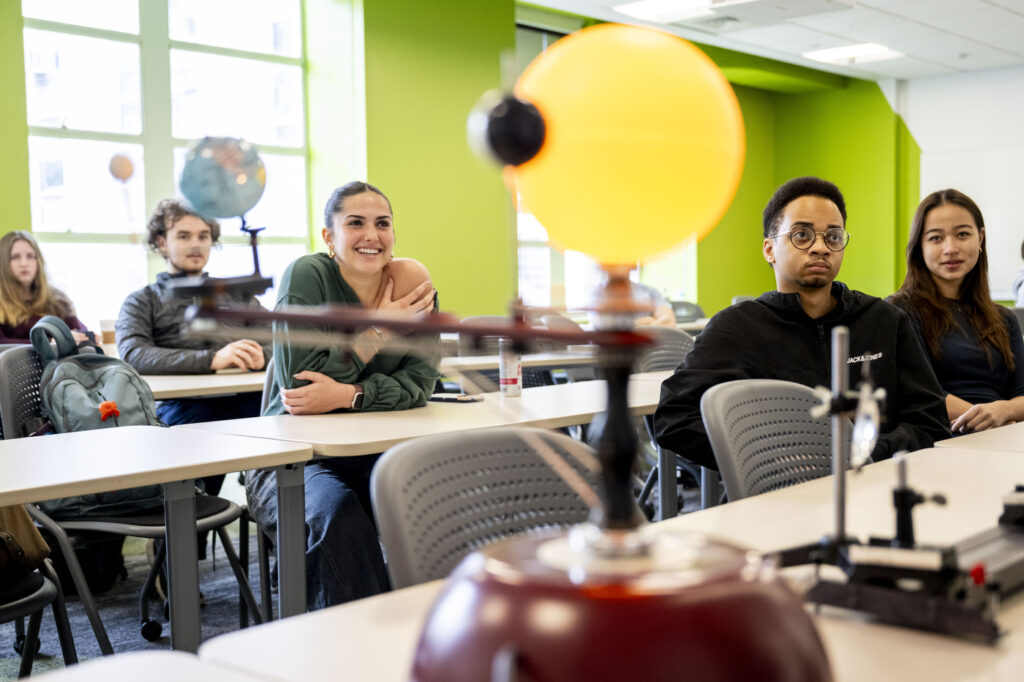
For students in PHYS1111 Introduction to Astronomy in Northeastern University’s Hayden Hall, learning about the vastness of the universe was mind-boggling enough.
The class’ instructor, Stefan Kautsch, asked them to consider the distance of the closest star system — Alpha Centauri — to the Earth’s solar system. How do you begin to make sense of 4.37 light-years, with each light-year measuring about 6 trillion miles?
Then Kautsch, a teaching professor and physicist, posed another thought-provoking question: How likely is it that aliens from other star systems in our universe, even other galaxies, have visited the Earth?
Kautsch wasn’t posing the question out of the blue. In recent months, he had picked up on chatter about alien life and encounters with humanity, inside and outside his own field of physics.
He was particularly struck by President Obama’s recent podcast comment that “aliens are real” and President Trump’s subsequent vow to have the Department of War and other government agencies release any files they might have on Unidentified Flying Objects (UFOs).
 03/11/26 – BOSTON, MA. – Students attend Stefan Kautsch’s astronomy class in Hayden Hall on March 11, 2026. Photo by Matthew Modoono/Northeastern University
 03/11/26 – BOSTON, MA. – Professor Stefan Kautsch teaches an astronomy class in Hayden Hall on March 11, 2026. Photo by Matthew Modoono/Northeastern University
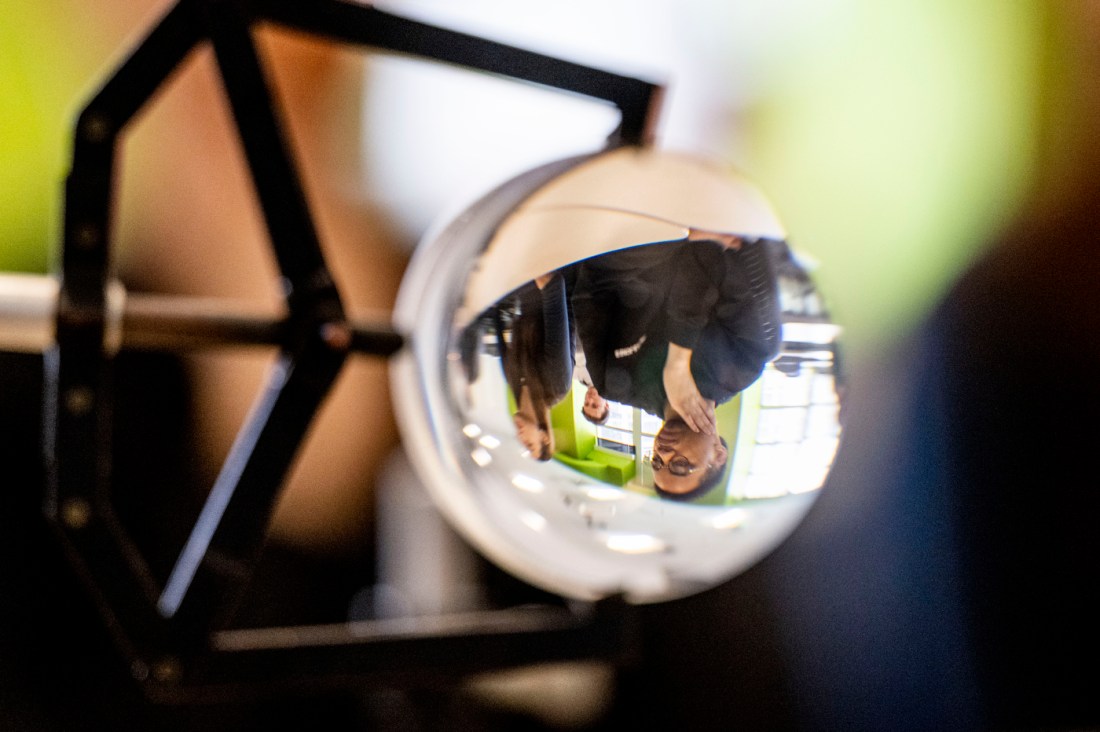 03/11/26 – BOSTON, MA. – Students attend Stefan Kautsch’s astronomy class in Hayden Hall on March 11, 2026. Photo by Matthew Modoono/Northeastern University
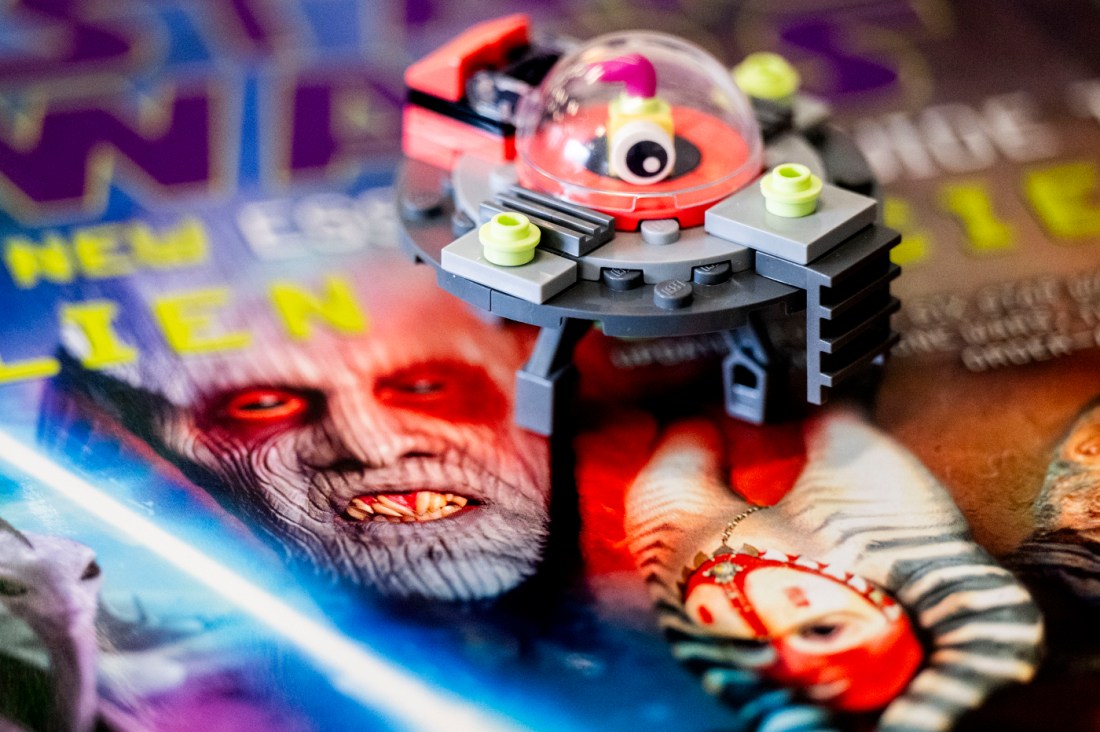 03/11/26 – BOSTON, MA. – Students attend Stefan Kautsch’s astronomy class in Hayden Hall on March 11, 2026. Photo by Matthew Modoono/Northeastern University
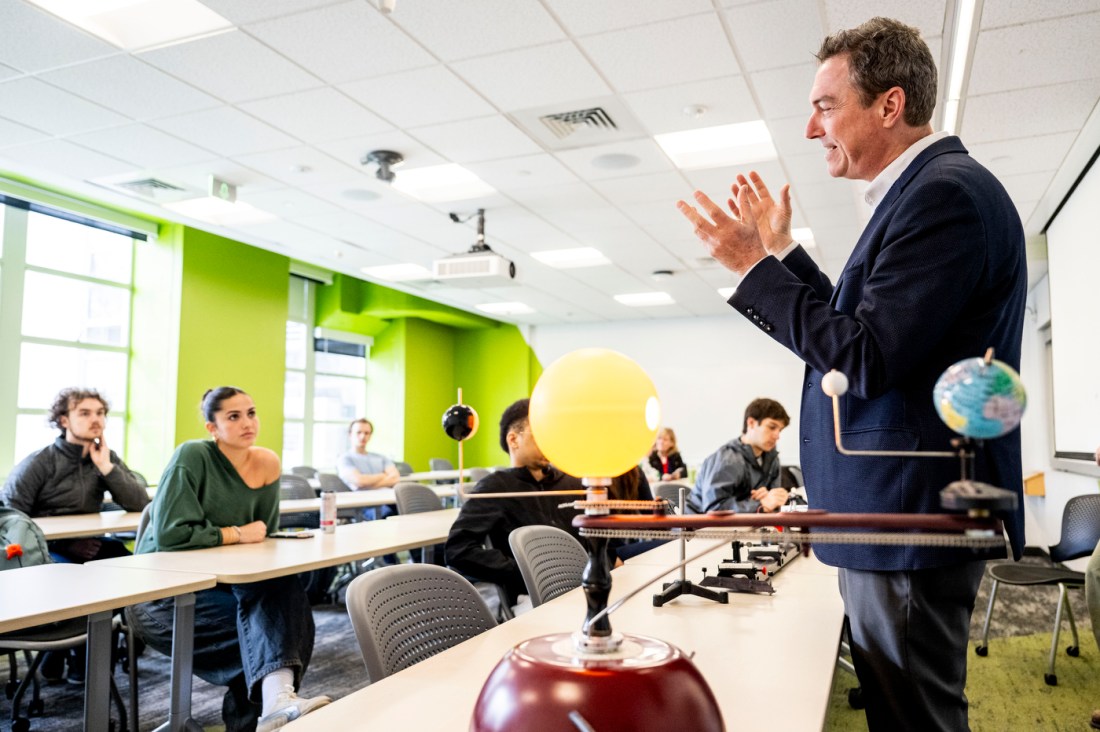 03/11/26 – BOSTON, MA. – Professor Stefan Kautsch teaches an astronomy class in Hayden Hall on March 11, 2026. Photo by Matthew Modoono/Northeastern University
The solar system model featured at bottom right next to professor Stephan Kautsch is an orrery. With the bright yellow bulb of the Sun at the center, it demonstrates the positions and motions of planets. Photos by Matthew Modoono/Northeastern University
It just happened “that the story with Obama and Trump was breaking around that time, so we included it in the classroom discussions,” Kautsch said.
Talk of extraterrestrials is seemingly everywhere. Beyond what Kautsch observed, TV shows like Pluribus and the documentary “Age of Disclosure,” released late last year, delve into the topic of alien contact with humanity.
And just last week, Steven Spielberg, whose fascination with aliens yielded movies including “Close Encounters of the Third Kind,” “E.T.” and the upcoming “Disclosure Day,” addressed the question of alien existence at the South By Southwest Film & TV Festival. He said that even as a child, he believed humans were not alone in the universe. “The big question is: Are we alone now?” he asked.
It was against this backdrop that Kautsch was curious about what his own students thought. He wasn’t bringing it up for the sake of it; students were learning about the existence of exoplanets, or planets outside the Earth’s solar system, where aliens might possibly be.
“We discussed that in a way that all the building blocks for life as we know it, such as water, carbohydrates, oxygen and nitrogen, even amino acids, are very common in the whole universe,” Kautsch said. “So we may speculate that life as we have here on Earth could be possible elsewhere, though we do not have evidence that it exists.”
Second-year student Zoe Aldairy said there’s a possibility life has evolved on exoplanets, but it could be millions of light-years away or be as basic an alien life form as algae. However, “The idea they’d be here [on Earth] is pretty unrealistic,” she said.
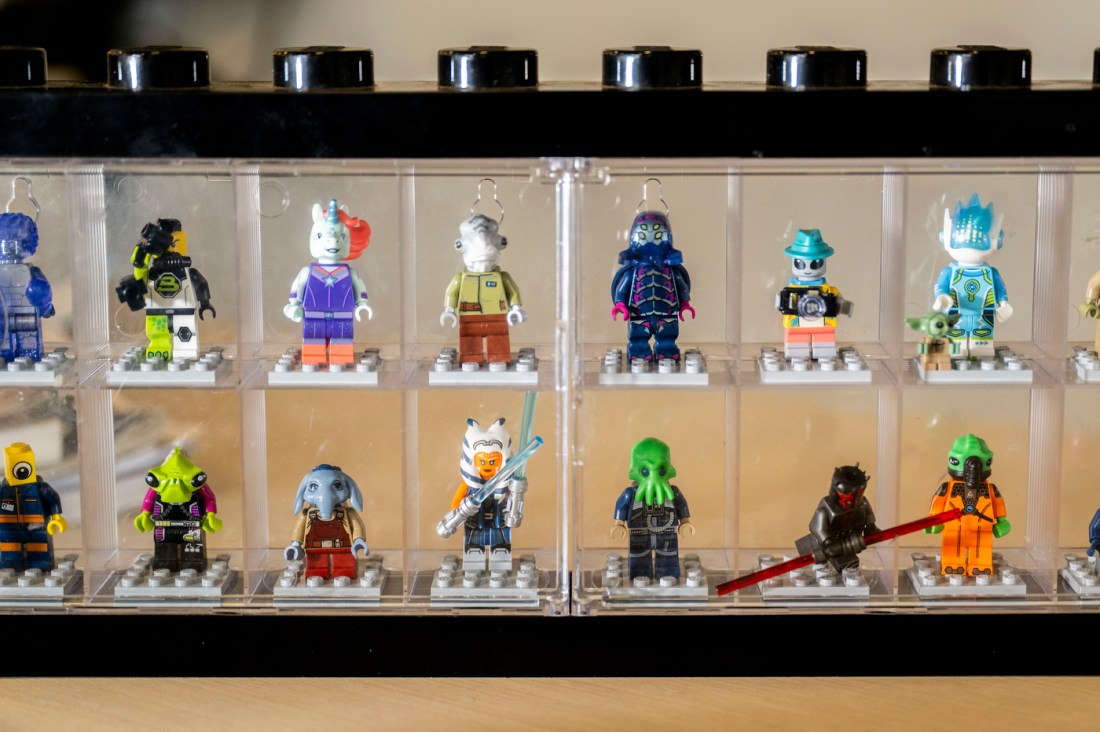 03/11/26 – BOSTON, MA. – Toy aliens are seen during Stefan Kautsch’s astronomy class in Hayden Hall on March 11, 2026. Photo by Matthew Modoono/Northeastern University
 03/11/26 – BOSTON, MA. – Students attend Stefan Kautsch’s astronomy class in Hayden Hall on March 11, 2026. Photo by Matthew Modoono/Northeastern University
 03/11/26 – BOSTON, MA. – Students attend Stefan Kautsch’s astronomy class in Hayden Hall on March 11, 2026. Photo by Matthew Modoono/Northeastern University
The topic of aliens is so enthralling LEGO has a number of toy models, displayed here in Prof. Stefan Kautsch’s astronomy class. Photos by Matthew Modoono/Northeastern University
Aldairy might not be off-base. One planet in the Alpha Centauri system is located in the habitable zone, where the temperature is suitable for liquid water, but so far, no biosignatures have been found, Kautsch said. Even so, flying light-years to the Earth in a tiny spaceship would require unrealistic levels of energy, he said.
Others were just as skeptical. “Aliens are fun to think about,” said third-year student Jake McKinley, adding he doesn’t think they’d be reaching out to Earth any time soon, given the recent state of humanity’s technological development.
If aliens were here, how have they gone undetected and why haven’t they made contact, asked student Jamie Brustman. The likelihood of intelligent life outside the Earth is high, but the probability it is close by is low, he said. “There’s no evidence. If it exists, show me.”
A prevailing topic when it comes to alien life is how much the government knows versus how much it has disclosed, causing Kautsch to wonder why Trump would want to release information that could potentially benefit adversaries.
Retired Rear Admiral Tim Gallaudet, one of the former military officials interviewed in “The Age of Disclosure,” has called on government officials to be more transparent about what they know about UFOs, and UAPS, or Unidentified Anomalous Phenomena, including advanced technologies that could benefit humanity.
A former acting and deputy administrator of the National Oceanic and Atmospheric Administration (NOAA), Gallaudet told Northeastern Global News that he has not seen recovered alien craft but has viewed what’s known as the “Go Fast” video of Navy pilots encountering a UAP years ago on a secret network before it was declassified and officially released in 2020.
Gallaudet, who has testified before Congress on technology of unknown origin, said he was not surprised at Obama’s statement that aliens are real. “It’s gradually starting to come out.” But he said Trump would not want to admit any possible weakness in national defense or otherwise. “No government wants to admit they are not in control and can’t keep their citizens safe.”
Obama later qualified his comments on Instagram, saying he was speaking in the “spirit” of the upbeat speed round and that “statistically, the universe is so vast that the odds are good there’s life out there.”
Still, Gallaudet said he is happy that Spielberg is creating more public awareness and advocacy for government disclosures with his alien movies.
“It’s the biggest story in human history. That’s why people are interested,” he said. “We believe American people have a right to know the nature of reality. We are not alone in the universe.”