
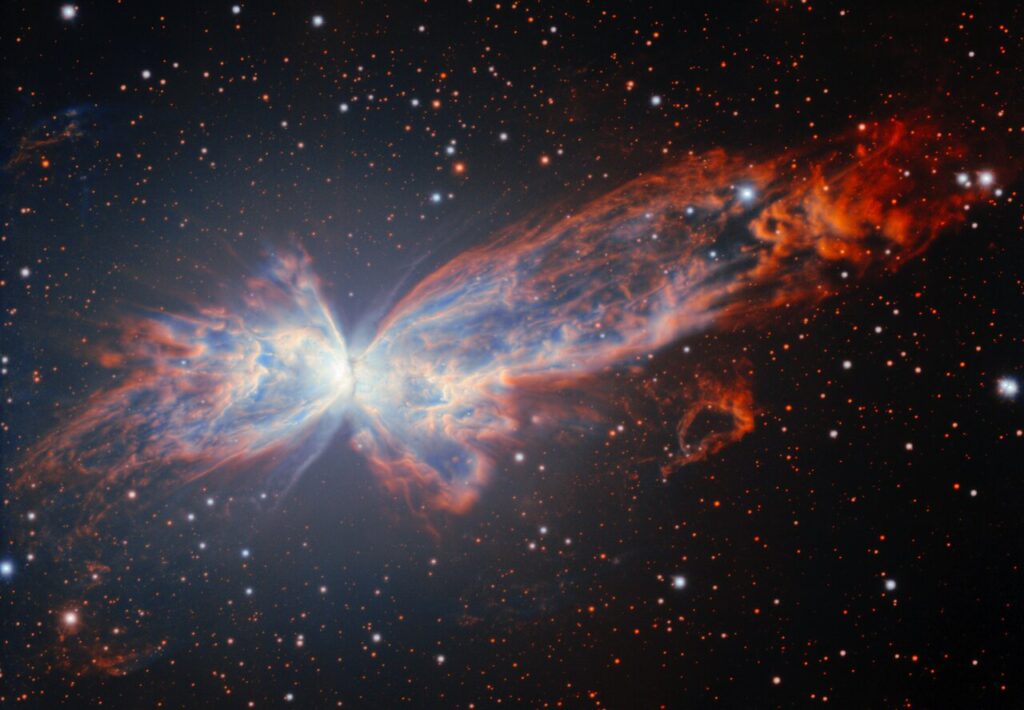
Scientists have discovered grains of solid carbon dioxide within the planetary nebula NGC 6302, also known as the “Butterfly.” This substance, or dry ice, has been detected for the first time within such an object.
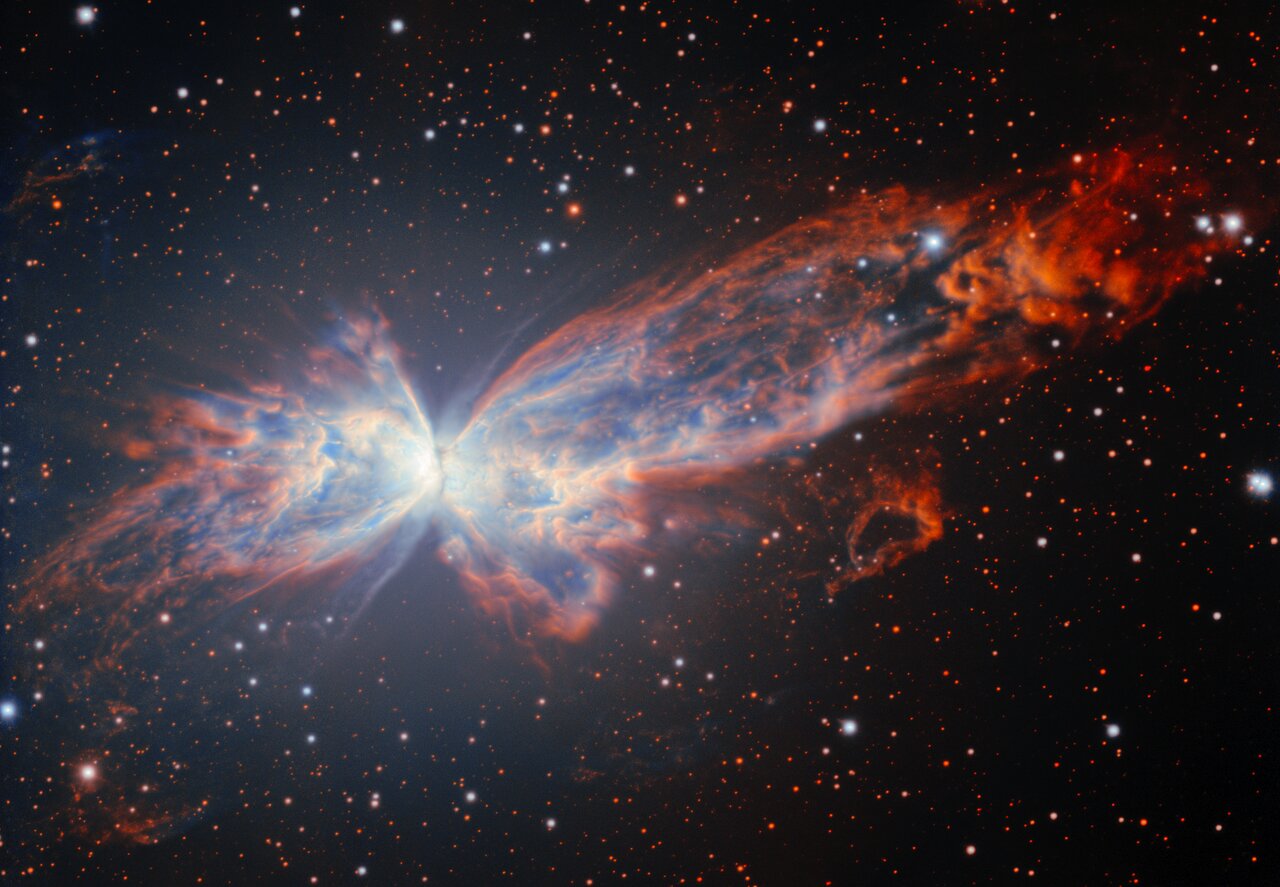 NGC 6302. Source: noirlab.edu
Study of the Butterfly Nebula
On February 25, a study by a group of astronomers examining the chemical composition of NGC 6302—also known as the Butterfly Nebula—was posted on the arXiv preprint server. The study reports the first-ever detection of dry ice in such object.
Planetary nebulae are gaseous shells that have been part of red giants. After these stars have shed their outer layers and become white dwarfs, all this matter expands in every direction, forming various amazing shapes that often truly resemble distant planets.
However, in the case of NGC 6302, it actually resembles a butterfly or a beetle. This object is located in the constellation Scorpio and is the result of a red giant shedding its outer layers approximately 3,400 years ago. Since then, it has been expanding in all directions and has already reached a radius of 1.5 light-years.
Scientists have long suspected that there might be some interesting organic chemistry to be found in the Butterfly Nebula. In fact, they even detected a methyl radical and aromatic polycyclic hydrocarbons in it. All of this suggested that interesting processes were taking place there.
Dry ice
Dry ice is essentially a solid form of carbon monoxide. And while the latter is not rare in the Universe, it is usually found in gaseous form. In the case of the Butterfly Nebula, the James Webb Space Telescope was a great help to scientists.
Precisely the Mid-Infrared Instrument (MIRI) and its attached spectrograph enabled scientists to study the chemical composition of NGC 6302 at wavelengths of 14.8–15.2 μm. And that’s where they saw two very distinctive peaks, one long and the other short.
They indicated that, within the Butterfly Nebula, at least some of the carbon dioxide exists in the form of solid grains. Actually, we’ve seen this before in other places. The only difference is that those were young protoplanetary disks. In this case, scientists are dealing with an environment saturated with intense ultraviolet radiation from the white dwarf at its center. And nevertheless, dry ice can be stored in such places.
According to phys.org