
WASHINGTON, D.C. — At least two years will pass before humans once more set foot on the lunar surface, according to NASA’s Artemis mission schedule. In the meantime, the program’s science flight operations lead said the upcoming Artemis II lunar flyby offers the chance to collect some novel observations.
NASA said last week it was targeting April 1 to commence this 10-day mission, which will send NASA astronauts Reid Wiseman, Victor Glover and Christina Koch, and Canadian astronaut Jeremy Hansen around the moon. They will be the first humans to lay eyes on the lunar far side since the Apollo missions, noted NASA’s Kelsey Young in a Thursday keynote at the Goddard Space Science Symposium.
“Human beings are the most sophisticated detector there is,” she said.
During their flyby, the astronauts are slated to pass within 6,400-9,000 kilometers of the lunar surface — “much further away” than the Apollo crews, Young said. This will allow the crew to observe large areas simultaneously, much like International Space Station crews are able to view and photograph large swaths of the Earth.
“The moon will appear to the crew about the size of a basketball held at arm’s length,” she said. “They’ll be afforded a whole disc view … that enables them to contextualize the observations that they see in one section of the moon to another section of the moon in the blink of an eye.”
The Artemis II trajectory will afford the crew several hours of visibility of the lunar surface, during which they are to take photos with handheld cameras, provide “some really, really nuanced verbal descriptions” and make annotations in field notebooks based on a lunar targeting plan, Young said. Software on their tablets will provide reference materials on lunar geography.
In preparation, “we get [the astronauts] in the classroom,” she said. “We get them in tabletop activities where we put the moon visualizations at the right distance away from them, we give them the flight hardware, and we have them rep the activities that they’ll have: photographing and describing the moon.”
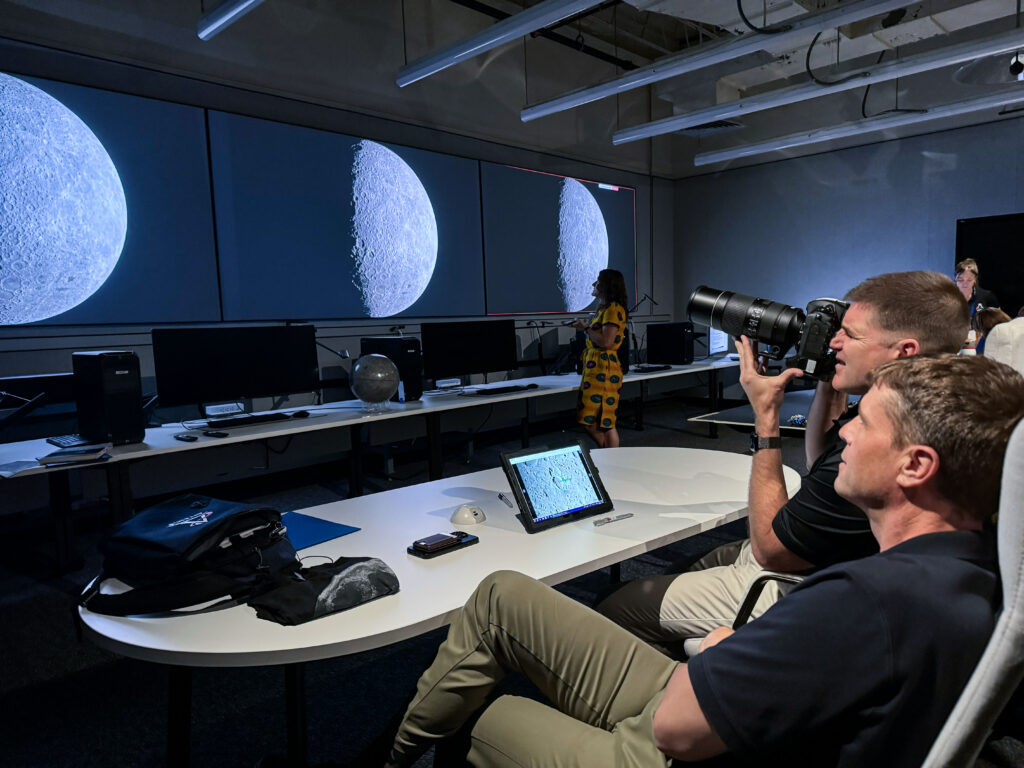 Artemis II astronauts Reid Wiseman (front) and Jeremy Hansen (back) practice photographing the moon at NASA Johnson: NASA/Kelsey Young
For additional prep, NASA sent the astronauts to Iceland in mid-2024, so they could see firsthand “terrain that looks a lot like what they will be seeing” on the moon, Young said. Apollo crews also visited the country to prepare for their lunar surface expeditions.
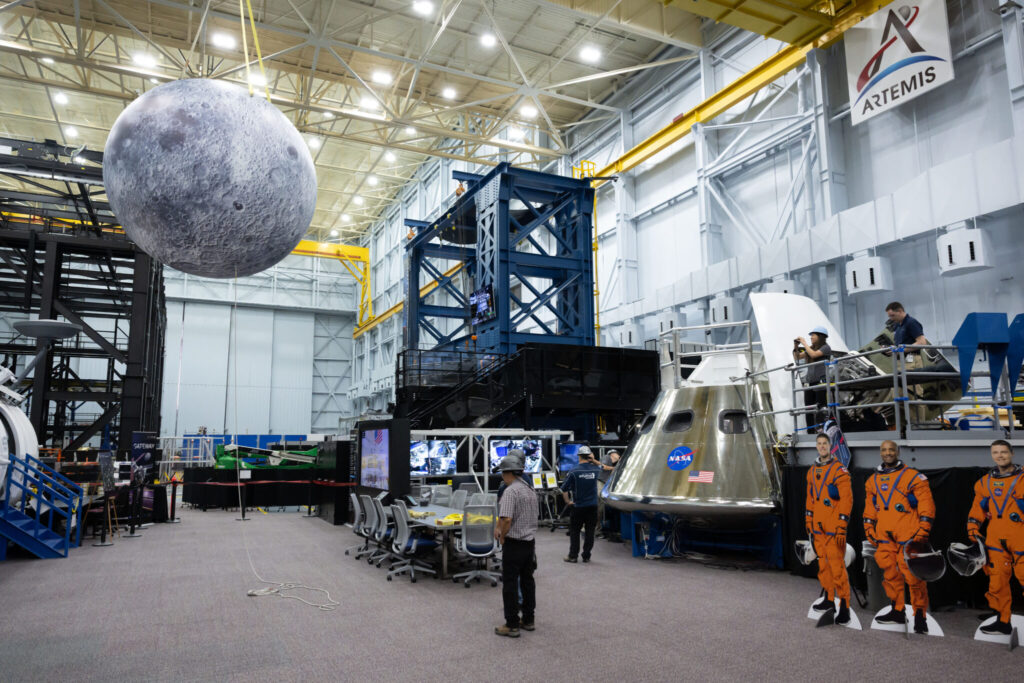
The Artemis II crew has also conducted practice runs of collecting imagery, she said. “We make giant inflatable moon globes [and] … hang it up at the right geometry and distance away from the Orion mockup down at the Johnson Space Center,” Young said. “We put [the crew] inside of the Orion vehicle, give them the cameras and have them practice in the actual physical space that they’ll be executing the flyby in.”
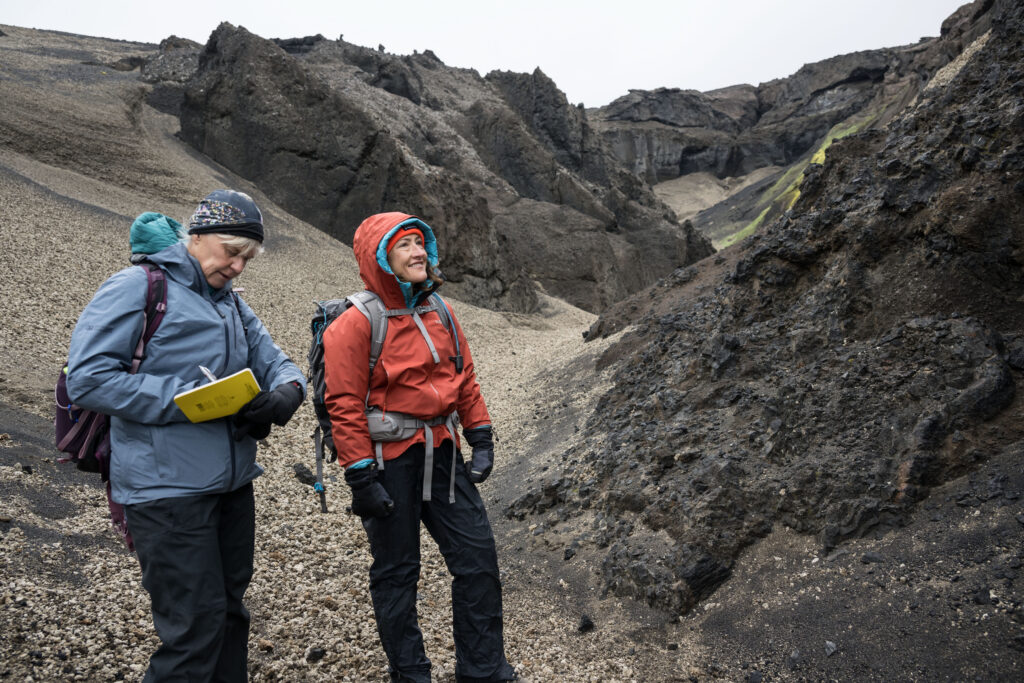 Artemis II astronaut Christina Koch (right) with the mission’s geology lead Cindy Evens (left) in 2024 during geology training in Iceland. Credit: NASA/Robert Markowitz
NASA has 10 lunar science objectives for Artemis II, she said, the top two of which are for the astronauts to collect imagery and observations about “color provinces and albedo variation” — meaning variation in light reflectivity — and “impact flashes,” or the bursts of light caused by a solid object hitting the moon’s surface.
“When they describe color and albedo, that tells us about composition, what is the surface made up of?” Young said. “When they describe geologic features, that tells us about the history [and] the geologic evolution of the surface of the moon. When they look at the terminator” — the line dividing lunar day from night — “and the limb, that tells us things about subtle morphology.”
These observations could help NASA determine the best landing sites for future surface excursions by highlighting “the spots that are best suitable for future surface crews to go and collect those really critical samples,” she said.
The agency hopes to conduct two landings in 2028 — Artemis IV and V, respectively — and follow that up with at least one surface mission per year.
“The crew is absolutely primed and prepared to really contribute to the scientific body of knowledge,” Young said. “This is only the first step.”