
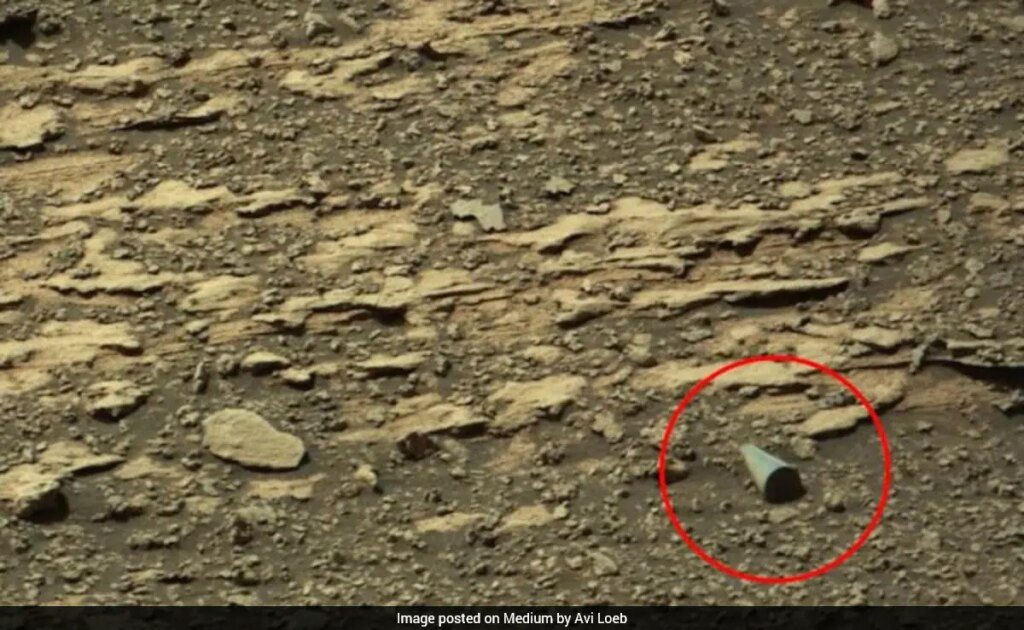
A party hat-shaped object spotted on Mars has sparked fresh debate among scientists, with some suggesting it could hint at something unusual, while others say there may be a far simpler explanation. The cone-like object, about 20 centimetres long with a flat base, was first photographed in 2022 by the Curiosity Rover while exploring Gale Crater on Mars. Interest in the mysterious object resurfaced on March 8 after Avi Loeb highlighted it in a post on Medium.
“Should we just assume that the mysterious cylinder is human-made debris and move on or turn back the rover to figure out whether its origin is different?” Loeb asked in the post.
Loeb urged NASA to send the rover to examine the object more closely. At the time the image was captured, the SUV-sized rover was operating on the slopes of Mount Sharp, roughly five miles from the object’s location.
“The most likely explanation is that it corresponds to man-made debris,” Loeb wrote.
Speaking further about the discovery, Loeb said NASA should consider directing the rover to study the cylinder rather than continuing with routine operations. In his view, investigating the mysterious object could provide valuable insight into its origin.
“NASA is funded by taxpayers, and if we asked them, they would likely agree that understanding the origin of the mysterious cylinder should be the top priority of Curiosity,” he said.
The object was first spotted in the vast archive of Mars images by amateur researcher Rami Bar Ilan. It was later brought to Loeb’s attention by Jan Spacek of the Foundation for Applied Molecular Evolution.
NASA has not yet provided an official identification of the object. However, Loeb himself acknowledged a more mundane possibility that the cone could simply be debris from the Curiosity mission. The rover may have shed a piece of equipment during its long journey across the Martian surface.
The Curiosity rover has been exploring the region since 2012, travelling across the landscape of Gale Crater in search of clues about the planet’s ancient environment and whether it once supported microbial life.