
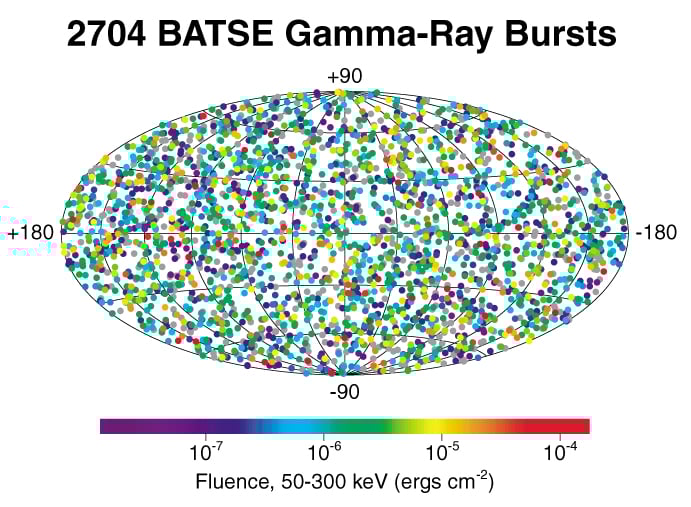
Gamma-ray bursts are the most violent explosions in the universe. In a fraction of a second, they can release more energy than the Sun will emit across its entire ten billion year lifetime. Most are over before you’ve had time to register them, gone in seconds, minutes at most. So when something arrived on 2 July 2025 that kept going for seven hours, fired three distinct bursts spread across an entire day, and then left behind an afterglow lasting months, astronomers knew immediately they were looking at something completely new.
GRB 250702B, detected by NASA’s Fermi Gamma-ray Space Telescope, is the longest gamma-ray burst ever recorded and it dwarfs all others in duration. Of the roughly 15,000 bursts catalogued since the phenomenon was first recognised in 1973, only a handful even approach its duration. Normal gamma-ray bursts don’t repeat. They arise from cataclysmic, one time events, maybe a pair of neutron stars colliding, or a massive star collapsing in on itself. GRB 250702B did neither. “This is certainly an outburst unlike any other we’ve seen in the past 50 years,” said one member of the detection team. The hunt for an explanation has occupied astronomers ever since.
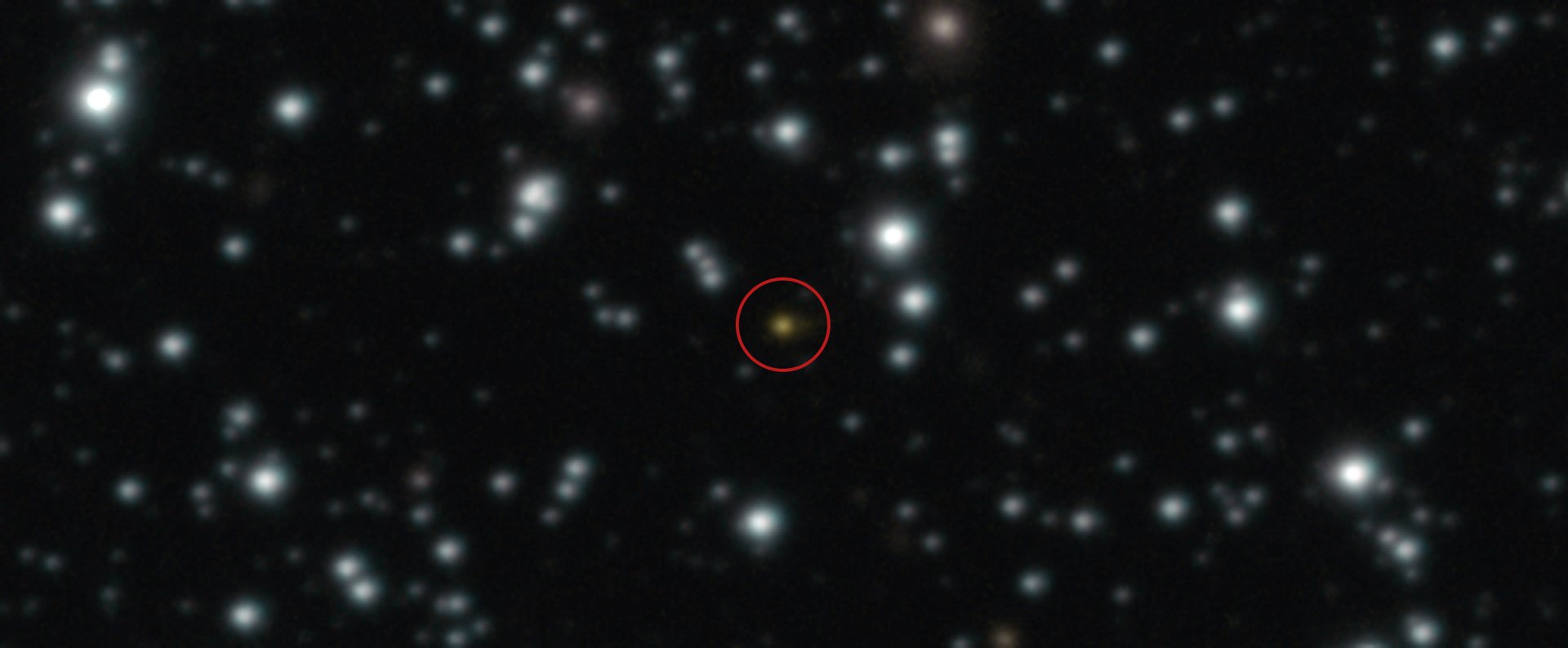
The new paper published in Monthly Notices of the Royal Astronomical Society focuses on one of the most intriguing possibilities, an intermediate mass black hole. Black holes come in dramatically different sizes. At one end you have stellar mass black holes, a few times heavier than the Sun, formed when massive stars die. At the other, you have the supermassive monsters lurking at the centres of galaxies, millions or billions of solar masses across. In between sits a largely missing population, intermediate mass black holes, ranging from a few hundred to a hundred thousand solar masses. Theory says they should be common. Finding them has proven stubbornly difficult.
The researchers propose that GRB 250702B was produced when an ordinary star like our Sun wandered too close to one of these intermediate mass black holes and was torn apart by its tidal forces. As the shredded stellar material spiralled inward and was consumed, it powered a relativistic jet of particles firing outward at close to the speed of light, generating the extraordinary gamma-ray emission Fermi detected.
Crucially, the repeating nature of the bursts fits this picture neatly. The star wasn’t necessarily destroyed in one go. Models suggest it could have been partially stripped across multiple close passes before final disruption, each encounter generating a fresh burst of emission which would explain the near regular spacing of the three Fermi triggers.
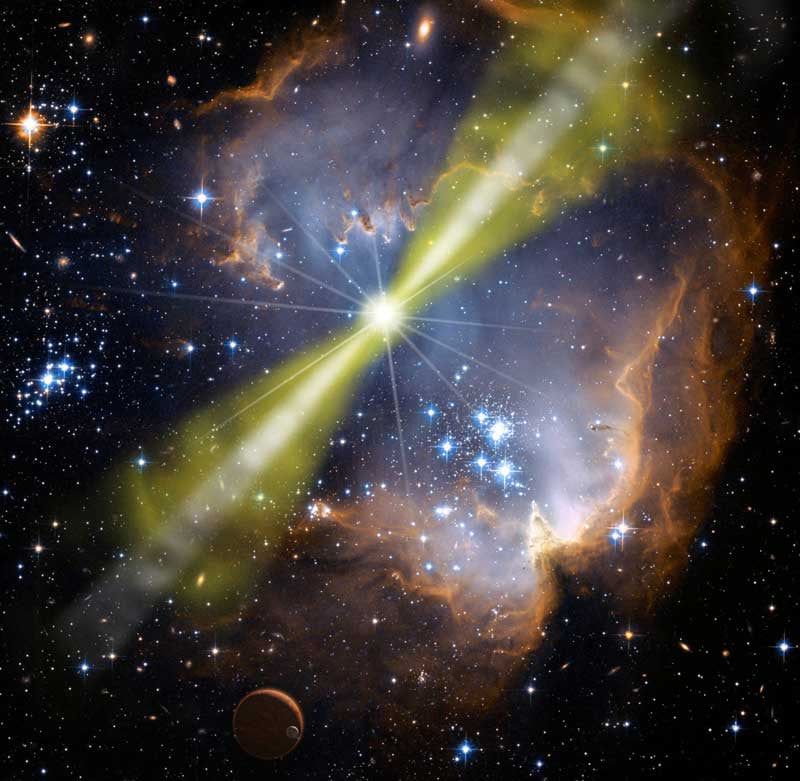 Artist’s illustration of a bright gamma-ray burst occurring in a star forming region. Energy from the explosion is beamed into two narrow, oppositely directed jets (Credit : NASA/Swift/Mary Pat Hrybyk-Keith and John Jones)
The event’s location adds another intriguing detail since GRB 250702B sits around 5.7 kiloparsecs from the centre of its host galaxy, well away from the supermassive black hole at the galaxy’s core. That’s exactly where you might expect a wandering intermediate mass black hole to lurk.
If this interpretation is correct, GRB 250702B would represent the first time humanity has ever witnessed a relativistic jet produced by an intermediate mass black hole in the act of consuming a star. That alone would make it one of the most significant astronomical events of the decade.
The mystery isn’t fully solved yet though since several competing models are still on the table, and the evidence remains contested. In a field where the biggest discoveries often arrive unannounced, a seven hour explosion that nobody can quite explain is exactly the kind of puzzle that drives astronomy forward.
Source : A milli-tidal disruption event model for GRB 250702B: main-sequence star disrupted by an IMBH