
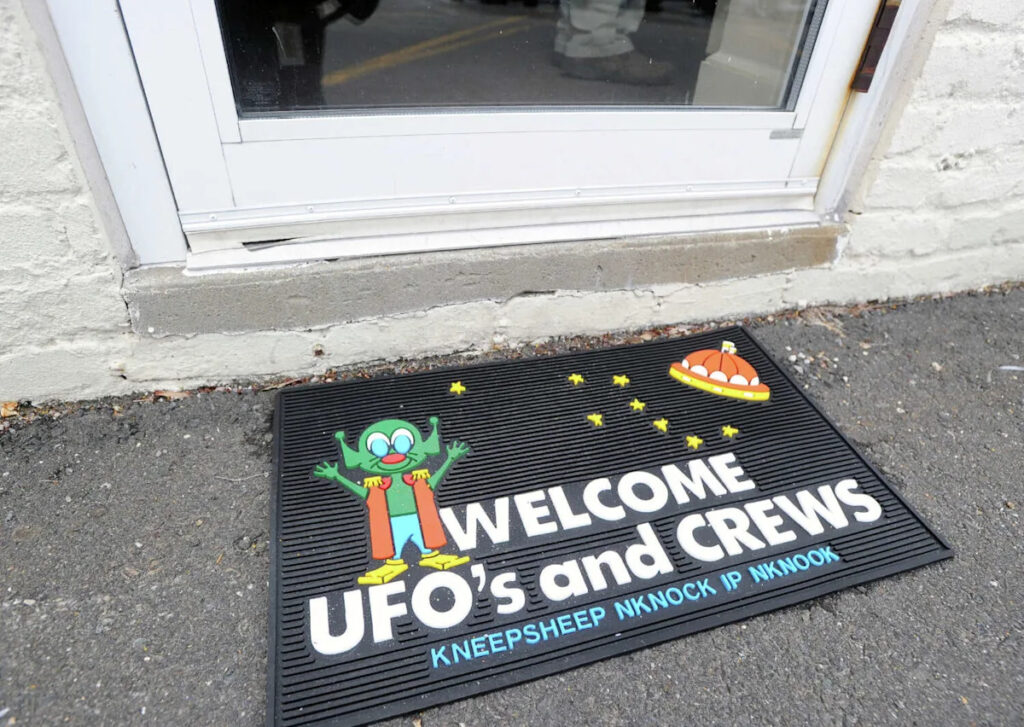
HARTFORD – Is something out there watching us, from a galaxy far, far away?
The University of Connecticut would have 10 months to gather and study available evidence on UFOs – which are called unidentified aerial phenomena these days – and report back to the General Assembly, under legislation before the budget-writing Appropriations Committee.
If it passes the committee, wins approval in the House and Senate and is signed by the governor, the law would give UConn until July 1, 2027, to consult with the state Department of Emergency Services and Public Protection, the Department of Energy and Environmental Protection, the Office of Military Affairs as well as national organizations involved in reports on unidentified flying objects, including abductions and other events, to gain information and create a report.
UConn would also explore the possibility of creating a state center for the study of UAPs.
The bill is supported by a group of scholars at Yale University, said Sri Tata, a doctoral candidate at Yale who told lawmakers Thursday that similar investigations are being undertaken in nearby states, including New Jersey, which has budgeted $2.5 million for research.
“A lot of students and faculty are interested in this topic,” Tata said during an appearance before the committee. “It’s also one that crosses state borders and international borders. Establishing a scientific study for both public policy, for scientific curiosity and for public reporting mechanisms would be important. It’s a topic that has broad interest among broad swaths of the population including very reputable academics that have been working on it.”
He cited a 2024 encounter that a Connecticut police officer reported.
State Rep. Martin Foncello, R-Brookfield, a committee member, agreed it’s a topic worth studying. “In fairly recent days I’ve seen things out there that need to be explained and haven’t,” he said.
State Rep. Cathy Osten, D-Sprague, co-chair of the committee, said before the hearing that the bill honored a request from state Rep. Joe Hoxha, R-Bristol, a second-term lawmaker who is a member of the panel.
“We don’t often have time on our agendas to hear a bill that’s a little bit avant-garde, but this time we felt we could squeeze it in. We have had a lot of written testimony and I encourage people to go in and read it,” she said.
When Tat took the microphone and identified himself, Osten briefly interrupted. “I have to stop you for one second because I didn’t think anybody was going to come and testify about this bill, and I am actually so excited that we have somebody up here testifying,” she said.
Hoxha, in his written testimony, said the federal government has explained away the events as weather-related or misidentified aircraft.
“Whatever the case may be, there is a growing contingent of people both inside and outside of government that want to study and better understand what goes on in our skies, because these sightings do happen and many times they truly do exist as physical objects,” Hoxha wrote.
There were 21 pieces of written testimony from the general public, academics and pilots who say they have seen UAPs, mostly in support of the proposed study, including two nationally known figures. Last month, President Donald Trump said he would order the Pentagon and other agencies to release federal files on UFOs.
“I recognize the skepticism surrounding this subject,” wrote Ryan Graves, a former U.S. Navy pilot who said he witnessed unexplained aerial phenomena before starting the Washington, D.C.-based Americans for Safe Aerospace. “If everyone could see the sensor and video data I’ve witnessed, our national conversation may very well change overnight. Only through determined action can we address this urgent, unexplained facet of our national airspace.”
Tim Galluadet, a retired Navy admiral who said he first encountered UAPs in 2015, said that over the past five years he has advocated for governmental transparency and more research.
“My motivation in this regard originated from my observing classified UAP video collected from U.S. Navy F/A-18 aircraft during a training exercise in 2015,” Galluadet wrote to the committee. “A major concern during the exercise was that UAP were coming so close to the aircraft that the pilots were afraid they might cause a mid-air collision.”
Kylene Perras, assistant dean at the UConn College of Engineering, also supported the proposal.
“The bill’s focus, evaluating the benefits of establishing a state center for UAP study and identifying the resources necessary to operate it, is both practical and forward-thinking,” Perras wrote. “It aligns directly with UConn’s mission of advancing scientific understanding and positions the University to deliver real value to the state.”
But Ronnell Higgins, commissioner of the state Department of Emergency Services and Public Protection, cast a shadow over the issue of aliens.
“Much of the data maintained by DESPP is sensitive and restricted to law enforcement or other authorized entities due to public safety and national security considerations,” Higgins wrote. “Because this information may not be accessible to non–law enforcement entities, we respectfully request that that provision be removed from the bill to avoid potential conflicts with existing data access restrictions.”
Others dismissed the study entirely.
“Connecticut has many issues that need attention,” wrote Harold Crevier, one of the few opponents. “UFOs are not one of them.”
“There are plenty of other entities studying the subject,” said another opponent, Alton Blodgett, who also filed written testimony. “Let’s not reinvent the wheel. Connecticut has more than it’s share of fiscal woes. Don’t waste more on this.”
This article originally published at Are UFOs flying over Connecticut? Lawmakers want UConn to find out.