
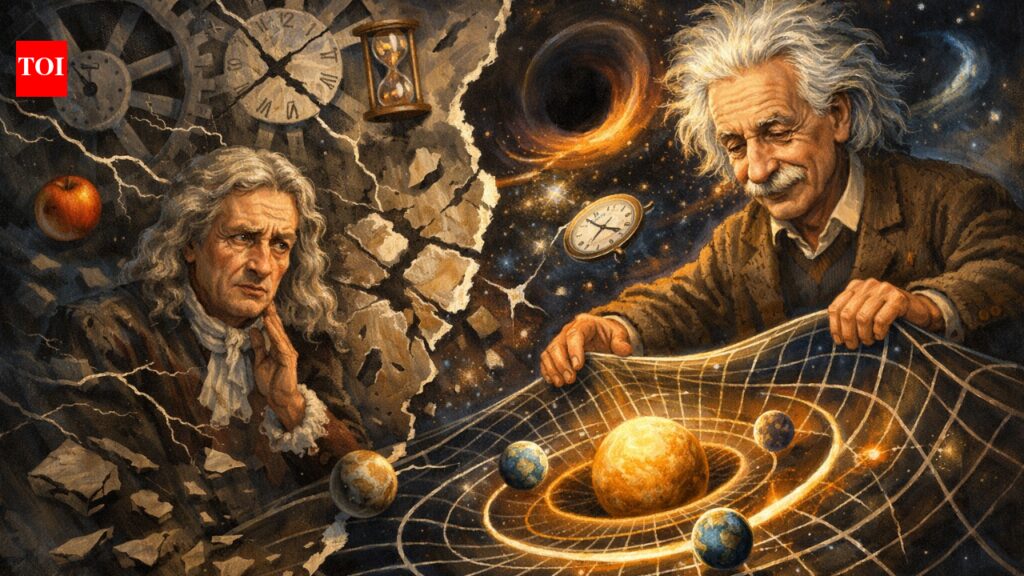
 Albert Einstein for beginners It is one of history’s more irritatingly on-brand coincidences that Albert Einstein was born on Pi Day, as though the universe itself decided that if it was going to manufacture the patron saint of theoretical physics, it might as well do the branding properly. Most people know Einstein as the man with the wild hair, the thoughtful eyes and the equation that has been printed on more T-shirts than the faces of most rock stars: E = mc². This is slightly unfair. It is like reducing Shakespeare to “that fellow who wrote to be or not to be” or reducing Sachin Tendulkar to someone who merely held a bat correctly. Einstein did not become Einstein because he produced one famous equation. He became Einstein because he changed the way human beings understood reality itself.Before Einstein, physics looked almost finished. The universe seemed to behave like an excellent Swiss railway timetable. Matter moved. Forces acted. Time ticked away in the background like a reliable clerk. Space was simply the stage on which objects performed their little dramas. Isaac Newton had given everyone such an elegant system that by the end of the nineteenth century many scientists believed the big problems had already been solved. There were a few loose threads, some stubborn puzzles, but the structure of the universe appeared largely understood.Then Einstein arrived and looked at those loose threads the way a cat looks at a ball of yarn. He pulled. And half of reality came undone.The remarkable thing about Einstein was that he did not begin by collecting huge amounts of experimental data. He began with questions. Childlike questions, the kind adults stop asking because they have grown comfortable with the illusion of understanding. What would it be like to ride alongside a beam of light? What if time did not pass at the same rate for everyone? What if gravity was not really a force in the way Newton imagined it? What if light sometimes behaved like a particle rather than a wave?These were not the questions of someone trying to preserve the old order. These were the questions of someone perfectly happy to overturn it.To understand Einstein for beginners, it helps to walk through his major contributions one by one, in plain language, without a chalkboard full of terrifying equations.
The first revolution: light is weirder than it looks
Einstein’s first major breakthrough involved something called the photoelectric effect. It sounds like a dull office term but it solved one of the strangest puzzles in physics at the time.Scientists had discovered that when light shines on certain metals, it can knock electrons out of them. Tiny charged particles come flying off the surface. But the behaviour of this effect did not match what classical physics expected.If light were purely a wave, then making the light brighter should make the effect stronger. But experiments showed something strange. Sometimes brighter light did nothing at all. What mattered was the frequency or colour of the light. High-frequency light could knock electrons free instantly, while low-frequency light could shine all day without success.Einstein suggested something radical: light does not always behave like a smooth wave. Sometimes it behaves like it arrives in tiny packets of energy. These packets later became known as photons.Think of it like rain. Classical physics had treated light like a gentle mist. Einstein suggested that in some situations it behaves more like individual raindrops. Each drop carries a specific punch. If each drop is too weak, no amount of drizzle will break the window. But one properly thrown stone will.This idea helped launch quantum physics, the branch of science that explains how nature behaves on the smallest scales. Ironically, Einstein later grew uncomfortable with some of quantum mechanics’ stranger implications, but he helped open the door to it. His Nobel Prize was awarded not for relativity but for this work on light.
Brownian motion: proving atoms were real
Today it seems obvious that matter is made of atoms. In Einstein’s time, that idea was still debated. Some scientists believed atoms were merely convenient mathematical tools rather than real objects.Einstein helped settle the matter through his explanation of Brownian motion.Brownian motion refers to the jittery movement of tiny particles suspended in a liquid. Under a microscope, particles such as pollen grains wobble around unpredictably, almost as if they are alive.Einstein showed that this movement could be explained if the liquid was made of countless invisible molecules constantly colliding with the particle from all directions. Because the impacts are uneven, the particle moves randomly.The beauty of this idea was that it turned something invisible into something measurable. Even if you cannot see the atoms themselves, you can observe the effects of their motion. Einstein transformed a philosophical argument into a physical one. Atoms were not just theoretical ideas. They had real consequences.
Special relativity: time is not universal
Einstein’s most famous work arrived in 1905 with the theory of special relativity. It challenged one of the most basic assumptions about the universe: that time flows the same way for everyone.Before Einstein, scientists assumed there was one universal clock ticking away in the background. One second was one second everywhere in the universe. Space also seemed fixed and stable.Einstein showed that both assumptions were wrong.His reasoning began with a simple observation: the speed of light is always the same for all observers. No matter how fast you are moving, light travels at the same speed.This leads to extraordinary consequences.
Time dilation
When objects move extremely fast, time passes more slowly for them compared with someone standing still. This is called time dilation.If a person travelled near the speed of light and returned to Earth, they would have aged less than people who stayed behind. This is not science fiction. It is a direct prediction of relativity.In everyday life the effect is tiny because our speeds are small compared with the speed of light. But the effect is real enough that even GPS satellites must correct for it to keep your phone’s location accurate.
Length contraction
Objects moving very fast appear shorter in the direction of motion when measured by a stationary observer. This phenomenon is known as length contraction.Again, nothing is being physically crushed. Instead, the measurements of space itself change depending on how observers are moving.
Relativity of simultaneity
Perhaps the strangest idea of all is that two events that appear to occur at the same time for one observer may not occur simultaneously for another observer moving at a different speed.In other words, the concept of “at the same time” depends on your motion through space.The neat, orderly universe of Newton began to look much less tidy.
E = mc²: matter is energy in disguise
From special relativity came Einstein’s most famous equation: E = mc².The equation states that mass and energy are equivalent. A small amount of mass contains an enormous amount of energy because it is multiplied by the square of the speed of light, which is an enormous number.This explains why nuclear reactions release such vast energy. When atoms split or fuse, a tiny fraction of mass is converted into energy.The equation revealed that matter is not fundamentally separate from energy. Matter is simply one form in which energy can exist.
General relativity: gravity bends the universe
If special relativity reshaped our understanding of time and space, general relativity reshaped gravity.Newton described gravity as a force that pulls objects toward one another. Einstein proposed something deeper.He suggested that massive objects bend spacetime itself.Imagine spacetime as a stretched sheet. If you place a heavy bowling ball on the sheet, it creates a dip. Smaller objects rolling nearby will curve inward toward it. They are not being pulled by a force. They are simply following the curved surface.In Einstein’s theory, planets orbit the Sun because the Sun bends spacetime around it.Gravity, in this view, is not really a force. It is the geometry of the universe.
Predictions of general relativity
Einstein’s theory made several predictions that were later confirmed.Light passing near massive objects should bend. This was observed during a solar eclipse in 1919 and made Einstein internationally famous.Time should pass more slowly in stronger gravitational fields. Experiments have confirmed this effect.The theory also predicted black holes and gravitational waves, ripples in spacetime produced by massive accelerating objects. Gravitational waves were detected a century later, confirming Einstein’s prediction.
Bose-Einstein statistics
Einstein also collaborated indirectly with Indian physicist Satyendra Nath Bose on a new way of describing particles.Bose developed a statistical approach to photons that Einstein immediately recognised as brilliant. Einstein extended the idea to atoms. The result was Bose-Einstein statistics, describing particles now called bosons.Unlike electrons, which refuse to share the same quantum state, bosons are happy to pile into the same state together. At extremely low temperatures they can form a strange new phase of matter called a Bose-Einstein condensate, where particles behave almost like a single quantum entity.
The seed of the laser
Einstein also described a process known as stimulated emission, where atoms can be triggered to emit identical light waves. This idea eventually led to the invention of the laser.From barcode scanners to eye surgery, lasers now play a central role in modern technology.
Final thought
What Einstein really did was ruin the comfortable universe people had inherited from Newton.Before him, the cosmos looked orderly and reassuring. Space was a stage. Time was a clock. Gravity was a polite invisible tug. Matter was solid. Light was a wave. Everything behaved the way nineteenth-century common sense expected it to behave.Einstein arrived and quietly informed everyone that none of this was strictly true.Time stretches. Space bends. Light behaves like both wave and particle depending on the situation. Matter can turn into energy. Gravity is geometry pretending to be a force. And the deeper physicists looked into the universe after Einstein, the stranger it became.Einstein did not make physics complicated.He discovered that reality already was.