
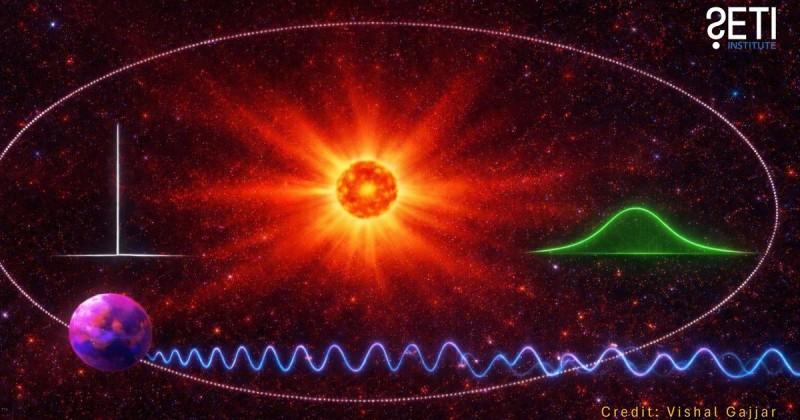
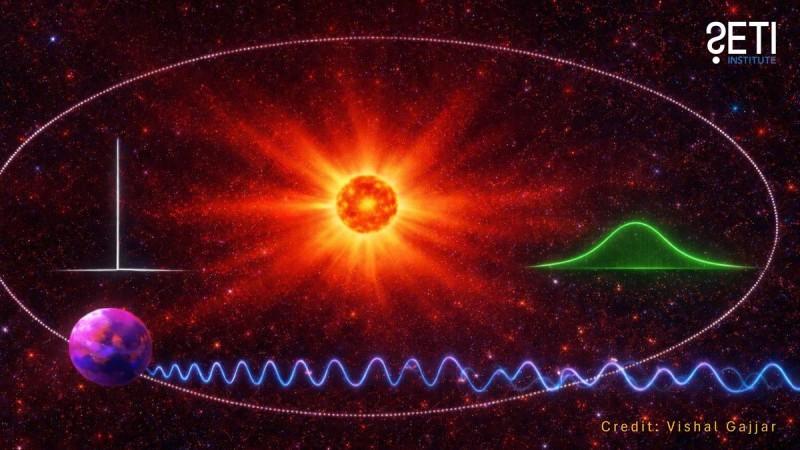
A planet’s radio signal may begin as a sharp tone (left, white) but can be spread out by the star’s surroundings plasma winds into a wider, fainter signal (right, green). The study suggests we may be missing signals by mostly looking for the sharp white shape instead of the broader green ones / Credit: Vishal GajjarVishal Gujjar
For the past 40 years, the most sensitive radio telescopes in the world have been scanning the sky. And the answer has been nothing, nothing, and nothing but radio static from deep space. Nothing but echoes of flotsam floating in the cosmic seas. And we are left wondering… where is everybody?
Is intelligent life really out there, or are we just imagining it? A new study by the SETI Institute released early this month suggests that the answer might be more humble to grasp: the signals might be right here, surrounding us all of the time, and we’re just unable to pick them out. The full study was published in IOP Science.
According to some scientists, the reason for this phenomenon is where your stars are located in their neighbourhood. They point out that every star is surrounded by a plasma ‘atmosphere’ and its magnetic field acts much like the rudder on a ship, creating storms of charged particles that acts just like a big turbulent ocean. When a radio signal passes through this charged weather of another star or even its own stellar atmosphere it becomes distorted. What is a sharp, tight artificially constructed line, very characteristic of what one might receive from an advanced civilization via the SETI techniques designed to uncover such, gets expanded into a much more diffuse and wide bandwidth emission.
What Happens When Signals Fade 94%?
“A signal originating near a red dwarf could lose up to 94% of its detectable power just passing through the stellar medium, before it even begins its interstellar journey,” lead author Vishal Gajjar told IB Times India in an exlcusive. That number is worth pondering. An alien civilisation could be screaming into space, and by the time its signal reaches us, it would be too faint and too diffuse to trip our detectors.
Scientists have calculated the life expectancy of extraterrestrial broadcasts by examining the impact of space-plasma turbulence on artificial radio signals here on Earth. However, in place of receiving broadcasts from other stars and planets, scientists only have artificial transmissions from probes.

Alien life forms could be discovered if scientists track atmospheric pollution. [Representational Picture]NASA
Probes such as Voyager and Cassini carry an experiment called the Radio and Plasma Weather (RPW) experiment that generates a tight, focused radio beam in order to gain insight into space-plasma. The scientists are concerned with how turbulence in plasma distort the beam of radiation, expanding its bandwidth over space and time. With a real-time measurement of distortion from these signals in the local vicinity of Earth, the team was able to run models of transmission which estimate how similar distortion from a star system a thousand light-years away could affect broadcasts transmitted from distant exoplanets. What they discovered is quite profound, as distortions on a similar scale could ruin radio transmissions over a vastly shorter distance.
The discovery is particularly significant in relation to red dwarf stars, the small, cool and highly magnetic objects that make up about 75 per cent of the stars in the Milky Way. They are also likely to be the stars with habitable planets, as well as being the most violent in terms of storms. Their planets are likely to be rocky worlds which have had plenty of time to develop life, but they are also the closest to their stars, which means their transmissions will have to pass through the worst of the plasma turbulence caused by the storms. In other words, the stars we should be watching most closely are also the ones most capable of mangling the very signals we’d be looking for.
Here’s what the lead author Vishal Gujjar told IB Times India in an exclusive interview:
Does this mean that the 75% of stars in the Milky Way most likely to host habitable planets are also the 75%, whose civilizations we are most structurally blind to?
Vishal Gujjar: In SETI, we typically search for narrowband signals — spike-like signals where the energy is concentrated at a single radio frequency. Our results suggest that for roughly 30 percent of stars, including Sun-like stars and red dwarfs, signals originating from planets can become spectrally broadened by about 10 Hz as they pass through the turbulent plasma around their host star before leaving the system. This distortion spreads the signal’s energy across frequency and can reduce its detectable intensity by as much as 94 percent.
Are alien civilizations invisible to us?
Vishal Gujjar: It does mean their signals might not appear as the sharp spikes our traditional algorithms look for. Instead, they could appear as weaker, more spread-out signals. The situation may be even more challenging for red dwarfs, which make up about 75% of the stars in the Milky Way, because their space weather is often more active and their planets orbit much closer to the star. This suggests that historically, radio SETI searches may have missed some signals from such systems. But now that we understand this effect better, we can adapt our search strategies to also look for signals that have been broadened or distorted by the stellar environment.
Does it imply that SETI has been panning the wrong side since 1984?
Vishal Gajjar: I wouldn’t say SETI has been looking in the wrong direction. Narrowband signals are still one of the clearest ways to distinguish artificial transmitters from natural astrophysical sources. What our work suggests is that we should broaden our search strategies, not only looking for extremely sharp signals but also for signals that may have been distorted by the space weather around their host stars.
The fix, the researchers say future algorithms should be designed to look not just for sharp spikes, but for the broader, weaker, smeared-out signals that physics predicts we’d actually receive from many civilisations. Co-author Grayce Brown puts it simply: searches should be matched to “what actually arrives at Earth, not just what might be transmitted.”
There is something almost poetic about this. Our best minds have spent decades designing exquisitely sensitive instruments capable of detecting a whisper from light-years away, only to discover that the whisper may have been turned into a sigh by the star it came from. The universe, it turns out, is not just vast. It is noisy.
And somewhere out there, someone might be shouting.