
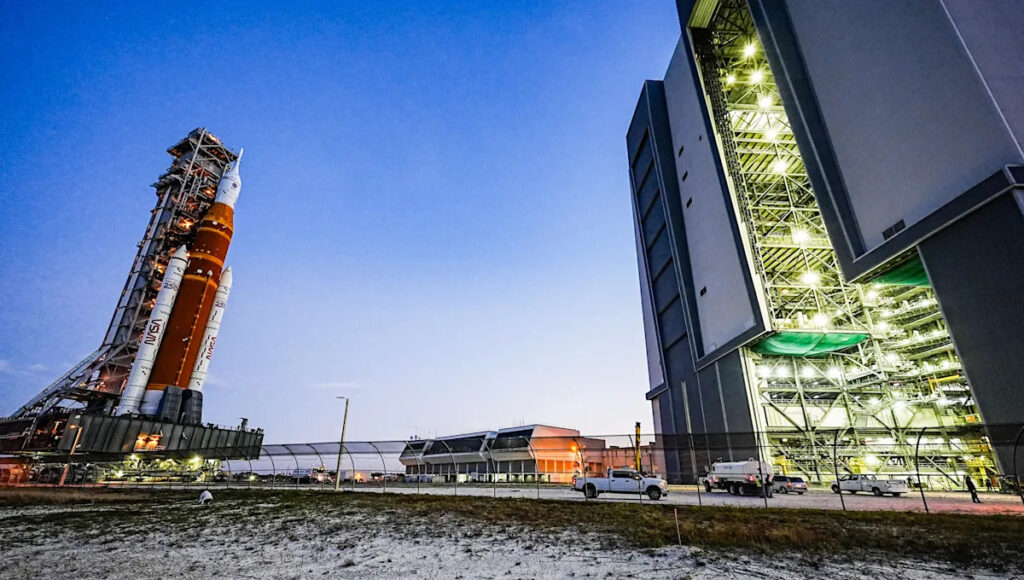
Once again, NASA may be on the cusp of sending a crew of astronauts on a lunar mission for the first time in more than five decades.
Officials with the U.S. space agency have announced that plans are on track for a mission known as Artemis 2 to get off the ground in April from the Kennedy Space Center in Florida. The news comes after the Artemis 2 launch slipped first from February to March before more issues with NASA’s towering Space Launch System prompted another monthlong delay.
Artemis 2 represents the second mission under NASA’s multibillion-dollar campaign to return Americans to the surface of the moon ahead of the first crewed voyages to Mars. When the mission does get off the ground, a crew of three Americans and one Canadian will fly on a historic 10-day trip without a lunar landing, where they will see parts of the far side of the moon that not even Apollo astronauts witnessed.
2025 spaceflight in photos. See images of Blue Origin, SpaceX missions
1 of 13
Firefly’s Blue Ghost lunar lander captures its shadow on the moon’s surface after completing a successful landing March 2 near a volcanic feature on the moon called Mons Latreille. The vehicle became the first of two landers manufactured by a U.S. company to reach the moon is 2025 in crucial missions to lay the groundwork for NASA to return humans to the lunar surface in the years ahead.
Here’s everything to know about the Artemis 2 mission and NASA’s latest target launch date.
Space exploration: 6 spaceflights ahead in 2026, from NASA moon missions to SpaceX Starship
When is the Artemis 2 launch date? NASA targets April liftoff
NASA is working toward an April 1 launch of its historic Artemis 2 mission from the Kennedy Space Center in Florida.
But if the weather or any other factors were to cause the launch to be delayed, several other days in April remain possibilities under NASA’s previously announced timeline. Those dates include April 3-6.
The announcement, made during a March 12 news conference, followed a flight readiness review in which officials assessed a variety of factors, including the status of the lunar rocket, before committing to a target launch date.
Artemis 2 astronauts to fly around moon without landing
Hitching a ride atop NASA’s Space Launch System rocket, the Artemis 2 astronauts are due to pilot an Orion capsule on a 10-day trip around the moon. While no moon landing is in store for the mission, the crew will test systems and hardware for future expeditions to the surface while traveling about 4,700 miles beyond the far side of the moon – the farthest humans have ever ventured in space.
While NASA tested its spacecraft during the Artemis 1 mission in 2022, Artemis 2 will be the first time that the SLS rocket and the Orion capsule will fly with humans aboard.
When will SLS moon rocket be rolled out to launch pad again?
Now that a new target launch date is set for Artemis 2, NASA will roll the 322-foot rocket Space Launch System (SLS) rocket – topped with the Orion crew capsule – back to the launch pad at the Kennedy Space Center.
That rollout is scheduled to take place Thursday, March 19, according to NASA.
SLS moon rocket repaired at NASA’s Kennedy Space Center
NASA’s update comes amid work on the troubled SLS – built by Boeing and Northrop Grumman – which at the end of February was rolled from its launch pad in Cape Canaveral for repairs.
For the last two weeks, the rocket has been in NASA’s Vehicle Assembly Building, where spacecraft are prepared for launch, as engineers work to fix an issue in which helium was not properly flowing to the rocket’s upper stage. While engineers repaired a seal suspected of being the culprit, “technicians also have been working to refresh other systems on the rocket” and Orion capsule, NASA said in a March 3 blog post.
A since-repaired liquid hydrogen leak also forced an earlier delay.
Who are the astronauts on the Artemis 2 mission?NASA’s Artemis 2 mission to fly 4 astronauts around moon. Photos of crew
1 of 11
NASA Administrator Jared Isaacman stands with the Artemis II crew during an SLS rollout press briefing.
The crew of Artemis 2 includes NASA astronauts Reid Wiseman, Victor Glover and Christina Koch, as well as the Canadian Space Agency’s Jeremy Hansen.
Koch and Glover represent the first woman and first African American, respectively, assigned to a NASA lunar mission. Additionally, Hansen is set to become the first Canadian to fly close to the moon.
With a target launch date set, the astronauts will be required to isolate in quarantine at the Johnson Space Center in Houston for about two weeks before the mission in order to avoid exposure to any illnesses. NASA has not yet announced when the quarantine process will begin.
What is the Artemis program? NASA aims to return astronauts to moon
NASA’s Artemis lunar program represents the agency’s ambitious campaign to return Americans to the moon for the first time since the Apollo era came to an end in 1972.
Astronauts are due to help build a permanent lunar base on the moon’s largely-unexplored south pole. There, water ice could be extracted and used for drinking, breathing and as a source of hydrogen and oxygen for rocket fuel for missions to Mars.
The Artemis campaign was conceived in 2017 under the first term of President Donald Trump, who has signaled he wants to see a moon landing before the end of his second term.
NASA overhauls lunar missions as Artemis 4 becomes moon landing
The Artemis program most recently made headlines when NASA leaders announced a major overhaul to the missions.
Most prominently, NASA Administrator Jared Isaacman revealed plans to add another mission between Artemis 2 and a moon landing. That mission, now known as Artemis 3, would entail astronauts aboard the Orion capsule meeting and docking in 2027 in Earth orbit with at least one of the commercial lunar landers being developed by Elon Musk‘s SpaceX and Jeff Bezos’ Blue Origin.
NASA then plans for a moon landing mission in 2028 as part of Artemis 4. Moon landings are then expected to occur once a year as astronauts work to establish a permanent lunar base ahead of crewed missions to Mars.
Eric Lagatta is the Space Connect reporter for the USA TODAY Network. Reach him at elagatta@usatodayco.com
This article originally appeared on USA TODAY: We have a target launch date for NASA’s Artemis 2 moon mission