
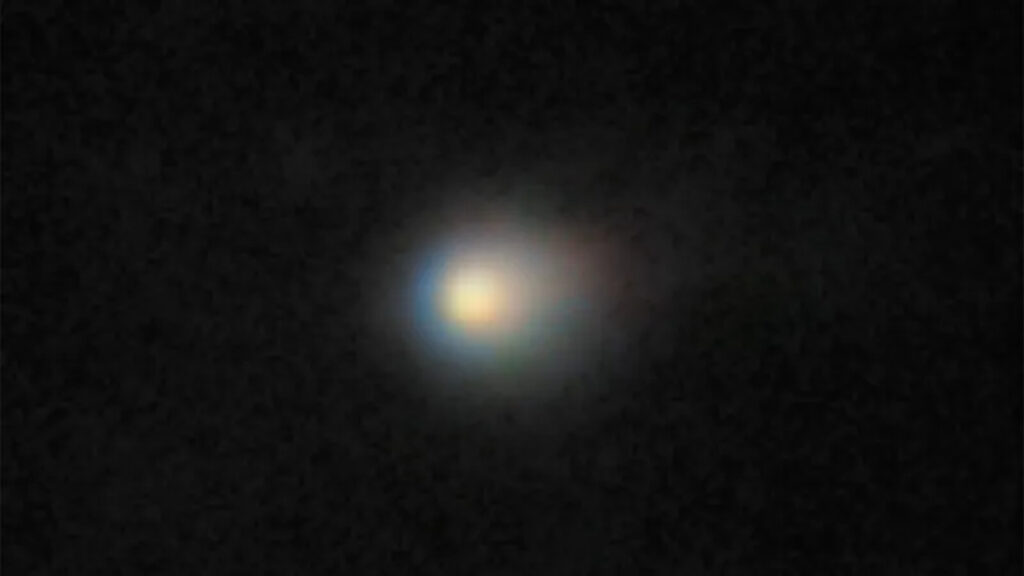
Another study into interstellar comet 3I/ATLAS has revealed that the space rock is rich in methanol. In fact, methanol present on this comet whizzing through our solar system is more abundant than hydrogen cyanide, which is more abundant in comets from our solar system.
What Does The Discovery Of Methanol On Interstellar Comet 3I/ATLAS Mean?
The foundation for the study, which revealed the presence of methanol on interstellar comet 3I/ATLAS, was signals detected by the Atacama Large Millimetre/submillimetre Array (ALMA) in Chile. A closer look at the signals detected by these radio antennas revealed strong signals of methanol (CH3OH).
Based on this finding and the abundance of methanol in this comet, the study says it was formed in a unique planetary system. This planetary system is colder and features a different chemical makeup from ours.
While methanol isn’t rare in space, it isn’t as abundant as it was observed on interstellar comet 3I/ATLAS. This compound is formed on the surface of icy dust grains present in interstellar clouds and is part of the building blocks of comets during planetary formation.
From the ALMA detection, methanol is released from the comet’s nucleus and icy grains, unlike hydrogen cyanide, which is released from only its nucleus. This is the first time that this behaviour has been noticed on a comet travelling through our solar system.
Interstellar Comet 3I/ATLAS Might Be A Window Into Deep Space
Efforts to understand the universe have led humans to explore the depths of space. Interstellar comet 3I/ATLAS might just offer us insight into what deep space and its formation.
Nathan Roth, a professor at American University and the lead author of the study that revealed the presence of methanol, likened the observation of 3I/ATLAS to “taking a fingerprint from another solar system”. Interstellar comet 3I/ATLAS is the third known object that has entered our solar system from interstellar space.
Studying this comet might help us understand more about interstellar space. Each reveal brings us a step closer to better understanding the formation and history of this comet.