
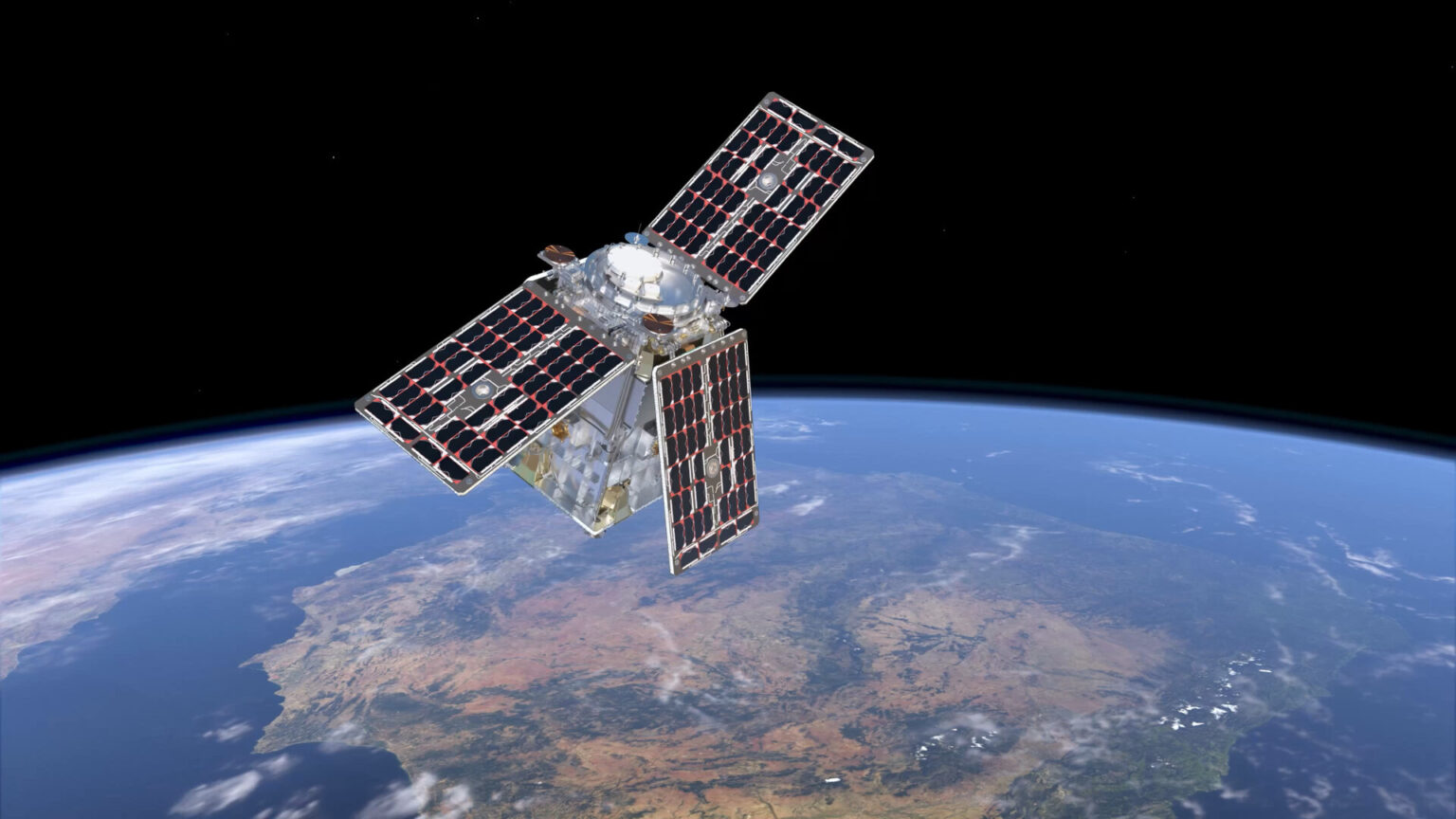
Ultra-low-noise amplifiers developed by European Engineering & Consultancy Ltd. (EECL) are now operating successfully in orbit on the European Space Agency’s HydroGNSS Earth observation mission, marking an early technical milestone for the satellite payloads.
The HydroGNSS mission—ESA’s first Earth Observation “Scout” mission to reach orbit—launched from Vandenberg Space Force Base in California in November 2025 and consists of two small satellites designed to monitor key hydrological and climate variables using signals from global navigation satellite systems (GNSS).
EECL supplied six multiband ultra-low-noise microwave amplifiers (LNAs) that form part of the radio-frequency front end for the mission’s GNSS reflectometry receiver. The LNAs amplify extremely weak reflected navigation signals while preserving signal integrity, allowing the satellites to capture usable data at the earliest stage of signal reception.
HydroGNSS uses a technique known as GNSS reflectometry, in which satellites receive navigation signals from systems such as GPS and Galileo after they bounce off Earth’s surface. By analyzing those reflections, the spacecraft can derive environmental measurements including soil moisture, freeze–thaw conditions over permafrost, inundation and wetlands, and above-ground biomass.
Early commissioning results indicate the payload hardware is performing as expected. Both satellites have successfully begun collecting Delay Doppler Maps—datasets that characterize the reflected GNSS signals and allow scientists to extract environmental information about the reflecting surface.
The LNAs were designed, manufactured and tested in the United Kingdom under a contract with Surrey Satellite Technology Ltd. (SSTL), which built the satellites and the GNSS receiver payloads. Their in-orbit performance validates the RF hardware after several years of development and space-qualification testing.
Low-noise amplification is particularly critical for GNSS reflectometry missions because the reflected navigation signals arriving at the satellite are extremely faint compared with direct signals from the GNSS satellites themselves. Maintaining a very low noise figure in the front-end electronics enables the receiver to detect these weak reflections and generate usable scientific data products.
HydroGNSS will collect global measurements of hydrological conditions to support climate monitoring and environmental research. According to ESA, the twin satellites operate in complementary orbital positions to maximize global coverage while continuously gathering reflected GNSS signals for analysis.