
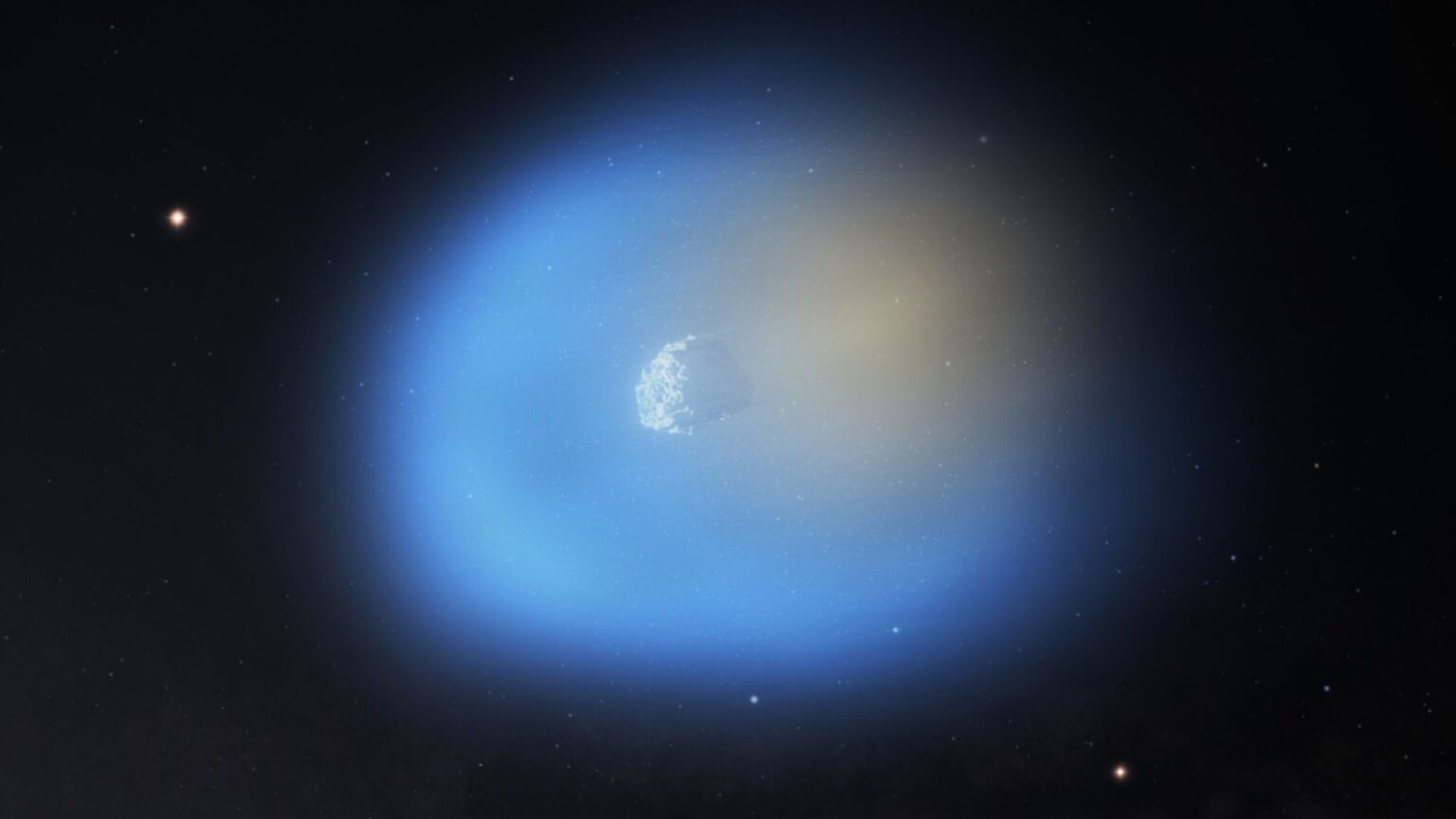
A BOOZY comet has stunned scientists after they discovered the ‘alien’ rock is filled with alcohol.
The mysterious interstellar comet is “bursting” with the substance like no other close to Earth.
Sign up for The US Sun newsletter
Thank you!
The rare comet dashed past Earth in DecemberCredit: NASA, ESA, David Jewitt (UCLA); Image Processing: Joseph DePasquale (STScI)
It’s only the third interstellar object ever detected passing through our solar systemCredit: NASA
Artist’s impression of what 3I/ATLAS looks like close upCredit: NSF/AUI/NSF NRAO/M.Weiss
3I/ATLAS captured the world’s attention late last year as only the third interstellar object ever detected passing through our solar system.
The huge space rock, thought to measure up to 3.5 miles at its solid core, whizzed past Earth on its closest approach ever days before Christmas – and it won’t be back.
Some wild theories had speculated that the comet may be a hostile alien probe.
But experts have now revealed that 3I/ATLAS has unusually high levels of methanol.
ROCKY HORROR
Nasa issues update on 220ft city-killer asteroid experts said risks Moon crash
LUNAR-CY!
Moon SHRINKING as scientists discover major clues littered across lunar surface
Methanol is a type of alcohol – though not the sort you find in drinks as it’s highly toxic.
Things like rocket fuel and antifreeze contain methanol.
Scientists from the Atacama Large Millimeter/submillimeter Array (Alma) observatory in Chile made the shock discovery after studying plumes of gas cloud coming off the comet as the sun warmed its icy surface the nearer it got.
It’s not unusual for methanol and another key ingredient, hydrogen cyanide, to be detected – but the “abundant alcohol” oozing from 3I/ATLAS is.
In fact, the huge amount of organic molecule methanol is more than almost all known comets in our own solar system.
“Observing 3I/ATLAS is like taking a fingerprint from another solar system,” explained Professor Nathan Roth, from the American University.
Sign up for The Sun Tech newsletter for gadgets, games & more

Hello! I’m Sean Keach, The Sun’s Head of Technology and Science
I’ve been writing about gadgets, games and the future of technology for more than a decade.
During that time I’ve penned thousands of articles, filmed hundreds of videos, talked tech on TV and radio, and travelled around the world to bring you the latest on Apple, Meta, Google, Amazon, Netflix and more.
And I’ve got a weekly newsletter called The Sun Tech that you can read for free every Thursday.
I bring you the latest from the world of tech, including behind-the-scenes action, exclusive content, expert analysis, and plenty of help advice – so please follow along!
“The details reveal what it’s made of, and it’s bursting with methanol in a way we just don’t usually see in comets in our own solar system.“
Researchers don’t have a certain answer yet as to why the comet is this way.
But previous information gives us a clue.
One theory is that 3I/ATLAS was born in a much colder region of its home star system.
Or, it could be due to the high-energy cosmic rays it’s been exposed to on its 7billion year journey.
This could all help us eventually understand where the comet came from.
For now, 3I/ATLAS is still dashing through our solar system, making its closest approach to Jupiter on Monday.
What’s the difference between an asteroid, meteor and comet?
Here’s what you need to know, according to Nasa…
Asteroid: An asteroid is a small rocky body that orbits the Sun. Most are found in the asteroid belt (between Mars and Jupiter) but they can be found anywhere (including in a path that can impact Earth)
Meteoroid: When two asteroids hit each other, the small chunks that break off are called meteoroids
Meteor: If a meteoroid enters the Earth’s atmosphere, it begins to vapourise and then becomes a meteor. On Earth, it’ll look like a streak of light in the sky, because the rock is burning up
Meteorite: If a meteoroid doesn’t vapourise completely and survives the trip through Earth’s atmosphere, it can land on the Earth. At that point, it becomes a meteorite
Comet: Like asteroids, a comet orbits the Sun. However rather than being made mostly of rock, a comet contains lots of ice and gas, which can result in amazing tails forming behind them (thanks to the ice and dust vaporizing)