
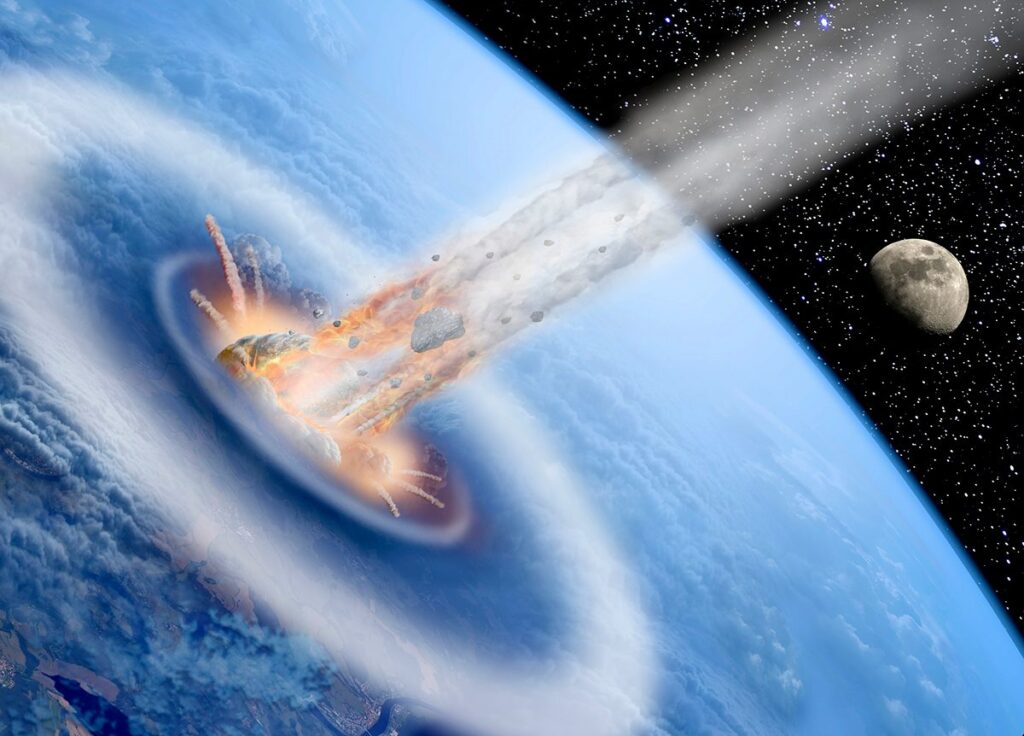
Scientists say they can confirm that an enormous crater under the North Sea was caused by an asteroid or comet smashing into Earth 43–46 million years ago.
What’s more, the resulting impact likely produced a tsunami that towered 100 metres (328 feet) high.
The study, if true, solves a decades-long scientific mystery around the origins of Silverpit Crater, which is located at the bottom of the southern North Sea.
It puts Silverpit alongside other famous impact structures like Chicxulub Crater in Mexico – which caused the extinction of the dinosaurs – and Nadir Crater off West Africa, now confirmed as an impact site.
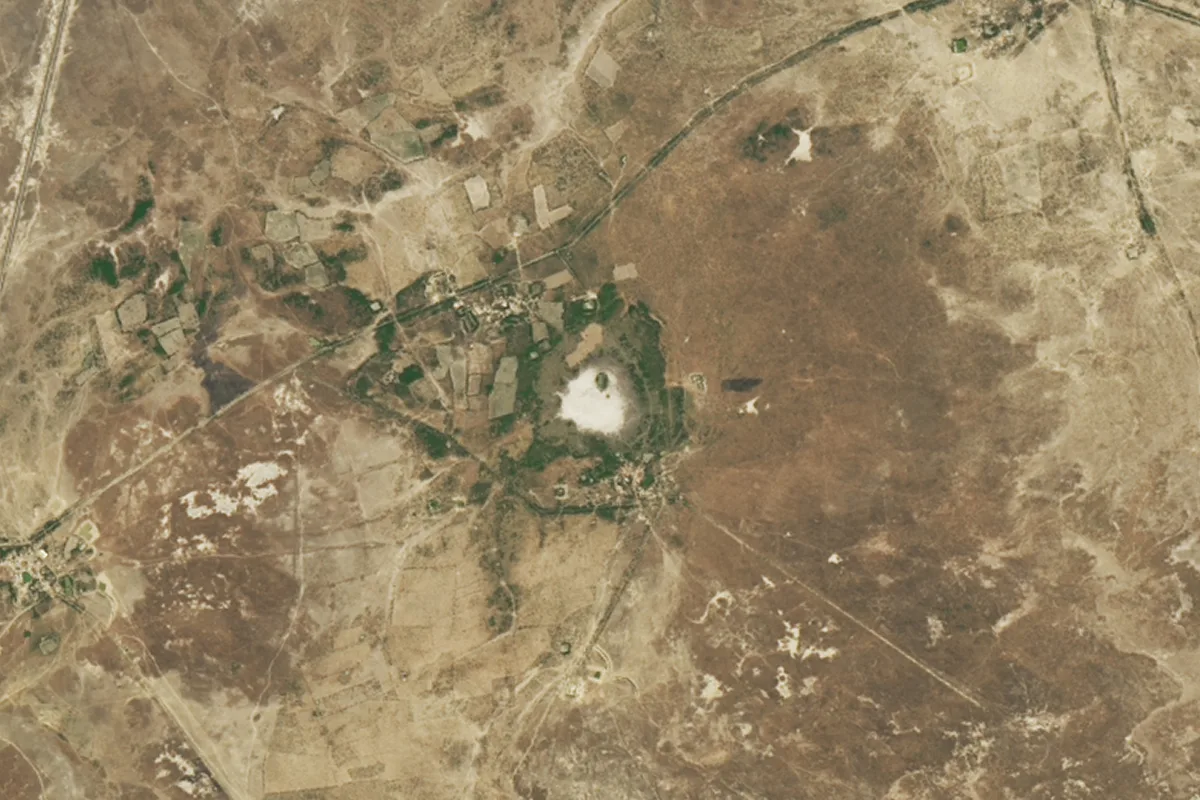 NASA Earth Observatory image by Michala Garrison, using Landsat data from the U.S. Geological Survey.
Science at the bottom of the ocean
The team behind the study was led by Dr Uisdean Nicholson from Heriot-Watt University in Edinburgh, UK.
They used seismic imaging, microscopic analysis of rock cuttings and computer models to conclude that Silverpit is in fact an impact crater on the seabed.
Studying Silverpit Crater is no easy task. Not only is it under the sea, it’s actually under the seabed itself: 700 metres below, in fact.
Silverpit is buried under a huge layer of sediment and was only discovered in 2002, about 130km (80 miles) off the coast of Yorkshire in the UK.
The crater is 3km (1.8 miles) wide and surrounded by a series of circular faults spanning 20km (12.5 miles) across.
These circular faults stretch outwards across the seabed from the key impact site, like widening ripples in water caused when a stone is thrown into a pond.
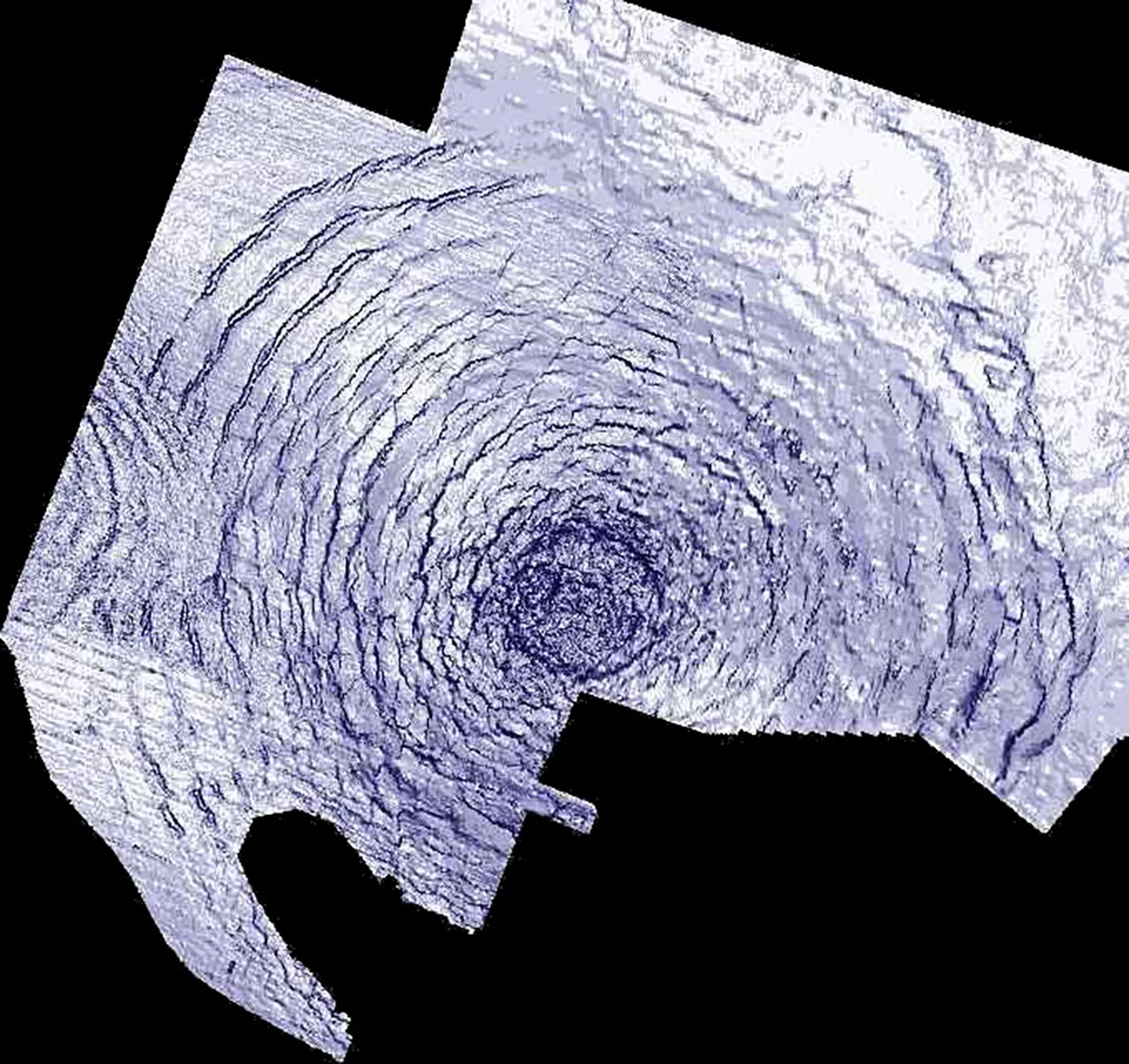 A seismic map of Silverpit Crater. Credit and copyright Phil Allen (Production Geoscience Ltd) and Simon Stewart (BP)
Determining Silverpit Crater’s origins
It has taken over two decades for scientists to reach a consensus as to what former Silverpit Crater.
Since its discovery in 2002, Silverpit has been at the centre of a debate among geologists.
Initial studies suggested it was an impact crater because of its central peak, circular shape and concentric faults, which many scientists say points to it being caused by a large space rock smashing into Earth.
Other theories suggest it might have been caused by salt moving below the crater floor or the collapse of the seabed caused by volcanic activity.
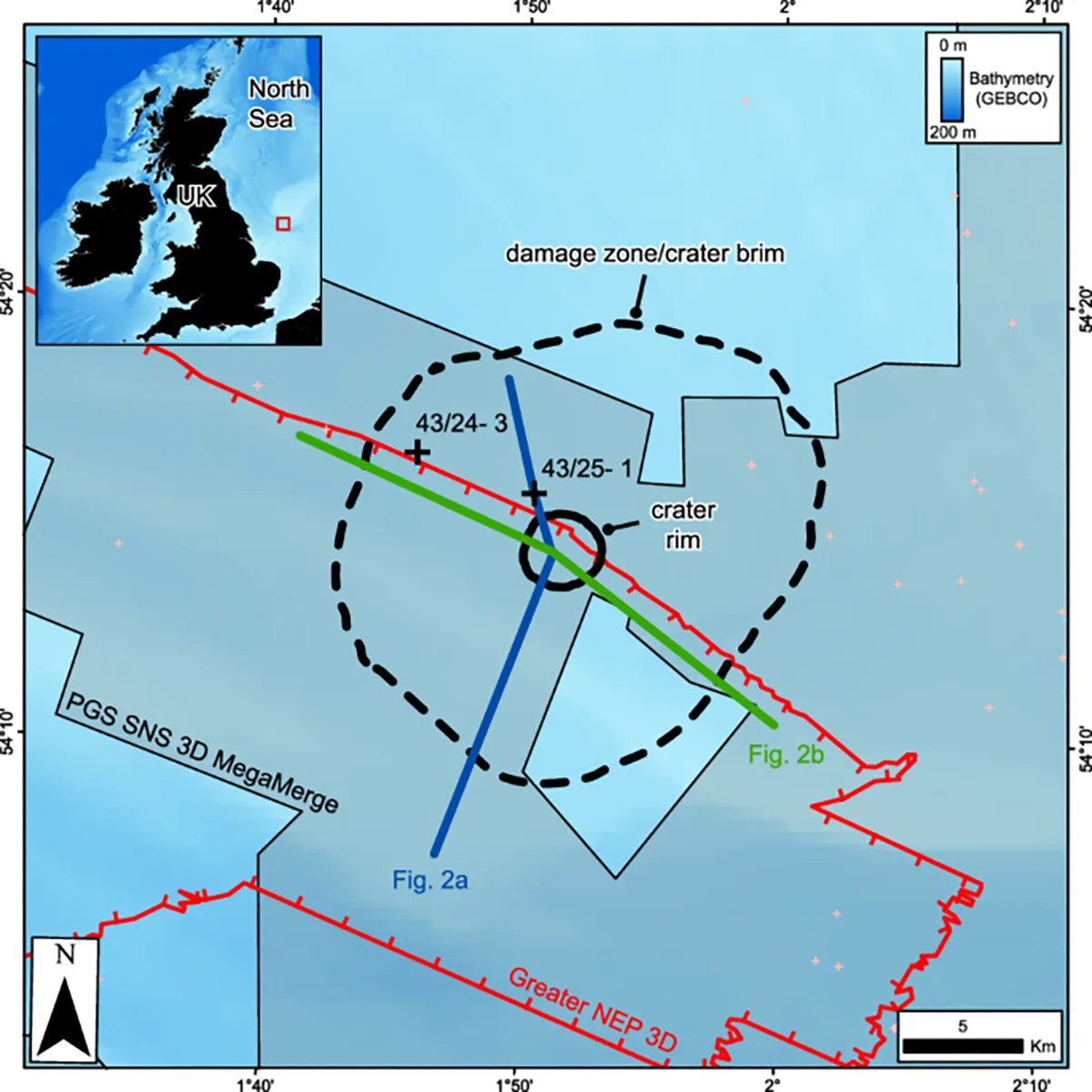 A location map showing the location of Silverpit Crater and its damage zone. Credit:
Nature Communications, Uisdean Nicholson, Iain de Jonge-Anderson, Alex Gillespie, Thomas Kenkmann, Tom Dunkley Jones, Gareth S. Collins, James Frankel, Veronica Bray, Sean P. S. Gulick & Ronnie Parr
The Heriot-Watt-led team used seismic imaging data and evidence gathered below the seabed that, they say, proves Silverpit is an ancient asteroid or comet impact.
Dr Uisdean Nicholson, a sedimentologist in Heriot-Watt University’s School of Energy, Geoscience, Infrastructure and Society, says: “New seismic imaging has given us an unprecedented look at the crater.
“Samples from an oil well in the area also revealed rare ‘shocked’ quartz and feldspar crystals at the same depth as the crater floor.
“We were exceptionally lucky to find these – a real ‘needle-in-a-haystack’ effort. These prove the impact crater hypothesis beyond doubt, because they have a fabric that can only be created by extreme shock pressures.”
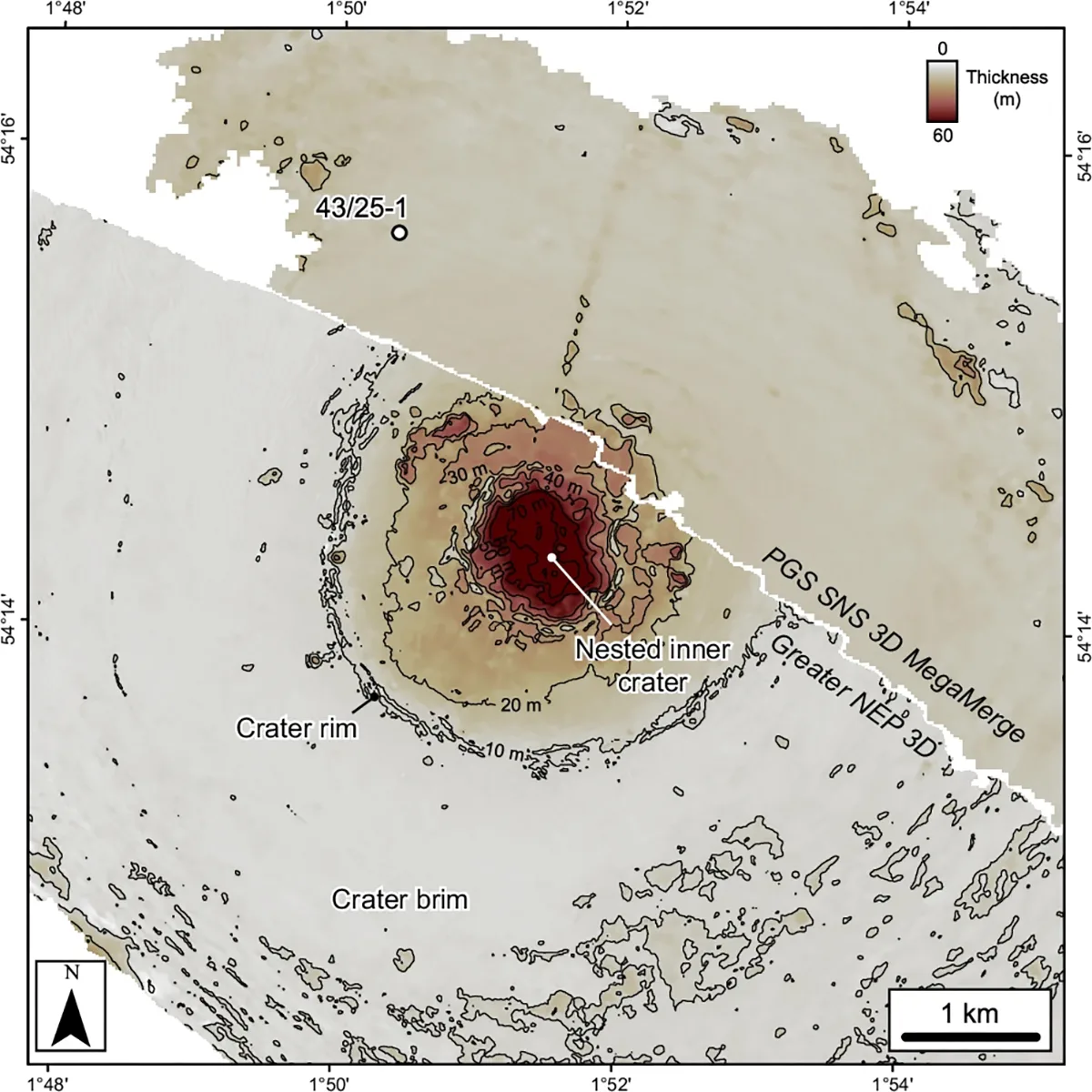 Map showing the varying thickness of Silverpit Crater and its damage zone. Credit: Nature Communications, Uisdean Nicholson, Iain de Jonge-Anderson, Alex Gillespie, Thomas Kenkmann, Tom Dunkley Jones, Gareth S. Collins, James Frankel, Veronica Bray, Sean P. S. Gulick & Ronnie Parr
A tsunami to dwarf Big Ben
“Our evidence shows that a 160-metre-wide asteroid hit the seabed at a low angle from the west,” says Dr Nicholson.
“Within minutes, it created a 1.5-kilometre high curtain of rock and water that then collapsed into the sea, creating a tsunami over 100 metres high.”
That’s just about taller than London’s Big Ben or the Statue of Liberty in New York.
“I always thought that the impact hypothesis was the simplest explanation and most consistent with the observations,” says Professor Gareth Collins from Imperial College London.
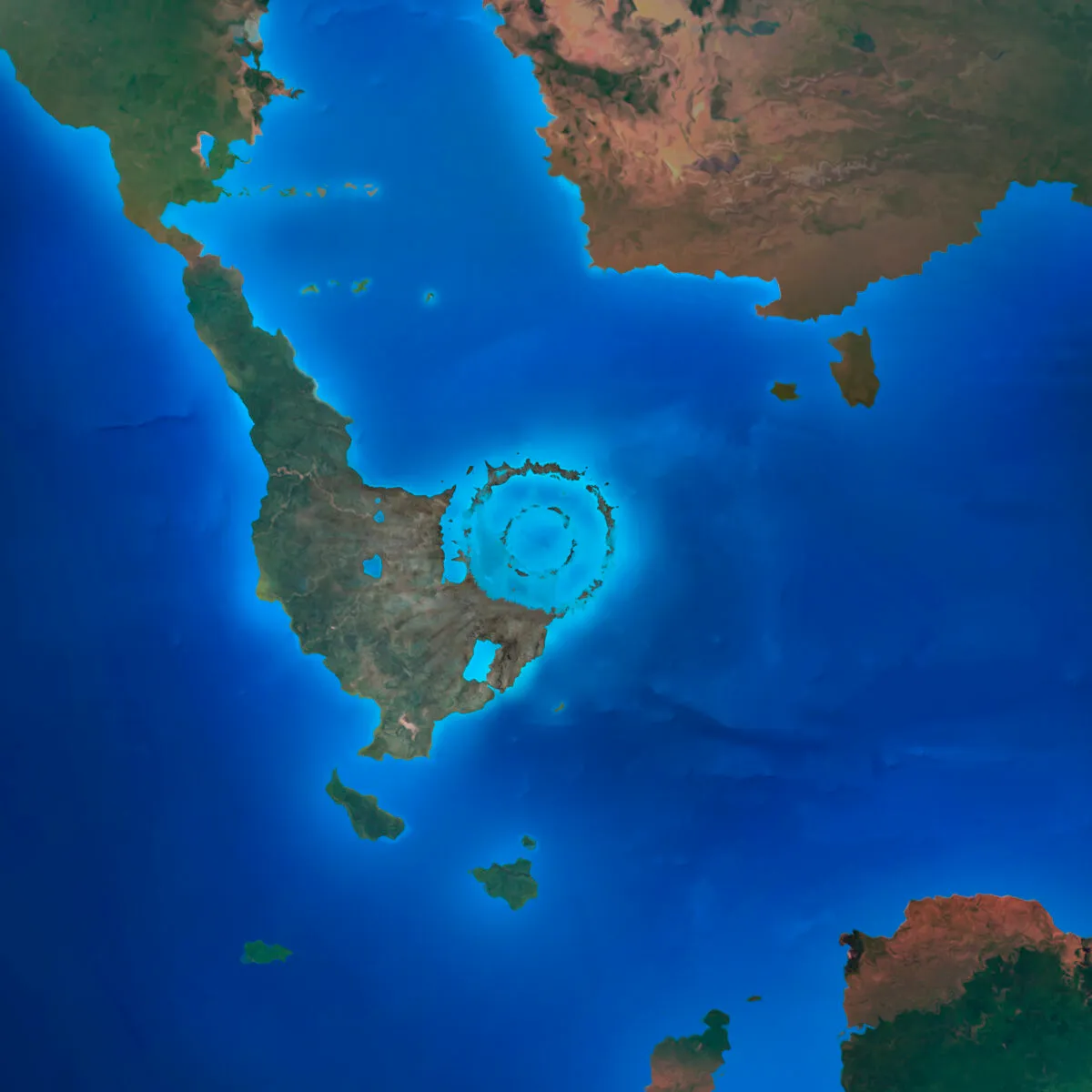 An illustration showing the location of the Chicxulub crater, shortly after its formation. The Chicxulub crater is thought to be the impact scar left over from the asteroid that wiped out the dinosaurs and other species on Earth. Credit: Mark Garlick / Science Photo Library
“It is very rewarding to have finally found the silver bullet. We can now get on with the exciting job of using the amazing new data to learn more about how impacts shape planets below the surface, which is really hard to do on other planets.”
“Silverpit is a rare and exceptionally preserved hypervelocity impact crater,” says Dr Nicholson.
“These are rare because the Earth is such a dynamic planet. Plate tectonics and erosion destroy almost all traces of most of these events.
“Around 200 confirmed impact craters exist on land, and only about 33 have been identified beneath the ocean.
“We can use these findings to understand how asteroid impacts shaped our planet throughout history, as well as predict what could happen should we have an asteroid collision in future.”
Read the full paper via Nature Communications