
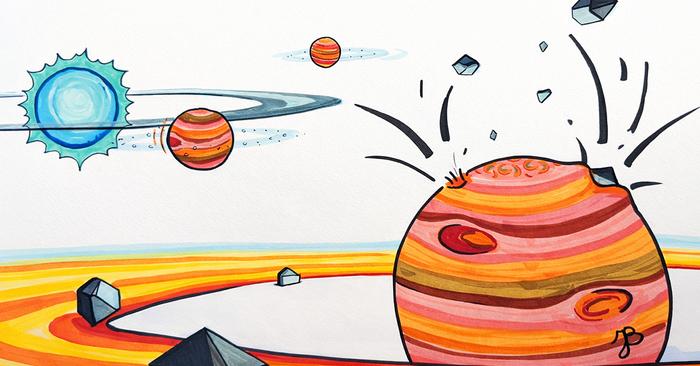
 One way gas giants form is through core accretion, where solid cores gradually grow in a disk by pulling in rocky and icy pebbles until they become massive enough to attract the gas that surrounds young stars. Jean-Baptiste Ruffio
The universe rarely makes things easy to understand. For decades, researchers thought they had the recipe for a solar system figured out. You put a star in the middle, scatter some rocky crumbs nearby for things like Earth, and let the gas giants like Jupiter and Saturn sweep up the leftovers in the cold, dark suburbs. It was neat, tidy, and, as it turns out, probably wrong — or at least very incomplete.
Exhibit A: HR 8799. This young star, just 42 million years old and 130 light-years away, is home to four behemoths that shouldn’t exist. These gas giants are 5 to 10 times the mass of Jupiter, sitting at distances far greater than Pluto is from our Sun.
Ever since these planets were discovered nearly two decades ago, they’ve stood as a middle finger to our best theories of how planets are born. They were too big and too far away to exist by the rules. Now, using the James Webb Space Telescope (JWST), an international team of astronomers has finally cracked the chemical code of these distant giants.
And this chemistry might explain how the planets formed — without breaking the rules.
A Cosmic Buffet at the Edge of Nowhere
The main problem with HR 8799 is called core accretion. This is the standard model for building a giant planet. Imagine a dusty disk around a young star. Inside this disk, ice and rock collide to form a solid core. Once that core gets to about ten times the mass of Earth, its gravity becomes so hungry that it starts inhaling gas from the surrounding disk. This is the accretion.
But the farther you go from the star, the less material you have to work with. So, you’d expect these planets which are farther from their star to be smaller. That’s why it’s so striking for planets to be huge and very far away from their star.
To get to the bottom of it, astronomers investigated the chemical composition of these planets for clues.
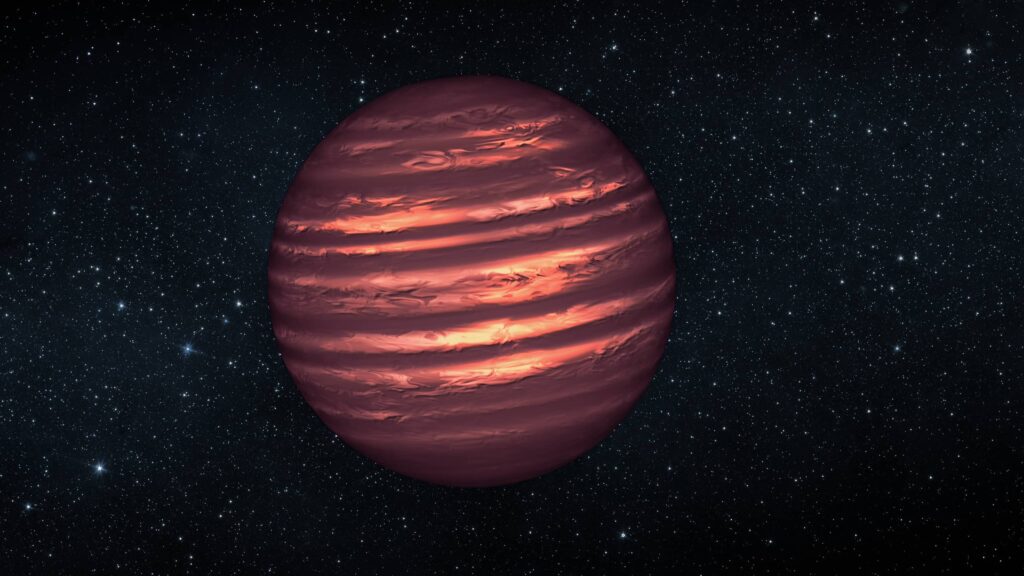
 AI-generated depiction of one of the planets.
They used the NIRSpec (Near-Infrared Spectrograph) instrument aboard the JWST, creating complex models to see what would explain the observations.
×
Thank you! One more thing…
Please check your inbox and confirm your subscription.
For starters, they found that all planets have a relatively similar chemistry. In other words, they formed in pretty much the same way. This likely means no collisions or extreme events.
They then found that the planets are metal-rich. In astronomy, anything heavier than hydrogen or helium is a “metal.” These giants are packed with them at a level that mirrors our own Jupiter and Saturn. The researchers found that the carbon, oxygen, and sulfur levels are all high.
So, What Does This Mean?
The presence of metals is the smoking gun hinting at accretion. In the early solar nebula, pure hydrogen and helium gas are too light and energetic to simply clump together on their own. Accretion acts as the cosmic construction crew. Solid grains of silicates, ices, and carbon collide and stick together to form a heavy, rocky core. So, when researchers see four planets with a similar, metal-rich chemistry, it has to be accretion.
The massive metal content also suggests these planets started forming early (within <1 million years) to capture enough dust from the disk. Furthermore, the presence of hydrogen sulfide (H2S) confirms that solid accretion was highly efficient during formation.
Sulfur is a stubborn element that refuses to stay in gas in the cold, outer reaches of a solar system. At these freezing temperatures, sulfur gets locked into solid ice grains and dust. Finding high levels of H2S means these planets were “heavy eaters,” especially in the early days of the solar system.
Essentially, the planets got so big because they started eating early and efficiently. To get this “fat” on solids so far from their star, the HR 8799 system must have been a chaotic, high-density construction zone. It’s surprising just how big they got, but it doesn’t contradict our existing models.
But How Big Can a Planet Get?
In our solar system, Jupiter is the undisputed king. If you added more mass to Jupiter, it wouldn’t actually get much bigger in size; gravity would just crush it down, making it denser. But if you keep adding mass (getting up to around 13 times the mass of Jupiter) things start to get really weird.
At that point, the core gets hot enough to start fusing deuterium (a heavy version of hydrogen). They become almost stars. We call these “Brown Dwarfs”. They are the “failed stars” of the cosmos, too big to be planets, too small to be true stars.
The HR 8799 planets are flirting with this boundary. At 5 to 10 Jupiter masses, they are the largest things you can call a “planet” without starting a fight at an astronomy conference. This is about as big as a planet can get, without losing its planet-ness.
Ultimately, a planet’s size isn’t just limited by how much gas is around; it’s limited by how much “solid” material it can grab to build that initial gravitational engine. The HR 8799 planets suggest that if you have enough dust, you can build a “Jupiter” anywhere, and you can build it big.