
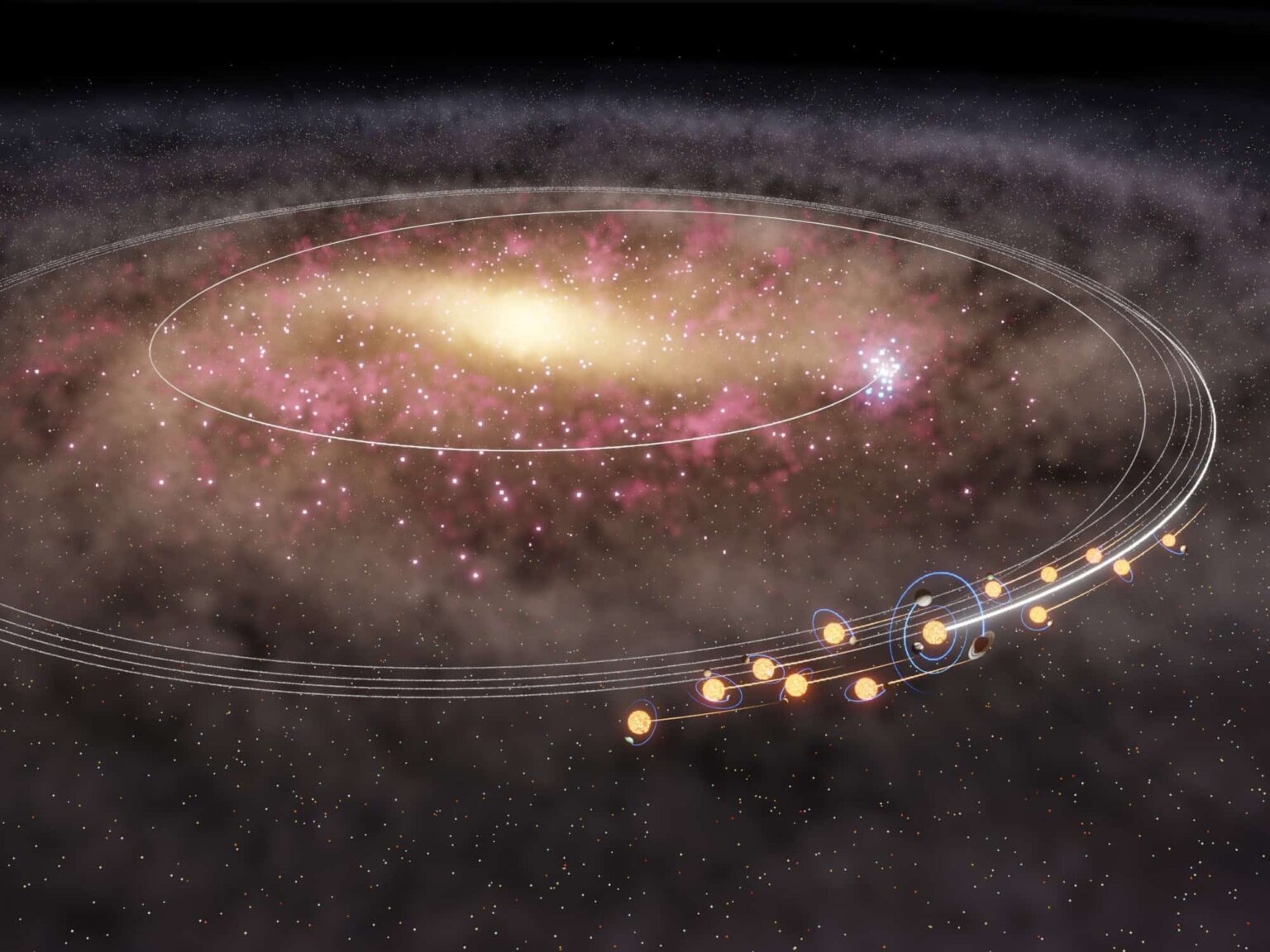
 A mass migration of stellar twins. Stars similar to our Sun form a mass migration from the center of the Milky Way, occurring approximately 4 to 6 billion years ago. Credit: NAOJ.
Our Sun is actually a cosmic refugee. Around 4.6 billion years ago, it first ignited in a hostile, radiation-blasted neighborhood 10,000 light-years closer to the Milky Way’s center than it is now. Today, the Sun harbors a planetary system in the galactic suburbs.
How did it cross that vast, treacherous distance?
Now, an unprecedented study in galactic archaeology provides the answer: it didn’t travel alone. Using data from the European Space Agency’s Gaia satellite, astronomers have discovered that our star was part of a massive stellar migration. Between 4 and 6 billion years ago, the Sun and thousands of identical “solar twins” surged outward from the inner galaxy in a synchronized wave.
This discovery profoundly shifts our understanding of our place in the cosmos. This mass exodus not only explains how our solar system found a safe haven where fragile life could evolve, but it also rewrites the timeline of the Milky Way itself. The findings suggest that the violent formation of the galaxy’s massive central bar acted as a gravitational slingshot, forging the very escape route these stars traveled.
The Solar Twin Search
How exactly do we know what the Milky Way looked like billions of years ago? This is where things get really interesting. In a sense, it’s not all that different from how archaeologists reconstruct the lives of ancient peoples. Only instead of digging through dirt to spot artifacts, galactic archaeology digs through starlight to reconstruct the past.
To trace the Sun’s specific journey from origin to where we are now, Assistant Professors Daisuke Taniguchi and Takuji Tsujimoto turned to the European Space Agency’s Gaia satellite. Gaia continuously tracks over two billion stars. From this massive dataset, the researchers hunted for “solar twins”.
These are not just stars that look broadly like our Sun. They are exact matches. They share the Sun’s exact temperature, surface gravity, and chemical makeup. In previous studies, astronomers usually relied on small samples containing only a few dozen of these stellar twins.
This time, the researchers built a catalog of 6,594 solar twins. This staggering collection is about 30 times larger than any past survey. It includes stars extending out to a distance of roughly 300 parsecs from Earth. If you imagine our entire 100,000-light-year-wide galaxy as a massive city, this 300-parsec search area is just a single local neighborhood block, yet it is still deep enough to encompass almost every individual star you can recognize by name in the night sky.
×
Thank you! One more thing…
Please check your inbox and confirm your subscription.
Traveling The Milky Way
Why do we need so many twins? Working with identical stars strips away the chaotic variables that can overwhelm even the most seasoned astrophysicist. It allows scientists to measure stellar ages with pinpoint precision.
In the Milky Way, there is a strict “inside-out” rule for growth: the inner regions of the galaxy formed faster and became enriched with metals much earlier than the outer regions. Because our Sun and its twins are metal-rich — containing a specific quantity of elements heavier than helium — astronomers know they must have been born in the dense, inner disk where those materials were available billions of years ago.
When the team calculated the ages of these thousands of twins, a pattern emerged. They discovered a massive statistical bump — a peak in the data showing a huge number of twins aged between 4 and 6 billion years.
This bump is the smoking gun of a migration. If stars stayed where they were born, we wouldn’t see such a high concentration of same-aged, metal-rich stars in our local neighborhood.
“By studying a large population of these Solar twins, we found evidence suggesting that many Solar twins of the same age migrated through the Milky Way around the same time as the Sun, giving us new clues about when and how the Sun moved from its birthplace to its current location,” Taniguchi told ZME Science.
Hopping the Galactic Fence
You might wonder if we can trust this pattern. Big, bright stars naturally catch our telescopes’ attention, while fainter, older stars easily fade into the background. Could the data simply be biased?
The researchers anticipated this exact problem. Taniguchi told ZME Science, “One of the main challenges was correcting for observational biases in the data (called “selection effects”). In astronomy, some stars are easier to detect than others (e.g., brighter stars are more likely to be observed). So, the raw age distribution of the observed Solar twins does not directly reflect the true distribution. To address this, we created simulated catalogs containing tens of thousands of artificial Solar twins to quantify how likely Solar twins of different ages were to be observed. We then applied statistical techniques originally developed in signal and image processing to remove these biases and succeeded in reconstructing the true age distribution of Solar twins.”
The team generated a mock universe containing over 75,000 artificial stars. By comparing the real data to this simulated catalog, they effectively wiped the smudges off their lenses.
Yet, discovering a mass migration solves one mystery but introduces a physical contradiction. The Milky Way features a massive bar-like structure at its center. This bar exerts a powerful gravitational force that creates a corotation barrier.
Think of this barrier as a giant cosmic fence. It actively traps stars in the inner galaxy and stops them from escaping into the outer suburbs. If this fence is so effective, how did the Sun and 6,500 of its siblings break out?
The simple answer is that the galaxy is not a static place.
“In the present-day Milky Way, the corotation barrier is thought to lie between the Sun’s birthplace and its current position. However, the barrier may not always have been located in the same place in the past (i.e., the Sun did not necessarily need to hop the fence),” Taniguchi told ZME Science.
Instead of jumping a fence, the stars likely rode a massive wave created by the fence’s construction.
“We propose that the formation of the Milky Way’s central bar structure may have played a key role. If the Galactic bar formed roughly 6-7 billion years ago, the dynamical processes associated with its formation could have both enhanced the star-formation rate in the inner region of the Milky Way and also triggered large-scale radial migration of stars. In this scenario, Sun and Solar twins formed in the inner part of the Galaxy around 4-6 billion years ago and soon migrated towards outer regions during this dynamically active period. This scenario, if correct, could also provide new constraints on the epoch of the Galactic bar formation,” Taniguchi said.
As the galactic bar violently assembled itself, it churned the surrounding space. This process, known as radial migration, flung stars outward by diffusing their angular momentum.
A Hazardous Birthplace
This ancient migration profoundly impacts our daily lives. If our Sun had never left the galactic core, human beings probably would never have existed.
The inner Milky Way is a chaotic, crowded environment. Stars pass violently close to one another, and cosmic radiation constantly saturates the space. It is an incredibly inhospitable place for a fragile planet to nurture life. That doesn’t mean it would’ve been impossible, though.
“One factor we had in mind is that high-energy events such as supernova explosions are thought to occur more frequently in the inner regions of the Milky Way than where the Sun is located today. However, this is a matter of probability (by a factor of a few or so) rather than a strict boundary. The inner Galaxy is likely a more hazardous environment, but that does not necessarily mean that the emergence of life there would be impossible,” Taniguchi said.
Regardless of the exact odds, moving 10,000 light-years away gave our solar system a distinct advantage. The Sun settled into a quiet, boring neighborhood where life on Earth could safely evolve.
We often suffer from a bit of cosmic ego. However, this massive new dataset paints a much more communal picture. Our star is just one part of a vast diaspora.
“The presence of many Solar twins in the solar neighborhood with ages similar to the Sun implies that the Sun’s migration may not have been an exceptional event. These stars likely formed in similar regions of the inner Milky Way and later migrated outward. This suggests that a mechanism existed that allowed Sun and many Solar twins to migrate large distances across the Milky Way. In other words, the Sun may simply have been one member of a much larger migrating population rather than an extraordinary traveler,” Taniguchi said.
Ultimately, galactic archaeology forces us to rethink our place in the dark. We are the lucky beneficiaries of a massive, synchronized exodus.
The findings appeared in two separate papers published in the Astronomy & Astrophysics:
Solar twins in Gaia DR3 GSP-Spec I. Building a large catalog of solar twins with ages
Authors: Daisuke Taniguchi, Patrick de Laverny, Alejandra Recio-Blanco, Takuji Tsujimoto, Pedro A. Palicio
DOI: 10.1051/0004-6361/202658913
Solar twins in Gaia DR3 GSP-Spec II. Age distribution and its implications for the Sun’s migration
Authors: Takuji Tsujimoto, Daisuke Taniguchi, Alejandra Recio-Blanco, Pedro A. Palicio, Patrick de Laverny
DOI: 10.1051/0004-6361/202658914