
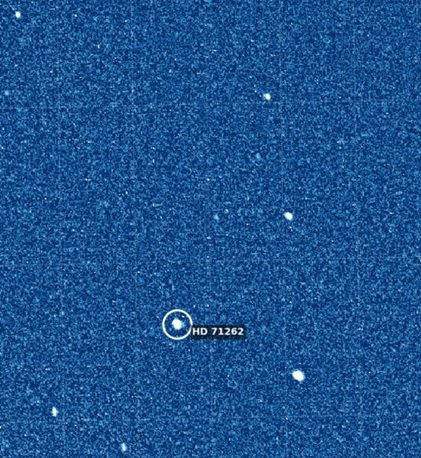
With the first images from the spacecraft now in hand, the team behind NASA’s Star-Planet Activity Research CubeSat, or SPARCS, is ready to begin charting the energetic lives of the galaxy’s most common stars to help answer one of humanity’s most profound questions: Which distant worlds beyond our solar system might be habitable?
Initial, or “first light,” images mark the moment a mission proves its instruments are functioning in space and ready to transition to full science operations. This milestone is especially important for SPARCS, whose observations depend on highly precise ultraviolet (UV) measurements, making the demonstration of the camera’s performance critical to achieving its science goals. The spacecraft launched Jan. 11; the images came down Feb. 6 and were subsequently processed.
Roughly the size of a large cereal box, SPARCS will monitor flares and sunspot activity on low-mass stars — objects only 30% to 70% the mass of the Sun. These stars are among the most common in the Milky Way and host the majority of the galaxy’s roughly 50 billion habitable-zone terrestrial planets, which are rocky worlds close enough to their stars for temperatures that could allow liquid water and potentially support life.
“Seeing SPARCS’ first ultraviolet images from orbit is incredibly exciting. They tell us the spacecraft, the telescope, and the detectors are performing as tested on the ground and we are ready to begin the science we built this mission to do,” says SPARCS Principal Investigator Evgenya Shkolnik, professor of Astrophysics at the School of Earth and Space Exploration at Arizona State University, which leads the mission.
The SPARCS spacecraft is the first dedicated to continuously and simultaneously monitoring the far-ultraviolet and near-ultraviolet radiation from low-mass stars for extended periods. Over its one-year mission, SPARCS will target approximately 20 low-mass stars and observe them over durations of five to 45 days.
Although such stars are small, dim, and cool compared to the Sun, they are also known to flare far more frequently than our solar system’s star. The flares can dramatically affect the atmospheres of the planets they host. Understanding the host star is key to understanding a planet’s habitability.
“I am so excited that we are on the brink of learning about exoplanets’ host stars and the effect of their activities on the planets’ potential habitability,” said Shouleh Nikzad, the lead developer of the SPARCS camera (dubbed SPARCam) and the chief technologist at NASA’s Jet Propulsion Laboratory in Southern California. “I’m doubly excited that we are contributing to this mission with detector and filter technologies we developed at JPL’s Microdevices Laboratory.” Created in 1989, the facility is where inventors harness physics, chemistry, and material science, including quantum, to deliver first-of-their-kind devices and capabilities for the nation.
The filters were made using a technique that improves sensitivity and performance by enabling them to be directly deposited onto the specially developed UV-sensitive “delta-doped” detectors. The approach of detector-integrated filters eliminated the need for a separate filter element, resulting in a system that is among the most sensitive of its kind ever flown in space.
“We took silicon-based detectors — the same technology as in your smartphone camera — and we created a high-sensitivity UV imager. Then we integrated filters into the detector to reject the unwanted light. That is a huge leap forward to doing big science in small packages,” Nikzad said, “and SPARCS serves to demonstrate their long-term performance in space.”
This technology paves the way for future missions like NASA’s next potential UV-capable flagship mission, the Habitable Worlds Observatory mission concept, as well as smaller interim missions, such as the agency’s forthcoming UVEX (UltraViolet EXplorer), which is led by Caltech in Pasadena.
The mission takes advantage of advances in computational processing as well, with an onboard computer that can perform data processing and intelligently adjust the observation parameters to better sample the development of flares as they happen.
“The SPARCS mission brings all of these pieces together — focused science, cutting-edge detectors, and intelligent onboard processing — to deepen our understanding of the stars that most planets in the galaxy call home,” said David Ardila, SPARCS instrument scientist at JPL. “By watching these stars in ultraviolet light in a way we’ve never done before, we’re not just studying flares. These observations will sharpen our picture of stellar environments and help future missions interpret the habitability of distant worlds.”
Funded by NASA and led by Arizona State University, SPARCS is managed under the agency’s Astrophysics Research and Analysis program. The agency’s CubeSat Launch Initiative (CSLI) selected SPARCS in 2022 for a ride to orbit. The initiative is a low-cost pathway for conducting scientific investigations and technology demonstrations in space, enabling students and faculty to gain hands-on experience with flight hardware design, development, and building.
Blue Canyon Technologies fabricated the spacecraft bus.
News Media Contact
Matthew Segal
Jet Propulsion Laboratory, Pasadena, Calif.
818-354-8307
matthew.j.segal@jpl.nasa.gov
Alise Fisher / Karen Fox
NASA Headquarters, Washington
202-358-2546 / 202-385-1287
alise.m.fisher@nasa.gov / karen.c.fox@nasa.gov
Kim Baptista
Arizona State University, School of Earth and Space Exploration
480-727-4662
Kim.Baptista@asu.edu
2026-016