
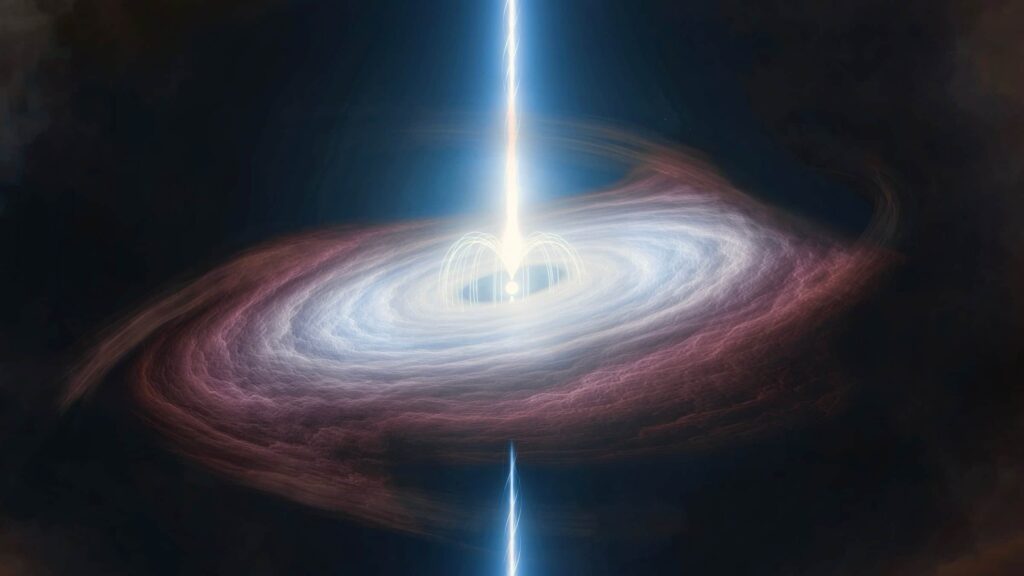
 Artist’s conception of a magnetar surrounded by an accretion disk exhibiting Lense-Thirring precession. Credit: Joseph Farah and Curtis McCully
In December 2024, the ATLAS astronomical survey detected a distant flash of light. It was a supernova, the explosive death of a massive star, located far, far away, roughly a billion light-years away. But when Joseph Farah, a graduate student at Las Cumbres Observatory (LCO) and UC Santa Barbara, looked at the continuous data streaming in, he noticed something highly unusual.
The massive stellar explosion wasn’t just fading smoothly into the dark. It was undulating, flashing with a rhythmic, periodic signal that was rapidly speeding up. If you translated this signal into the acoustic domain, the exploding star was “chirping”.
This erratic behavior triggered a mad dash involving a global network of telescopes to track the event, known as SN 2024afav. The resulting data has finally helped scientists solve a long-standing mystery about some of the brightest explosions in the universe.
It turns out this cosmic chirp provides the first direct evidence that magnetars — highly magnetized, rapidly spinning neutron stars — are at least sometimes behind some of the universe’s brightest events.
The team discovered that as this incredibly dense core spins, its extreme gravity twists the fabric of space-time, causing a surrounding disk of stellar debris to wobble. As this disk wobbles, it periodically intercepts and redirects the intense radiation pouring out from the central magnetar, creating the rhythmic flashes captured by telescopes on Earth. This also marks the first time scientists have needed Einstein’s general theory of relativity to describe the mechanics of a supernova.
A Cosmic Strobe Light
When massive stars run out of fuel, their cores collapse and they die in a spectacular explosion. Over the past two decades, astronomers have cataloged a rare, enigmatic class of these explosions called Type I superluminous supernovae (SLSNe-I). These events are at least ten to a hundred times brighter than your typical supernova.
The power source behind this extreme luminosity has always been hotly debated. Many scientists suspected a magnetar was behind them. As such an ultra-dense neutron star with massive magnetic fields spins, it pumps energy into the expanding supernova debris, making it glow incredibly bright.
However, the standard magnetar model had a glaring flaw. It predicted a smooth decline in brightness after the initial peak. Yet, astronomers frequently observed unexplained bumps or undulations in the light curves of these extreme supernovae.
×
Thank you! One more thing…
Please check your inbox and confirm your subscription.
SN 2024afav, the supernova investigated by the astrophysicists behind the new study, blew this mystery wide open. Unlike past events where astronomers only caught one or two random bumps, SN 2024afav displayed at least four distinct, sinusoidal modulations. Even more shockingly, the time between these flashes shrank rapidly, dropping from about 50 days to roughly 20 days.
If we could somehow translate these light waves into audio, the effect would be striking. “It would sound like a deep hum that gets higher and more urgently pitched,” Farah told ZME Science.
The sheer scale involved for us being able to see this flickering is almost incomprehensible. “The supernova explosion is over 100 billion (100,000,000,000) times brighter than our Sun,” Farah told ZME Science. “While SN 2024afav was exploding, the power output from this single event rivaled that of the entire Milky Way galaxy combined!”
“It’s definitely very difficult to wrap your head around! In order for us to see it at that vast distance, the supernova has to be unbelievably bright — and it is,” Farah added.
Twisting the Fabric of Space-Time
Astronomers have previously blamed the bumps in the light curves of hyper-bright supernovae on the explosion randomly slamming into shells of gas previously shed by the star. However, the flashes in SN 2024afav were too rhythmic and the timing too precise to be caused by accidental collisions with surrounding material. To explain why the signal was so structured and why the frequency was speeding up, researchers had to look at the extreme gravitational environment governed by Einstein’s general relativity.
They realized that when the original star exploded, not all of its material escaped. Instead, a massive amount of debris fell back toward the center, forming a thick, glowing accretion disk around the newborn magnetar.
Because this magnetar is incredibly dense and spinning hundreds of times per second, it actually drags the fabric of space-time around with it as it rotates. If the surrounding disk of gas is tilted, this space-time dragging forces the entire disk to wobble like a spinning top — a relativistic effect known as Lense-Thirring precession.
One way to think about this is like a spinning ball dragging a silk sheet around it.
“The key thing is that the silk sheet closer to the spinning ball gets dragged faster than the sheet farther away,” Farah said, explaining the frame-dragging effect at play. “At infinity, there’s no drag. If you’re very close to the spinning ball, sitting on the sheet, you’ll get dragged around too, even if you’re not trying to move.”
As this disk wobbles, it periodically blocks or reflects the intense radiation pouring out of the magnetar, creating the strobe-light effect we see from Earth.
But why did the flashes speed up? The intense radiation from the magnetar pushes outward against the disk, determining its inner radius. As the supernova slowly fades and the magnetar loses energy, this outward pressure drops. The accretion disk slips closer and closer to the magnetar. Because the relativistic dragging effect is much stronger closer to the star, the disk wobbles faster as it shrinks inward, perfectly explaining the decreasing period between the flashes.
By matching their models to the observed chirp, the team was able to calculate the core’s exact properties. They found the magnetar spins with a period of 4.2 ms and possesses a magnetic field strength of 1.6 × 10^14 G.
Rewriting the History of Exploding Stars
 LCO and UCSB graduate student Joseph Farah will be defending his PhD thesis in May. Credit: Joseph Farah
To capture this phenomenon, the team relied heavily on the LCO global network of robotic telescopes, observing the supernova for over 200 days. Because they recognized the mathematical pattern early on, the researchers dynamically adjusted their telescopes to catch future bumps as they happened.
“When the new bumps started showing up right on schedule, we were stunned. It’s really rare to make predictions in real-time about a brand-new astrophysical phenomenon and have it come true!” Farah said.
This discovery provides the first unambiguous observational evidence of the Lense-Thirring effect operating in the violent environment of a newly born magnetar. It also effectively crowns the magnetar model as the definitive explanation for the extreme brightness of superluminous supernovae.
But what about the dozens of other superluminous supernovae astronomers have observed over the years? Many of those featured one or two unexplained bumps, which scientists previously wrote off as the explosion crashing into random clouds of surrounding gas or experiencing central-engine flares. The team applied their new Lense-Thirring model to legacy data from older supernovae, like SN 2018kyt and SN 2019unb, and found that the wobbling disk theory perfectly explained those older observations too.
Does this mean astronomers have fundamentally misunderstood past observations?
“Possibly one or two!” Farah told ZME Science. “For the other objects, we are only showing that our model is consistent — not necessarily definitively powering them.”
Farah noted that the periodic luminosity mechanism requires a specific set of circumstances — a tilted disk forming and an observer looking from just the right angle — which explains why we haven’t seen many such clear “chirps” so far.
As next-generation facilities like the Vera C. Rubin Observatory in Chile prepare to scan the night sky, astronomers expect to find thousands more of these extreme explosions. Equipped with a new understanding of how dead stars twist the fabric of reality, scientists are finally ready to decode the messages hidden in their flickering light.