
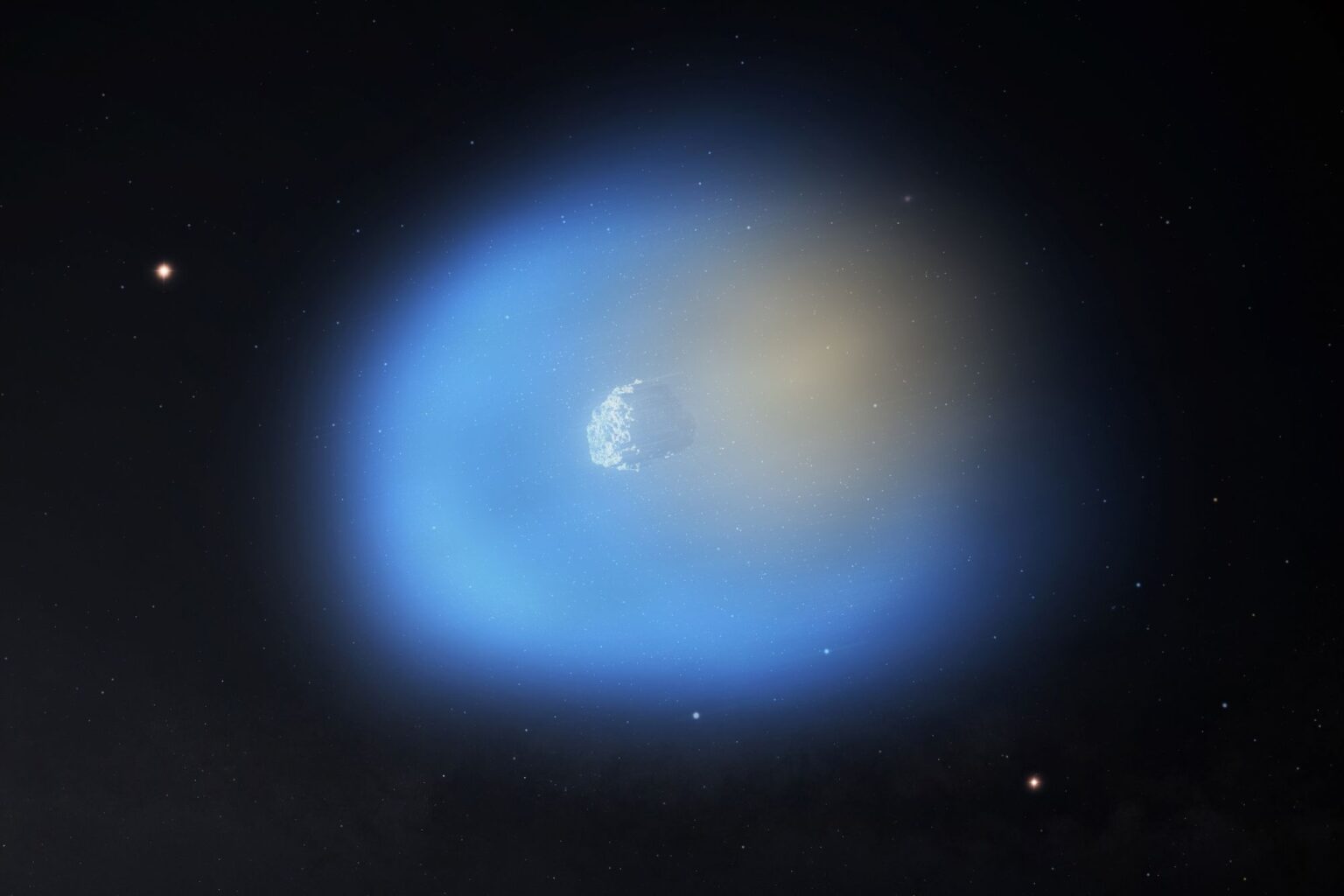
When astronomers first observed comet 3I/ATLAS, they realized it was special. It is just the third confirmed interstellar object to pass through our Solar System, after the enigmatic ‘Oumuamua and the icy Borisov.
But the real thing that makes 3I/ATLAS special is not that it came from somewhere other than Earth; it’s the chemistry it contains, which is, in effect, a chemical sample from another star system.
After decades of observation that helped it become one of the first interstellar objects ever detected, studies showed the complex makeup of this cosmic wanderer, with an appearance that contrasts sharply with that of cometary bodies found nearer to Earth. Infrared observations from the James Webb Space Telescope (JWST) revealed a carbon dioxide-rich coma with an atypically high CO₂/H₂O ratio.
That was a surprising finding: the chemical signature indicated that either it formed close to the CO₂ snowline of its native disk or that it had gotten heavily processed by galactic cosmic rays long before setting off on its interstellar journey.
Growing Tail of Interstellar Comet 3I/ATLAS Captured
Now, a new study using the Atacama Large Millimeter/submillimeter Array (ALMA) has added more intrigue yet. The astronomers found that methanol (CH₃OH) was present at levels higher than expected, compared to hydrogen cyanide (HCN), a chemical normally dominant in comets originating from the Solar System.
Nathan Roth, the lead author of the study and a professor at American University, expressed the excitement: “Viewing 3I/ATLAS is akin to taking an impression of another solar system. The specifics show us what it’s composed of, and it’s gushing with methanol in a way we don’t often see from comets in our own solar system.”
Using its sensitive instruments, ALMA detected several methanol transitions near 338 GHz and 350 GHz, as well as HCN at distances of 2.17 and 2.08 au from the Sun (and those mentioned above for CH3CN). The results were dramatic: methanol-to-HCN ratios of about 70 and 120, which made this comet one of the most methanol-rich comets ever studied.
Such a difference hints at a very different chemical environment where this comet originated. However, the enrichment of methanol may suggest that the icy grains from which 3I/ATLAS formed experienced rare radiation environments or processing distinct from those that have affected materials in our Solar System.
JWST had previously shown that far from the comet, carbon dioxide was dominant in its coma. Now, methanol has joined a list of unusual ingredients, suggesting that this comet formed under conditions of foreign chemistry.
ALMA’s high-resolution imaging did more than quantify the molecules; it mapped their escape into space. HCN behaved as expected, streaming directly from the comet’s nucleus. Methanol, in contrast, was ejected both from the nucleus as well as from icy grains that tended to drift in the coma. These grains function like tiny comets, releasing methanol as sunlight warms them.
Similar processes have been seen in Solar System comets, but this is the first time outgassing has been traced so closely for an interstellar traveler.
Each of those interstellar comets is also a messenger from faraway places, bringing information about the chemistry and physics of planetary systems to be found across the Galaxy. With 3I/ATLAS, astronomers now have proof of a comet that was formed or modified in conditions distinctly different than those around our own object.
This finding highlights the diversity of planetary systems and indicates that our Solar System’s recipe for comets is one rather than a fixed outcome. Each interstellar guest adds to our knowledge of how worlds form, develop, and scatter their frozen leftovers into the cosmos.
As one researcher nicely put it, studying 3I/ATLAS is like popping open a time capsule from another world. With every molecule we detect, we are reconstructing the story of a comet that traveled light-years to reveal its secrets.
Journal Reference:
Nathan X. Roth, Martin A. Cordiner, Dominique Bockelée-Morvan, Nicolas Biver, Jacques Crovisier, Stefanie N. Milam, Emmanuel Lellouch, Pablo Santos-Sanz, Dariusz C. Lis, Chunhua Qi, K. D. Foster, Jérémie Boissier, Kenji Furuya, Raphael Moreno, Steven B. Charnley, Anthony J. Remijan, Yi-Jehng Kuan, and Lillian X. Hart. CH3OH and HCN in Interstellar Comet 3I/ATLAS Mapped with the ALMA Atacama Compact Array: Distinct Outgassing Behaviors and a Remarkably High CH3OH/HCN Production Rate Ratio. The Astrophysical Journal Letters. DOI 10.3847/2041-8213/ae433b