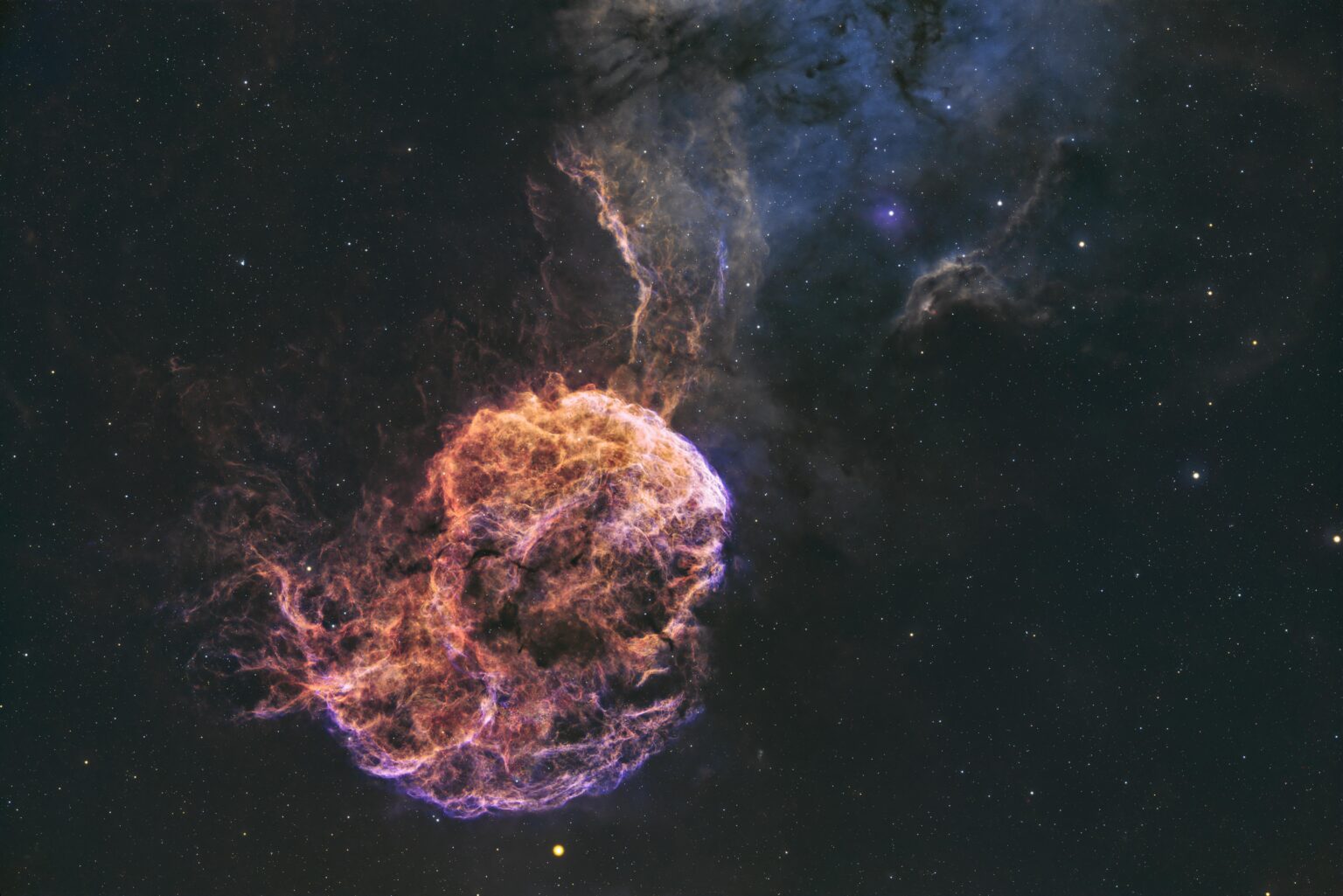
I’ve been working to learn how to process SHO data over the past month. With some much-needed clear weather finally arriving and a highly illuminated Moon, I spent the past week focusing on a single narrowband target: IC 443.
Estimated to be about 30,000 years old and roughly 5,000 light-years away, this supernova remnant was a great target for this time of year since it barely clears my backyard tree line. Also known as the Jellyfish Nebula, IC 443 is the expanding debris field
of a long-ago stellar explosion interacting with surrounding interstellar gas, producing its intricate web of filaments and shock fronts.
The image is presented at the original capture orientation.
Processing
Pixinsight: WBPP, Blux correct only, Graxpert, BlurX nonstellar, NoiseX, and StarX on each channel. RGBcombine SHO, autolinearfit, SCNR, stretch, masks, curves, processed stars, recombined, NoiseX.

1 Comment
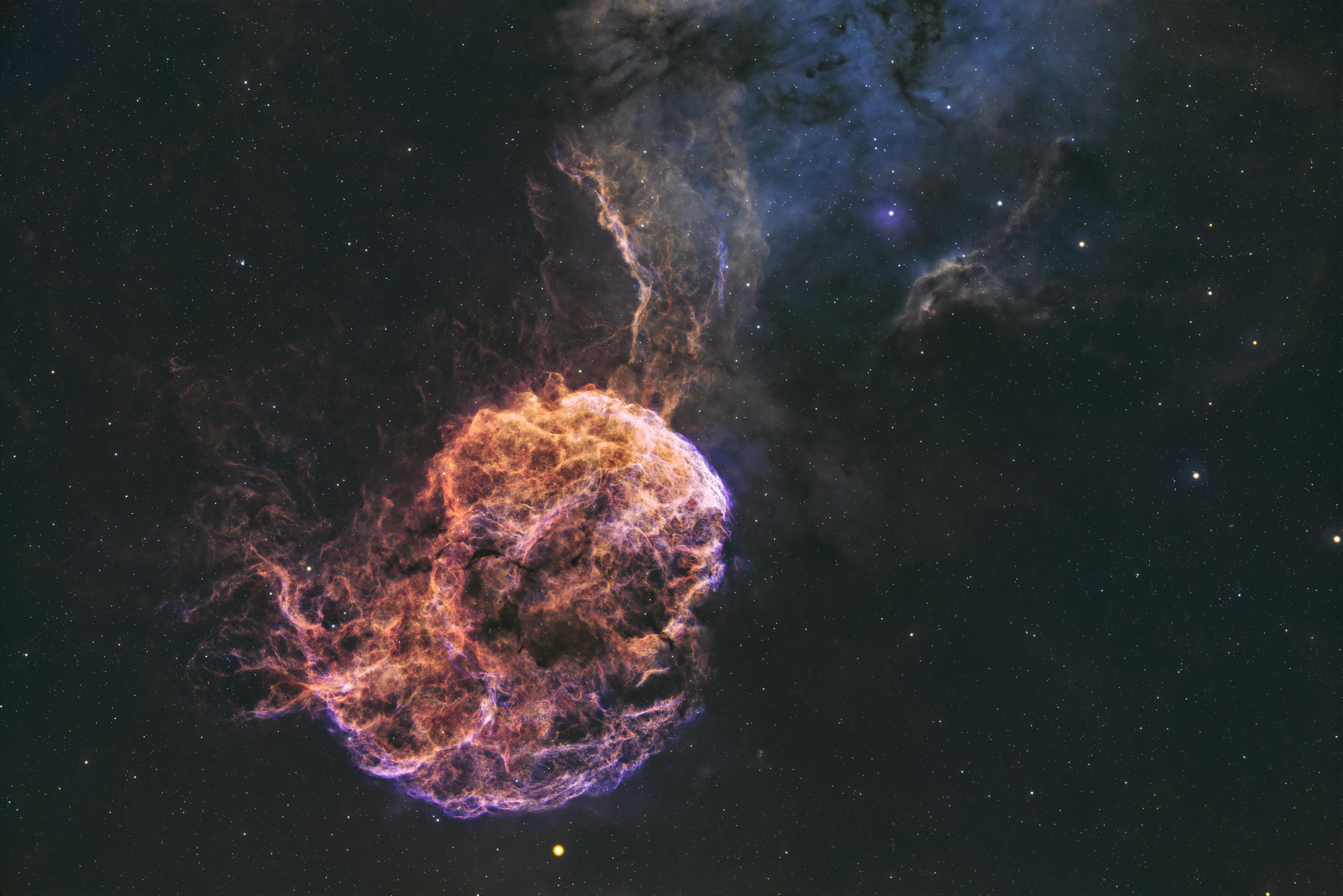
I’ve been working to learn how to process SHO data over the past month. With some much-needed clear weather finally arriving and a highly illuminated Moon, I spent the past week focusing on a single narrowband target: IC 443.
Estimated to be about 30,000 years old and roughly 5,000 light-years away, this supernova remnant was a great target for this time of year since it barely clears my backyard tree line. Also known as the Jellyfish Nebula, IC 443 is the expanding debris field
of a long-ago stellar explosion interacting with surrounding interstellar gas, producing its intricate web of filaments and shock fronts.
The image is presented at the original capture orientation.
Processing
Pixinsight: WBPP, Blux correct only, Graxpert, BlurX nonstellar, NoiseX, and StarX on each channel. RGBcombine SHO, autolinearfit, SCNR, stretch, masks, curves, processed stars, recombined, NoiseX.