
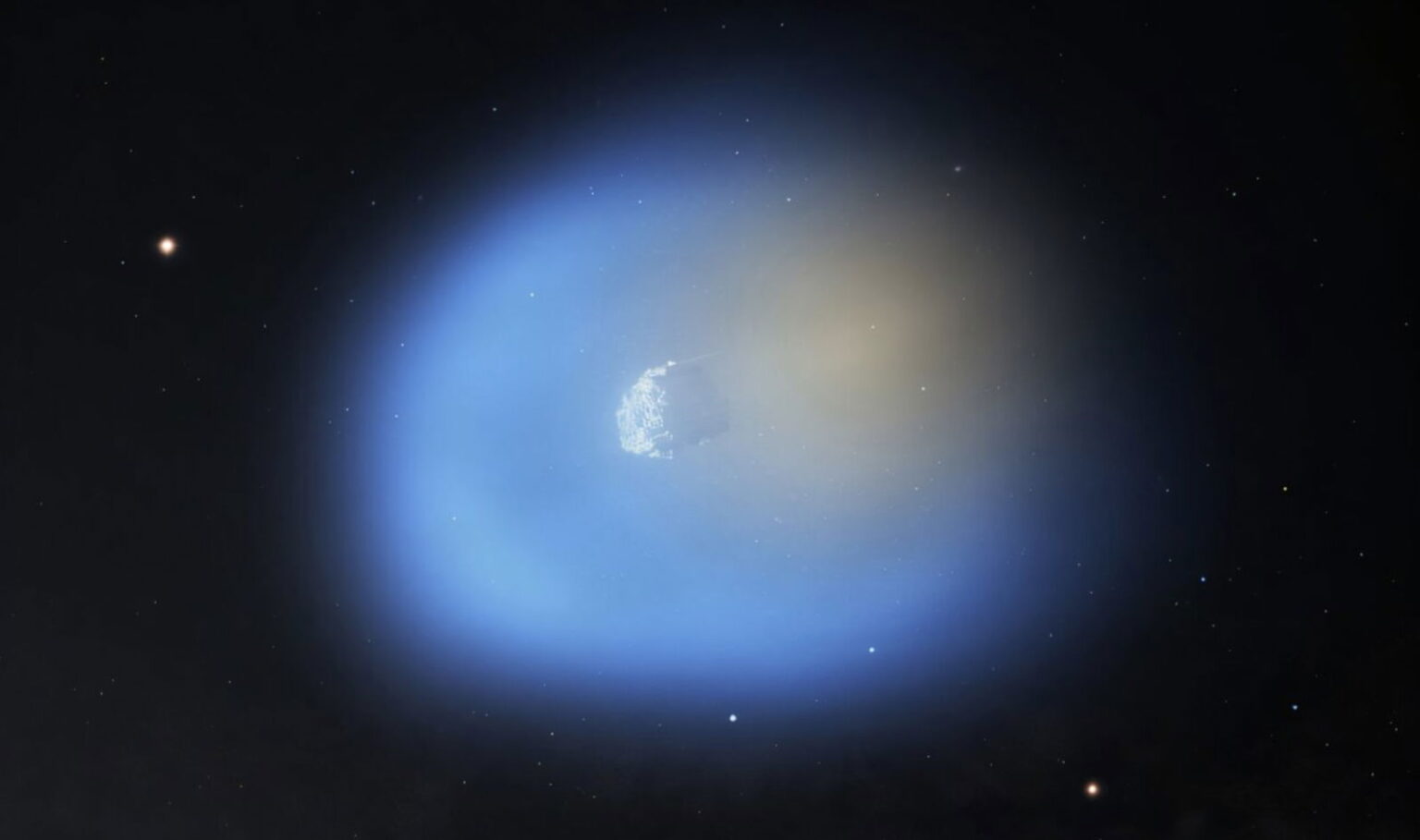
3I/ATLAS, the unusual interstellar comet that continues to fascinate astronomers, appears to be keeping an intoxicating cosmic secret, new research has revealed.
The latest findings come courtesy of the Atacama Large Millimeter/submillimeter Array (ALMA), which has revealed evidence supporting an unusually large amount of methanol, a form of alcohol, hidden away within the ancient icy interstellar wanderer, which was first discovered last summer.
The discovery suggests that 3I/ATLAS may contain more of the organic molecule than any other comet known in our solar system.
Fingerprints of the Distant Cosmos
Nathan Roth, who led the recent research and is the primary author on a new study detailing his team’s findings, compares observing the oddball comet 3I/ATLAS to “taking a fingerprint from another solar system.”
“The details reveal what it’s made of, and it’s bursting with methanol in a way we just don’t usually see in comets in our own solar system,” said Roth, who is presently a professor at American University.
The recent detections were made possible with ALMA’s Atacama Compact Array in Chile, thanks to observations spanning several dates late last year while 3I/ATLAS approached its closest distance from the Sun.
As the comet’s surface grew warmer, gas and dust were released from its surface, which caused its surrounding coma to increase and brighten, forming a halo-like luminous appearance. Based on studies of the comet’s coma, Roth and his colleagues were able to collect information they liken to the chemical “fingerprints” of its material components—offering a rare look at an object that was assembled long ago by cosmic forces in a far-distant planetary system.
An Intoxicating Discovery
The team’s observations produced faint submillimeter fingerprints of the molecule hydrogen cyanide (HCN), which is a nitrogen-bearing organic molecule common in the composition of comets. That isn’t all the team’s observations revealed, however: there was also a surprising abundance of methanol (CH₃OH), a type of alcohol, present in the comet’s coma.
More specifically, ALMA’s observations indicate that the interstellar interloper seems to possess quite a lot of methanol in contrast to the amounts of hydrogen cyanide it carries, which Roth and his colleagues say is far greater than what “native” comets from within our solar system tend to display. Based on separate measurements on multiple dates, the team says that the methanol to hydrogen cyanide ratios they observed were about 70 and 120.
In short, 3I/ATLAS not only has a lot of methanol; it probably has a significant amount more than most other comets.
A Unique Formation Process
What the current evidence suggests is that 3I/ATLAS is very different from comets in our solar system, given that the conditions under which it was made appear to have been so alien compared with those which give rise to comets in our own solar system.
Based on past observations made by NASA’s James Webb Space Telescope, 3I/ATLAS appeared to possess a coma consisting mostly of carbon dioxide while it was still a significant distance from the Sun. The addition of the new ALMA data adds methanol into the mix, and a surprising abundance of it, at least as far as comets are concerned.

Additionally, the high-resolution imaging made possible by ALMA’s sensitive array of telescopes also helped to reveal the movement of molecules escaping from 3I/ATLAS, which pointed to some unique observations involving the differences between how the hydrogen cyanide and methanol molecules behaved during this process. Namely, while the former appears to originate mostly from the core of the comet, the methanol it produces seems to be abundant not only in its nucleus, but also in the ice particles populating its coma.
As 3I/ATLAS neared the sun, these individual ice particles each began to sublimate, effectively functioning like an untold number of miniature comets themselves, releasing their methanol stores in the process. While such processes are known from past observations of comets originating from within our solar system, these phenomena had never been observed in relation to an interstellar object before the historic journey of 3I/ATLAS.
With the discovery of additional confirmed interstellar objects in the years ahead, astronomers hope that observations of their unique behavior and composition can help to unravel many of the existing mysteries associated with distant planetary systems, their origins, and their formation processes.
Roth and his colleagues’ recent paper, “CH3OH and HCN in Interstellar Comet 3I/ATLAS Mapped with the ALMA Atacama Compact Array: Distinct Outgassing Behaviors and a Remarkably High CH3OH/HCN Production Rate Ratio,” was accepted for publication in The Astrophysical Journal Letters.
Micah Hanks is the Editor-in-Chief and Co-Founder of The Debrief. A longtime reporter on science, defense, and technology with a focus on space and astronomy, he can be reached at micah@thedebrief.org. Follow him on X @MicahHanks, and at micahhanks.com.