
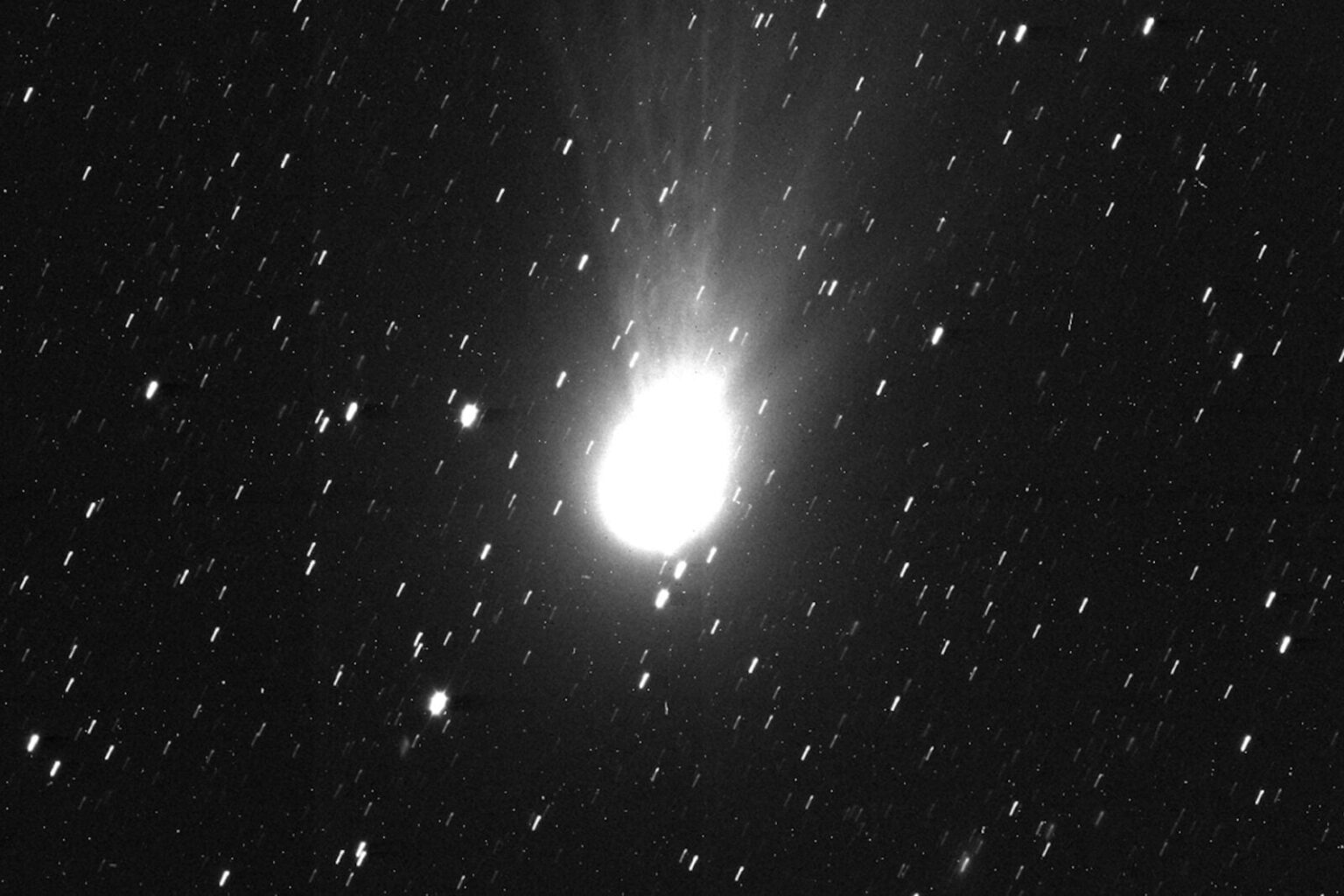
Astronomers studying a rare visitor from another star system have discovered something unexpected. The interstellar comet known as 3I/ATLAS appears to contain unusually large amounts of alcohol. While the finding may sound amusing at first glance, scientists say it could offer valuable clues about how planetary systems form across the galaxy.
3I/ATLAS was first detected in July 2025 by the ATLAS survey telescope in Chile, becoming only the third confirmed interstellar object ever observed passing through our Solar System. Its high speed and hyperbolic orbit revealed that it originated beyond the Sun’s gravitational reach, meaning it formed around another star before drifting into our cosmic neighbourhood.
Recent observations with powerful radio telescopes have revealed that this icy traveller contains unusually high levels of methanol, a simple alcohol commonly found in space. The discovery does not mean the comet contains drinkable alcohol. Instead, it highlights a unique chemical fingerprint that could help scientists better understand the environments in which distant planetary systems are born.
Why Scientists Say The Comet Is ‘Rich In Alcohol’
The alcohol detected in comet 3I/ATLAS is methanol, an organic molecule made of carbon, hydrogen, and oxygen. Astronomers identified it using the Atacama Large Millimetre/submillimetre Array, or ALMA, which can detect the chemical signatures released as cometary ice evaporates under the Sun’s heat. Researchers found that the comet contains an unusually high amount of methanol compared with hydrogen cyanide, another molecule commonly observed in comets. This chemical ratio stands out because it is rarely seen in comets that formed within our own Solar System.
In fact, measurements suggest the comet may be releasing between 70 and 120 times more methanol than hydrogen cyanide. Such levels make it one of the most methanol-rich comets ever detected. For scientists, this unusual chemical composition provides a rare opportunity to examine the building blocks of a planetary system beyond our own. One researcher described observing the comet as similar to taking a chemical fingerprint of another solar system.
Methanol is a particularly interesting molecule because it forms in extremely cold regions of space where icy grains accumulate complex organic compounds. When these grains combine to form comets and planets, they carry those molecules with them. By analysing the gas released from 3I/ATLAS, astronomers are essentially peering into the chemical environment of a distant star system that existed billions of years ago.
What The Discovery Could Reveal
The chemical makeup of interstellar objects like 3I/ATLAS offers scientists a direct glimpse into planetary systems far beyond the reach of telescopes. Because the comet formed around another star, its composition reflects the conditions that existed in that distant system’s protoplanetary disc.
If methanol levels are indeed much higher than those typically found in Solar System comets, it may indicate that the comet’s original star system had a different chemical balance or temperature structure during planet formation. This could mean that planetary systems across the galaxy form under a wider range of conditions than previously thought.
Another intriguing aspect is the connection between methanol and prebiotic chemistry. Methanol and related organic molecules are considered important stepping stones in the formation of more complex compounds that can eventually lead to life. While the discovery does not suggest that life exists on the comet, it supports the idea that organic ingredients for life may be widespread throughout the galaxy.
Scientists also emphasise that the comet poses no danger to Earth. Its orbit keeps it at a safe distance of around 270 million kilometres from our planet as it travels through the Solar System, then returns to interstellar space. Once it leaves the Sun’s gravitational influence, 3I/ATLAS will continue wandering between the stars, carrying its chemical secrets with it. For now, however, astronomers are racing to study it while it remains visible.