
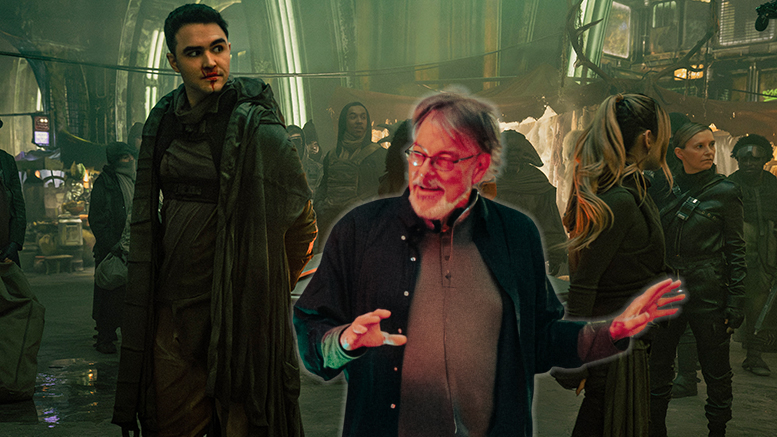
Michael Cassabon previously wrote about his experiences helping the Discovery crew film the scenes at “The Eternal Archive,” known in its non-televised life as the University of Toronto’s Fisher Library, where he worked. Star Trek location manager Melissa Warry-Smith invited Michael back to watch a day of filming at Starfleet Academy: Below is his chronicle of spending the day on the Ukeck set.
Entering the holodeck
The first thing one would notice visiting the set of Starfleet Academy for the filming of episode 109 (“300th Night”) in February 2025 was a prominent sign on the wall outside the soundstage, reading “ENTER HOLODECK” Naturally, it’s printed on a grid that looked straight out of the Next Generation era, letting you know you are in for something special.
Warry-Smith was nice enough to invite me to Pixomondo’s AR wall facility just outside Mississauga, where Starfleet Academy was shooting one of episode 109’s key settings: Ukeck, the shadowy alien market where cadet Caleb Mir finally reunites with his fugitive mother Anisha — one of the season’s most emotionally charged storylines, and the scene at the heart of this episode. Adding to the drama of the event was witnessing Jonathan Frakes at the helm, not knowing at the time this could be his last Star Trek episode as a director.

(Photo courtesy of Michael Cassabon)
Into the shadowy marketplace…
Even with Frakes directing, little of the physical set initially read as familiar Star Trek iconography. There were no Starfleet insignias or polished Federation surfaces; instead, the space was filled with weathered stalls, rough fabrics, smoke effects, unusual (disturbing) food displays, and extras in layered costumes, some hooded, some in full prosthetics. The result was a dense, shadowed marketplace far removed from the franchise’s more familiar institutional settings.
The practical set established the foreground of Ukeck, but the full environment depended on the AR wall surrounding it. Once activated, the LED Volume extended the market outward in real time, adding architecture, depth, and atmosphere beyond the physical footprint of the stage.
For part of the visit, I sat beside Jonathan Frakes in video village, positioned behind the physical wall at the back of the set. On one side were monitors, cables, scaffolding, machinery, and cooling fans. On the other was Ukeck. Frakes moved between the two spaces throughout the shoot, stepping onto the floor to work with Sandro Rosta and Tatiana Maslany, who plays Anisha, then returning to the monitors to review the scene and adjust its rhythm.

Jonathan Frakes and Sandro Rosta (Caleb Mir) on the Ukeck set in the ‘Star Trek: Starfleet Academy’ episode “300th Night” Photo: Jonathan Frakes/Instagram
Combining the Volume with standing set pieces
Also present that day was executive producer/producing director Olatunde Osunsanmi, who would direct the season finale episode being teed up by 109. He explained how the A camera interfaced with the AR wall, with the digital environment shifting in real time to preserve depth and perspective as the lens moved. That synchronization allowed the background to function as part of the filmed space rather than as a static projection.
A separate technical team managed the wall independently of the standard camera and grip crews, maintaining alignment between the digital environment and the practical set. On the monitors, the illusion held without drawing attention to the mechanics behind it.
That production model placed unusual demands on direction. Frakes was shaping not only performance and blocking, but also a tightly integrated system of camera movement, lighting, practical design, and digital extension. The scene depended on those elements functioning together with precision.

L-R: Tatiana Maslany as Anisha and Sandro Rosta as Caleb on the set of season 1, episode 9 of Star Trek: Starfleet Academy streaming on Paramount+. Photo Credit: Michael Gibson/Paramount+
The Volume itself was smaller than it appeared on screen. At roughly 70 feet by 30 feet, the enclosed playing space was about the size of a tennis court. Yet Ukeck appeared substantially larger, with the AR wall extending the market into a wider and deeper environment than the practical set alone could provide.
That sense of scale came from the integration of multiple production layers. Steam and smoke drifted across the floor from off-camera machines, softening the line between foreground and background. Torches and production lights mixed with the illumination from the LED wall. Some signage and environmental details were physical elements on set; others appeared only in the digital background; still others were reserved for post-production. The final effect depended on all three levels working together.
The production also addressed one of virtual production’s most visible technical challenges: the seam where the physical floor meets the digital wall. In Ukeck, vendor tents and foreground structures were positioned to conceal that transition and preserve continuity across the frame. From normal viewing angles, the effect was convincing enough that the set read as a continuous world.

Olatunde Osunsanmi and Michael Cassabon on the Ukeck set of Star Trek: Starfleet Academy episode 109 (Photo courtesy of Michael Cassabon)
Frakes’ last Trek?
For Star Trek viewers, Frakes’s role in this setting was especially apt. Riker figured prominently in several of The Next Generation’s best-known holodeck stories; here, Frakes was directing inside a production environment built around a real-world analogue of that concept.
Near the end of the visit, I gave Frakes a small gift: a 3D-printed replica of the Betazoid library card from Discovery’s “Labyrinths.” He asked whether I knew what any of the Betazoid writing meant. I told him I knew only one word: imzadi. He laughed and said, “Yeah, me too.”
Whether or not this proves to be Frakes’s final Star Trek episode as a director, the set offered a clear view of what has made him so effective. He moved easily between performance, technology, and tone, guiding a scene that depended as much on coordination across departments as on the actors at its center. On a stage built to merge physical and virtual worlds, that range was fully on display.

Michael Cassabon with Jonathan Frakes on the set of Star Trek: Starfleet Academy episode 109 (Photo courtesy of Michael Cassabon)
Bonus video
Here is a clip of some of what was shot on the Ukeck set.
Pixomondo’s AR wall set in Toronto has been used before in Trek, by both Discovery and Strange New Worlds. The set has evolved over the years, but this inside look from 2022 features an industry panel where Pixomondo showed off the tech they were using for SNW.
Keep up with news about the Star Trek Universe at TrekMovie.com.