
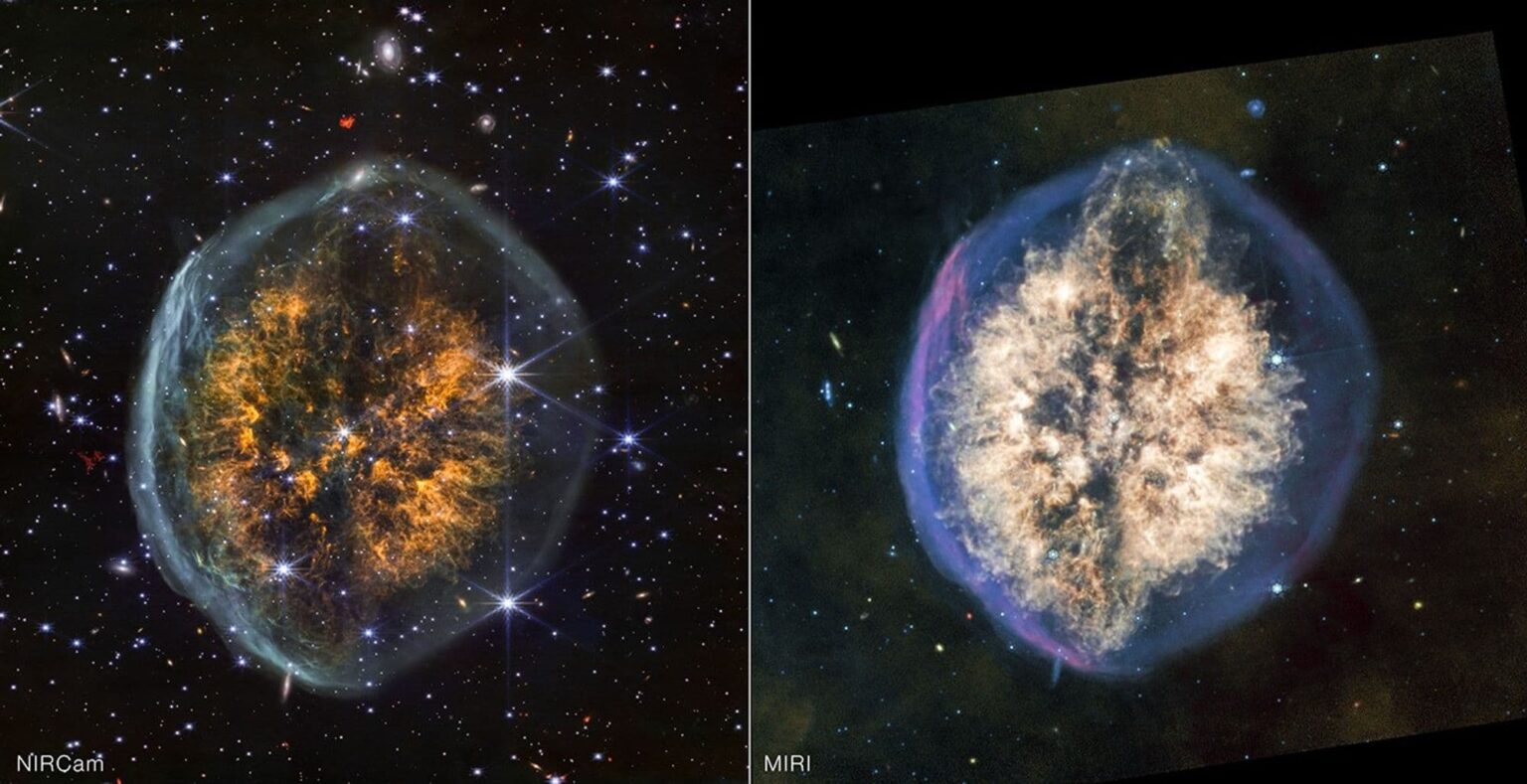
 Image credits: NASA / JPL.
The universe has a dark sense of humor. Five thousand light-years away, in the constellation Vela, a star is dying in the most cinematic way. It’s almost like it’s stripping its flesh, flinging its outer layers into the void to create a glowing curiosity. To the human eye (which tends to see patterns in random things), it almost looks like a brain seen through a transparent skull.
Astronomers officially call it Nebula PMR 1, but they’ve nicknamed it the “Exposed Cranium.” New images from the James Webb Space Telescope (JWST) have just dropped, showing this nebula in more detail than ever before.
Two Views of the Same Nebula
A nebula (Latin for “cloud” or “fog”) is a vast, interstellar cloud of dust, hydrogen, helium, and other ionized gases. Nebulas are the birthplaces for new stars and the remnants of dying stars, such as supernovae or planetary nebulae.
The Exposed Cranium Nebula (PMR 1) is a planetary nebula. Despite its name, it’s not a planet at all. Rather, it is the expanding, glowing shell of ionized gas ejected from red giant stars late in their lives. As a star similar to our Sun reaches the end of its fuel-burning life, it begins to “exhale” its outer layers of gas and dust into space, creating a series of concentric shells.
The Exposed Cranium nebula lies deep in the constellation Vela, which was mentioned by 2nd-century astronomer Ptolemy and described in 1603 by German cartographer Johann Bayer. But the cranium nebula required state-of-the-art technology to reveal its secrets.
The James Webb Space Telescope (JWST) imaged it using both near-infrared and mid-infrared light. The NIRCam (near-infrared) instrument is energetic enough to pierce through much of the gas, revealing the “skeleton” of the nebula, including the background galaxies, the precise location of the central star, and the delicate outer hydrogen shell. Meanwhile, the Mid-Infrared (MIRI) shows the “guts” of the system: the dense, complex structures where the star is currently ejecting its heavier elements.
Both cameras, however, show a sharp, dark lane cutting vertically through the center of the nebula. Astronomers believe this gap is carved by twin jets of gas blasting out from the central star in opposite directions. As the star’s nuclear furnace runs dry, it coughs up its guts in violent, rhythmic outbursts, pushing inner gas outward and sculpting the “lobes” of the nebula.
What’s Going To Happen To It?
The big question hanging over PMR 1 is: How does the story end? This question boils down to the mass of the star, which we don’t know yet.
×
Thank you! One more thing…
Please check your inbox and confirm your subscription.
If the star is a heavyweight (at least eight times more massive than our Sun), it will collapse under its own gravity and explode as a supernova. This is the ultimate “reset” button through which the universe creates heavy chemical elements like gold, silver, or uranium, and spreads them around.
If the star is a middleweight, like our Sun, it has a much lonelier retirement planned. It will continue to puff away its layers until nothing is left but the hot, exposed heart of the star, becoming what is called a white dwarf.
White dwarfs are extremely bizarre in their own way. They concentrate a mass greater than that of the Sun into a ball the size of the Earth. A single teaspoon of white dwarf material would weigh as much as a heavy-duty pickup truck. But white dwarfs don’t burn fuel anymore, they just glow from the leftover heat of its former life. Over trillions of years, it will cool down until it becomes a “black dwarf”: a cold, dark cinder. Interestingly, the universe is actually too young for any black dwarfs to exist yet.
By studying PMR 1, we can better understand how our own solar system will evolve. Every detail Webb captures tells us more about the recycling program of the cosmos. Stars die so that their atoms can be flung into space, where they will eventually settle into new clouds, form new stars, and perhaps, new people.