
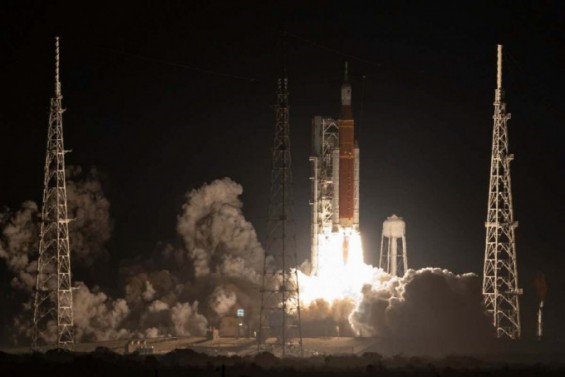
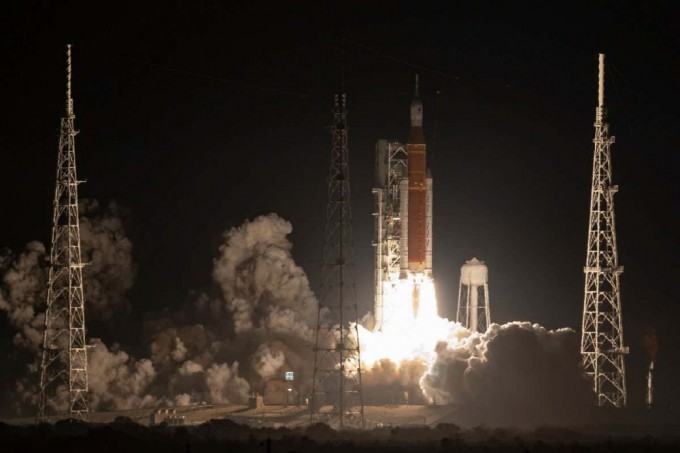
NASA’s manned lunar exploration mission ‘Artemis II’, whose launch has been postponed to April, is set to head to the Moon after 54 years. Carrying four astronauts, Artemis II will orbit the Moon before returning to Earth.
Artemis II is a historic mission to test the feasibility of long-term human habitation in deep space by comprehensively verifying the health of its astronauts. Amid intensifying competition for space dominance, experts anticipate that the international race to the Moon will heat up, emphasizing the need for South Korea to establish a proactive strategy to secure leadership in space technology.

● Verifying Survival in the Space Environment is the Top Priority
The astronauts aboard the ‘Orion’ crew capsule, part of the Artemis II mission, will carry ‘organ-on-a-chip’ devices called AVATAR to directly measure the effects of the space environment on the human body. AVATAR is a USB-memory-sized chip created from an astronaut’s bone marrow cells. It will record changes in the body exposed to microgravity and radiation during the ten-day space journey. This will serve as essential medical data for future long-term stays on the Moon and manned missions to Mars.
The most critical mission of Artemis II is to comprehensively verify the health of the astronauts. They will undergo regular check-ups of their cardiovascular system, muscles, gut microbiome, and eye and brain health from six months before the flight to one month after their return. During the flight, they will also be monitored for motion sickness in the microgravity environment.
A key focus is measuring exposure to deep space radiation. The Orion capsule is equipped with six radiation sensors, and astronauts will also carry radiation detectors in their suit pockets. South Korea’s cubesat, ‘K-RadCube,’ which will be carried on Artemis II, will focus on the Van Allen belts, where radiation particles are concentrated, to accurately assess the radiation exposure astronauts will face during lunar exploration. The collected data will be used to design radiation-shielded spaces for future lunar base construction.
The mission will also include tests of the immune system using ex vivo secretions like saliva. Astronauts will collect and dry saliva samples before, during, and after the flight. NASA researchers will analyze the saliva components to track changes in the immune system and study whether viruses that are dormant on Earth become reactivated in the space environment, and by what mechanism. This immune system research is crucial for developing strategies to prevent infectious diseases during long-term lunar habitation.
Kim Kyu-sung, director of the Institute of Aerospace and Medical Sciences at Inha University, stated, “No matter how much we simulate on the ground, it’s different from the actual space environment, so direct verification is necessary.” He added, “The data collected by Artemis II will form the foundation for all future long-term deep space habitation plans.”
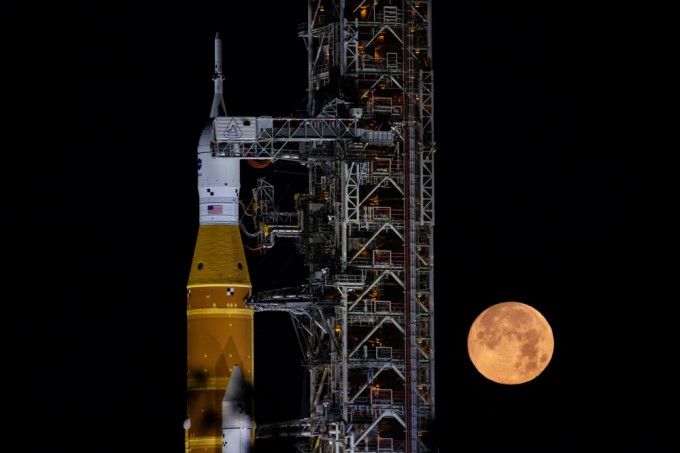
● The Starting Gun Has Fired on the Lunar Exploration Race: What’s Next for South Korea?
Experts predict that the human race to the Moon will reignite with the Artemis II mission. Countries around the world, including China, Russia, and India, are planning their own lunar explorations. The fundamental reason for this competition is considered to be space resources. “The next field of competition after oil and semiconductors will be over space resources, including the Moon,” said Kim Sung-soo, a professor of space science at Kyung Hee University.
Several countries have already presented realistic roadmaps. The United States, through the Artemis program, plans a manned lunar landing by 2028 and a lunar base in the 2030s. China is also pursuing a manned lunar landing by 2030 and the construction of an International Lunar Research Station (ILRS) by 2035 through its Chang’e program. India has already succeeded in landing near the lunar south pole in 2023, and Japan is preparing to send a pressurized manned rover to the Moon in 2031. NASA previously highlighted the importance of lunar resources in 2015, stating they are “worth hundreds of billions of dollars, including water, helium-3, and rare earth elements.”
South Korea’s strategy is ‘international cooperation.’ The Danuri lunar orbiter, successfully launched in 2022, was equipped with the NASA-developed ShadowCam, and the country is actively pursuing international collaboration by including its K-RadCube cubesat on Artemis II. “South Korea has technological strengths in energy, communications, and construction,” said Professor Kim Sung-soo. “If we leverage these strengths in the lunar industry, we can be sufficiently competitive in the space economy.”
As the Moon is redefined from an object of exploration to an industrial base and a gateway to Mars, experts emphasize that South Korea must secure technological leadership. This means moving beyond being a mere follower or supporter to securing its own independent technologies.
Ryu Dong-young, head of the Lunar Lander Program at the Korea AeroSpace Administration (KASA), stressed, “We must strategically invest so that South Korea’s technological strengths can also be utilized in space.” He added, “The success of Artemis II will be a touchstone for gauging South Korea’s competitiveness in space.”
Copyright ⓒ DongA Science. All rights reserved.