
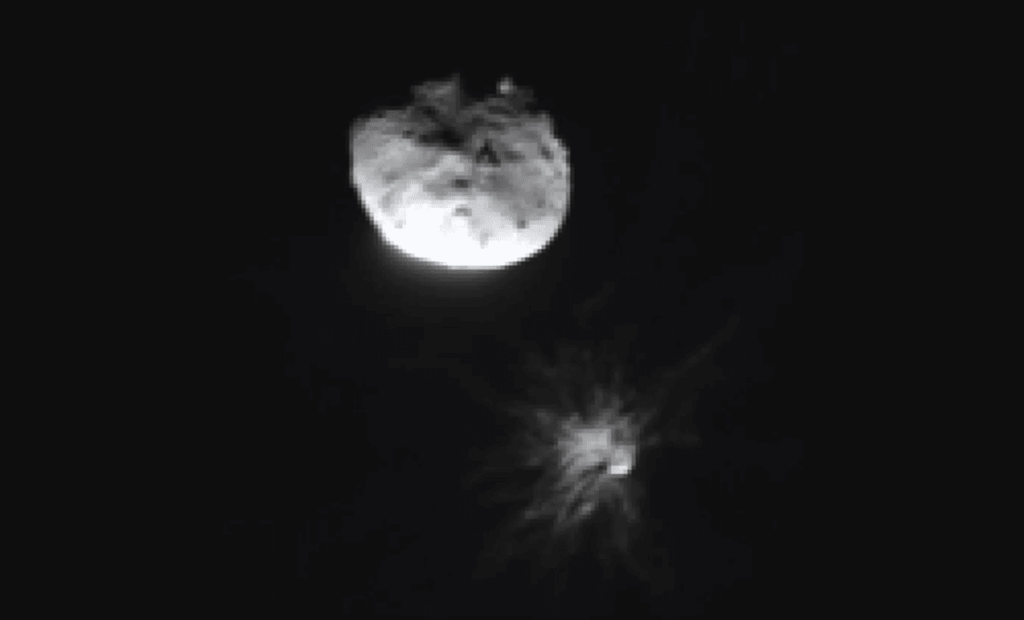
In a pioneering achievement for planetary defense, NASA’s DART (Double Asteroid Redirection Test) mission has proven its capability to alter the orbit of a celestial body. A new study published in Science Advances reveals that not only did the DART spacecraft successfully redirect the moonlet Dimorphos in September 2022, but it also shifted the orbit of both Dimorphos and its larger companion, Didymos, around the Sun. This accomplishment marks the first time a human-made object has measurably impacted the orbit of an asteroid system in space, showcasing the potential of kinetic impact as a tool for defending Earth against future asteroid threats.
Small Change, Big Impact: The Power of Tiny Orbital Adjustments
The DART mission involved a dramatic collision between the spacecraft and Dimorphos, the smaller of two asteroids in a binary system. The goal of the mission was to demonstrate whether a spacecraft could redirect an asteroid, a technique known as a kinetic impact. Following the impact, scientists observed that Dimorphos’ orbit around Didymos had shortened by 33 minutes, a significant change considering its 12-hour orbital period. However, new research revealed an even more groundbreaking discovery: the collision also affected the asteroids’ orbital period around the Sun.
As Thomas Statler, lead scientist for solar system small bodies at NASA, emphasized,
“This is a tiny change to the orbit, but given enough time, even a tiny change can grow to a significant deflection.”
While the change in the orbital speed of the binary system is minuscule, just 0.15 seconds, it represents a milestone in space exploration. Over time, these small changes could accumulate, making a profound impact on an asteroid’s path and potentially preventing a collision with Earth in the future.
The study in Science Advances further validates the effectiveness of kinetic impactors, spacecraft designed to strike asteroids, in planetary defense. If a hazardous asteroid were detected far enough in advance, this technique could be used to deflect it from a collision course with Earth. This discovery positions NASA’s DART mission as a critical step in developing future methods to protect our planet from asteroid impacts.
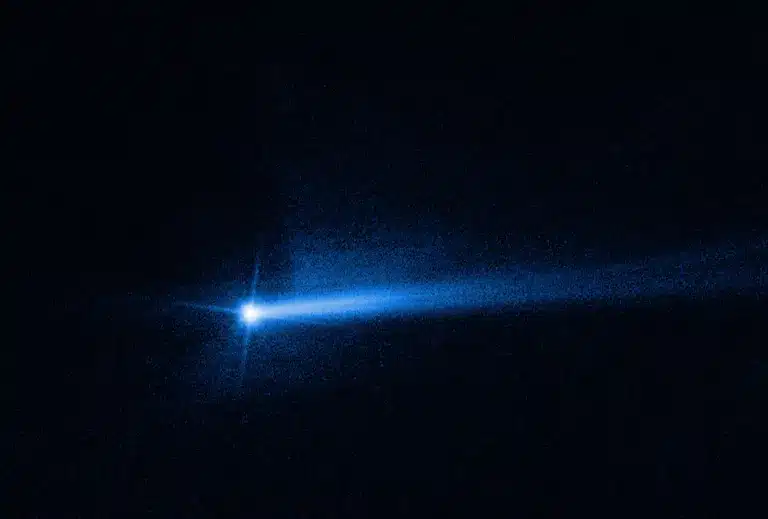 The Hubble Space Telescope observed two tails of dust ejected from the Didymos-Dimorphos asteroid system several days after NASA’s DART spacecraft impacted the smaller asteroid.
NASA, ESA, Jian-Yang Li (PSI), Joe Depasquale (STScI)
The Role of Stellar Occultations in Measuring Orbital Changes
One of the key methods scientists used to measure the effect of DART’s impact on the Didymos-Dimorphos system was stellar occultations. This technique occurs when an asteroid passes in front of a distant star, causing the star’s light to momentarily fade. By precisely timing when the star’s light disappears and reappears, astronomers can determine the asteroid’s speed, position, and even its shape.
Tracking these occultations required extraordinary precision, with observers stationed around the world to capture this fleeting event. The research team relied on volunteer astronomers who, between October 2022 and March 2025, recorded 22 stellar occultations. Their dedicated efforts, combined with other ground-based observations, provided the data necessary to confirm the changes in the binary system’s orbit. These precise measurements were crucial for understanding how the DART mission had altered the asteroid’s trajectory around the Sun.
The Momentum Enhancement Factor: A Critical Discovery
When DART collided with Dimorphos, the spacecraft released a massive cloud of debris, which altered the shape of the asteroid and imparted additional momentum to it. This phenomenon, known as the momentum enhancement factor, was a crucial aspect of the mission’s success. More debris meant more force, amplifying the impact and allowing the spacecraft to move Dimorphos more effectively.
According to the study, the momentum enhancement factor for DART’s impact was about two, meaning the debris ejected from Dimorphos doubled the effectiveness of the spacecraft’s collision. This discovery has important implications for future planetary defense strategies, as it shows that not only the spacecraft but also the debris generated by an impact can play a significant role in altering an asteroid’s motion.
Deflecting Hazardous Asteroids: The Long-Term Implications of DART’s Success
While the DART mission’s success is a significant achievement, the true value lies in its long-term potential for planetary defense. As Rahil Makadia, the lead author of the study, noted, “The change in the binary system’s orbital speed was about 11.7 microns per second, or 1.7 inches per hour.” Though this change may seem insignificant at first, even the smallest adjustments can make a major difference over time. For example, a small deflection could prevent an asteroid from colliding with Earth, as its trajectory slowly shifts over the course of many years.
The DART mission demonstrates that planetary defense doesn’t necessarily require drastic, large-scale interventions. Even minor adjustments to an asteroid’s orbit, if detected early enough, can have significant effects in preventing future impacts. The success of this mission shows that humanity has the potential to protect itself from one of the most dangerous natural threats.