
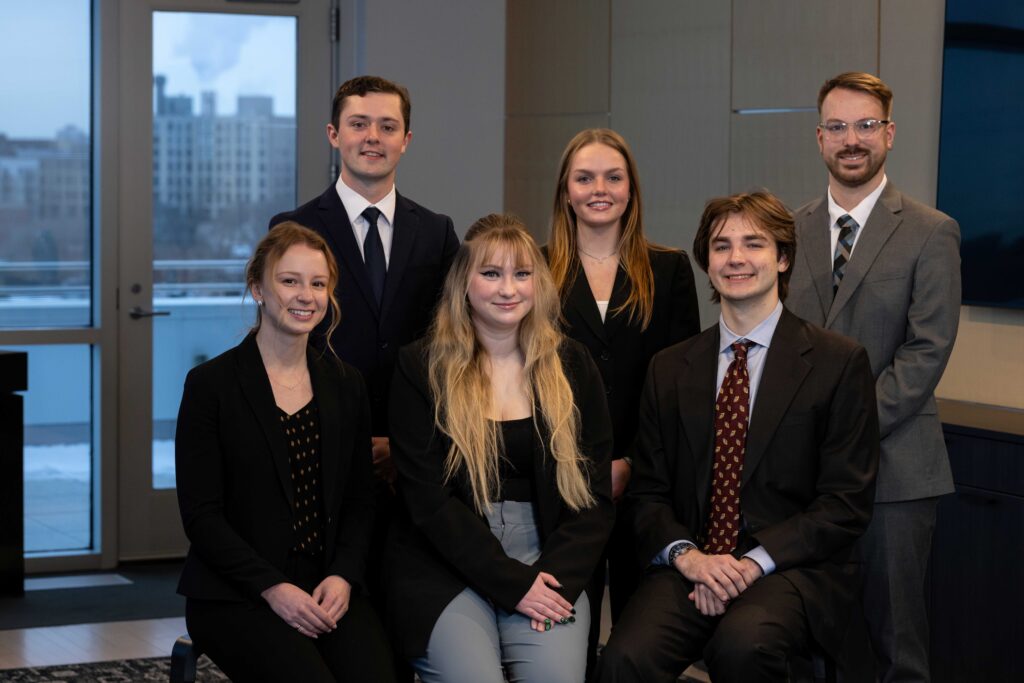
Five students from the College of Saint Benedict and Saint John’s University presented their commercialization recommendations for a NASA biomedical technology innovation to NASA technology transfer officers on Feb. 24 in Minneapolis, marking the culmination of their work in the 2025-26 Innovation Scholars program.
The following CSB and SJU seniors represented the team:
Madisen Carter from Billings, Montana (chemistry and biology major)
Tatum Leibke from Lino Lakes, Minnesota (biology, pre-med major; Hispanic studies minor)
Ben Reddan from Chaska, Minnesota (biology, pre-med major; psychology minor)
Wyatt Robertson from St. Paul, Minnesota (global business leadership major; pre art auctioneering, global languages and culture and English writing minor)
Wyatt Schaeffer from Clearwater, Minnesota (biology major; chemistry minor)
Working at the intersection of science, health care and entrepreneurship, the multidisciplinary team of five CSB+SJU students spent four months tackling a challenging NASA-developed biomedical tech transfer project in which they analyzed the commercialization potential of a portable unit for metabolic analysis (PUMA) designed to detect hypoxia to ensure health and safety of astronauts, pilots, divers, miners and first responders.
Led by University of St. Thomas MBA student Melissa Rose, the team completed extensive research, developed recommendations, prepared its final report and polished its final presentation for NASA technology transfer officers.
Innovation Scholars is a nationally recognized experiential learning program that engages teams of liberal arts students in the complex processes of translational medicine, taking an idea “from the bench to the bedside.”
Project sponsors include Mayo Clinic, early-stage biomedical and health care companies, and NASA.
The Innovation Scholars program (formerly known as Mayo Innovation Scholars) is celebrating its 20th anniversary in 2026. CSB+SJU have 79 alums who have participated on multidisciplinary IS teams since 2006.
Support and praise from advisors
CSB and SJU faculty members Clark Cotton, associate professor of biology; Lauri Miller, visiting assistant professor of accounting and finance; and Jennifer Schaefer, professor of biology and interim dean of faculty, served as project mentors. Trisa Schaeffer, senior associate director in the Office of Undergraduate Research and Scholars at CSB and SJU, provided administrative support.
“I was extremely impressed by our team’s success with this year’s Innovation Scholars project involving patented NASA technology,” Rose said. “The students navigated significant ambiguity and collaboratively transformed a highly complex, innovative technology into a feasible and distinctive market application – all within just a few months.
“What stood out most to me was not only each student’s individual growth, but the strength of their teamwork. Throughout the project, they consistently leveraged one another’s strengths, supported each other through challenges, and demonstrated a level of cohesion and shared leadership that truly elevated their work. I am certain that the skills, collaboration and confidence they developed will translate into successful and fulfilling careers,” Rose added.
“Thanks to the Innovation Scholars program, students grow not only in knowledge but in confidence, discovering their voice as thinkers, problem-solvers and emerging professionals as they work through ambiguous, interdisciplinary, real-world obstacles,” Schaeffer said.
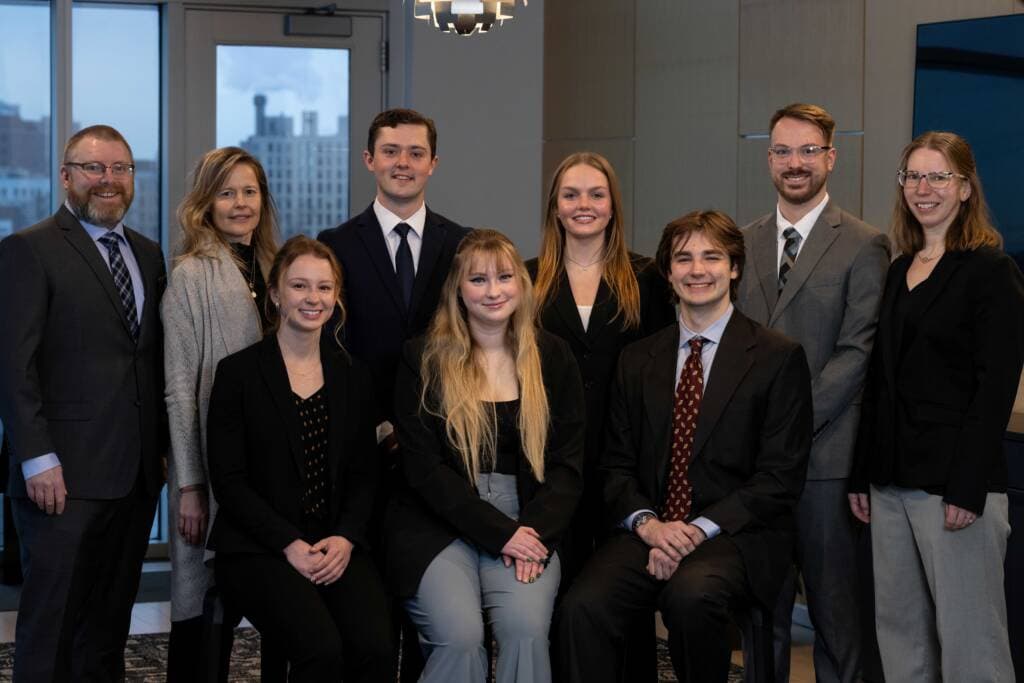 Back Row (L to R): Clark Cotton, Lauri Miller, Ben Reddan, Tatum Leibke, Wyatt Schaeffer, Trisa Schaeffer
Front Row (L to R): Melissa Rose, Madisen Carter, Wyatt Robertson
Student reflections on Innovation Scholars Program
Madisen Carter: “Although the program has not necessarily influenced my career goals, it has given me a greater appreciation of what other aspects of the medical field are important, especially if a device can be life-changing for an individual. On the academic side, this project felt very similar to a capstone as it was a culmination of learning and working together to create a product that we were proud of. It allowed us to have creative freedom through innovation, as well as through how we were going to present the topic to others. It also allowed us to showcase our disciplines in a different way and allowed us to learn something we were not as comfortable with. That’s all to say that it, academically speaking, was a project that allowed us to directly apply and show off our knowledge. Overall, I would say that this project helped me cultivate a lot of soft skills. For example, it improved my ability to collaborate with others in a long-term sense, especially with having different knowledge bases from each other. It also allowed me to develop more technical skills, such as making an effective presentation and report.”
Tatum Leibke: “Innovation Scholars allowed me to explore a new realm of research beyond my typical scope of biology. I got to participate in real-world ideation, innovation and technology transfer, opening my eyes to a whole new side of science and health care by engaging in the intersection of business and science firsthand through technological research. Without any specific deliverables, I learned to be comfortable in ambiguity. Our team effectively collaborated to create a commercialization plan for our given technology, ultimately developing a meaningful product idea and successfully presenting it to our NASA contacts. This experience was incredibly meaningful in engaging in the innovation process that allows for technological advancement in the medical field today and I am so grateful I got the opportunity to work alongside my peers, our phenomenal graduate team-leader and NASA tech transfer officers.”
Ben Reddan: “The Innovation Scholars program provided me with valuable, real-life experience in working with a diversified team. It has pushed me to get involved in tasks that embrace creativity and ambiguity, while also providing me with great exposure to fields like medicine and medical devices. There have been so many things I have learned from this project, but I think the one that sticks out to me is the importance of communication between team members. Not only does it encourage the group to grow closer together, but also allows for different perspectives and new ideas to be shared in an effective manner.”
Wyatt Robertson: “Working with the Innovation Scholars program has granted me the opportunity to explore and grow beyond my degree, emphasizing the scope of what a business or STEM degree can entail and how these degrees work in conjunction when put in a team setting. The cohesion within the Innovation Scholars team provided an incredibly unique group opportunity to leverage our learned experiences across our time at CSB+SJU.”
Wyatt Schaeffer: “This program has potentially changed the trajectory of my academics and my career. Because of this experience, I am looking to get into tech transfer and, in a few years, potentially get an MBA. This will hopefully allow me to do what we did in Innovation Scholars as a full-time career. This program taught me to be uncomfortable with ambiguity and the unknown. I also learned about the cross-section of science and business, especially on the business side. Before this program, I had no experience with business and finance, and I learned a lot about these fields. These experiences led me to learn more about myself and the type of career I want to pursue.”