
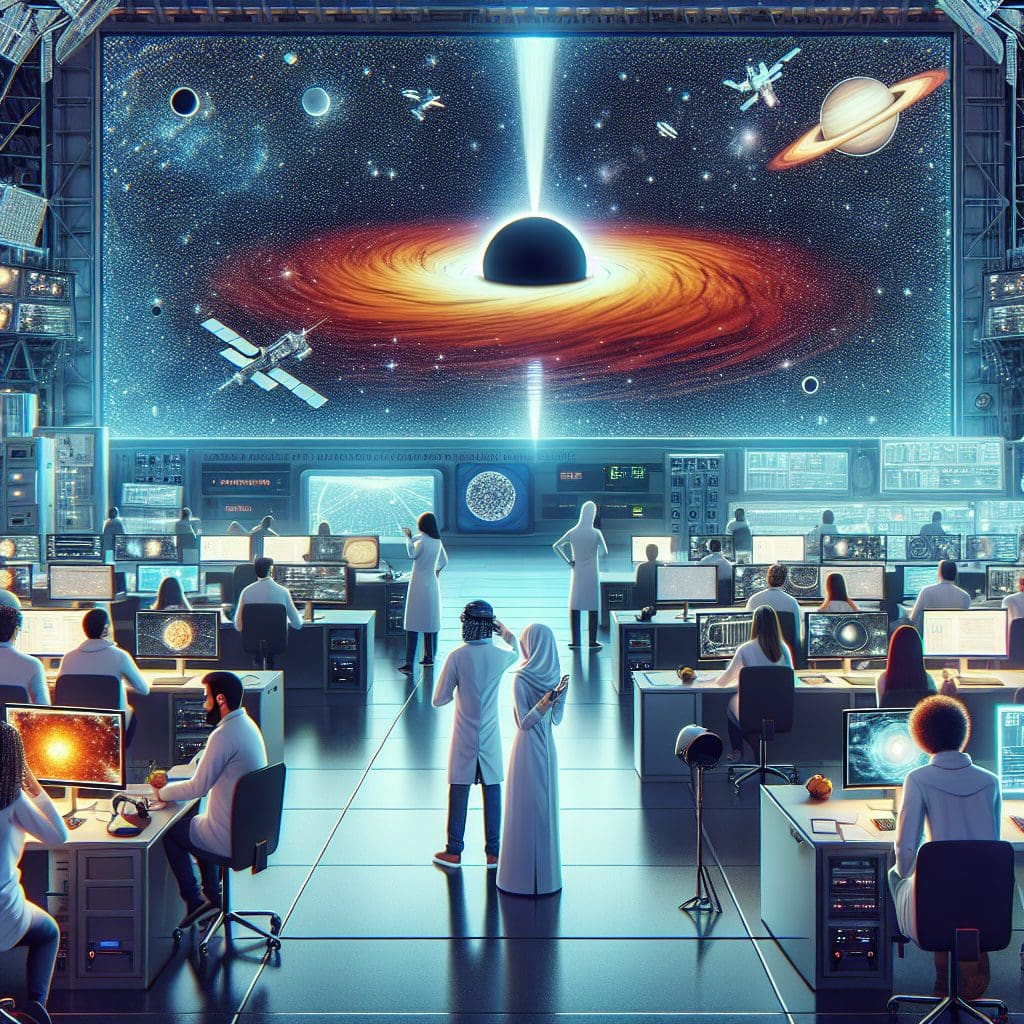
Headline: Astronomers Capture Historic Black Hole Video 2023
In a groundbreaking achievement for astrophysics, a team of astronomers has successfully captured the first-ever video footage of a black hole, marking a monumental leap in our understanding of these enigmatic cosmic giants. This monumental event took place on July 18, 2023, at the Event Horizon Telescope (EHT) collaboration’s headquarters in Cambridge, Massachusetts. The video showcases the swirling accretion disk of a supermassive black hole located at the center of the Messier 87 (M87) galaxy, providing unprecedented insights into the dynamics and behavior surrounding black holes. By delving into this black hole’s intricate movements, scientists hope to unravel some of the universe’s most enduring mysteries.
A New Era in Astronomy
The significance of this achievement cannot be overstated. While astronomers have previously captured stunning images of black holes, the ability to record live action transforms our comprehension of these celestial phenomena. The video emphasizes the dynamic processes occurring around black holes, illustrating how matter interacts with their immense gravitational fields. By harnessing a network of radio telescopes around the world, researchers were able to synchronize their observations and capture this groundbreaking footage, bringing theoretical concepts into vivid reality.
Evolution of Black Hole Observation
Historically, the study of black holes has been a challenging endeavor. Einstein’s theory of general relativity predicted their existence, yet capturing definitive evidence remained elusive. The first direct image of a black hole, released in 2019, marked a crucial step forward. However, the newly captured video takes this discovery further, allowing scientists to observe real-time fluctuations and behavior surrounding these celestial phenomena.
– Advertisement –
The team’s leader, Dr. Laura Jones, expressed her excitement regarding the breakthrough. “This is not just an image; it’s a dynamic representation of a process that has puzzled scientists for decades. We can now witness how gas and debris orbit the black hole, illustrating the chaotic interplay of gravitational forces.”
Implications for Future Research
The implications of this development are vast. The video offers valuable data that can refine black hole models, contributing to better predictions in astrophysics. It opens doors for exploring questions about dark matter, gravity, and the formation of galaxies. Researchers now have a new way of documenting black hole behavior that could significantly enhance our understanding of not just black holes, but also the broader dynamics of the universe.
Dr. Emily Carter, an astrophysicist not involved in the study, emphasized the importance of these findings. “Being able to see an accretion disk in action allows us to study the physics of black holes in unprecedented detail. We can now focus on the interactions that occur and how they contribute to the growth of the black hole itself.”
How the Video Was Captured
The technical logistics behind recording the black hole were as complex as the phenomenon itself. The Event Horizon Telescope used a technique called Very Long Baseline Interferometry (VLBI), which combines observations from multiple radio telescopes around the globe. This method enables the telescopes to work in unison, effectively creating a planet-sized observational array. By capturing electromagnetic wavelengths in different parts of the spectrum, astronomers compiled and synthesized the data into a high-definition visual representation.
The synchronization of multiple telescopes, some spanning thousands of miles, was not an easy task. Continuous data acquisition took place for a series of weeks to ensure accurate representation, with careful calibration hardwired into every step of the process.
Fascination with Black Holes
Public interest in black holes has surged since the first image was released in 2019. The new video is likely to amplify this fascination. Black holes, often dramatized in popular culture, have intrigued humanity for centuries. However, it’s essential to differentiate between sensationalism and scientific reality.
This latest evidence grounded in scientific methodology may help further popularize black hole research and inspire a new generation of astronomers. Dr. Sarah Wang, a science communicator, stated, “The mesmerizing video will not only draw in amateur astronomers and enthusiasts but will also inspire students to explore careers in science, technology, engineering, and mathematics.”
Challenges Ahead
Despite this monumental achievement, challenges remain for astronomers. The team acknowledges that capturing video footage from different black holes across the universe will be a demanding task. Each black hole presents unique observational challenges, from varying distances to fluctuations in luminosity. Moreover, researchers must continue developing technology to enhance imaging capabilities and expand observational reach.
The Broader Impact on Science
This landmark moment in astrophysics carries far-reaching implications beyond the realm of black holes. It stands as an emblem of collaborative scientific effort, illustrating how international teamwork often leads to groundbreaking discoveries. “This video represents the collective skill, dedication, and ingenuity of scientists from different fields,” says Dr. Jones. “It showcases what we can achieve when we work together.”
As scientific understanding of black holes continues to evolve, so too will our comprehension of fundamental forces shaping the universe. Each new discovery, like this video, adds a layer of complexity and depth to our astronomical knowledge.
Conclusion
The capture of the first video of a black hole stands as a testament to human ingenuity and the relentless pursuit of knowledge. It not only enhances our understanding of black holes but also rekindles curiosity about the universe’s most profound mysteries. As researchers continue to explore the cosmos, each observation brings us one step closer to uncovering the truths hidden within the celestial fabric of space and time. With the advancements in astronomical technology and collaboration, the future looks promising for further groundbreaking discoveries in astrophysics. This video is just the beginning of what promises to be an exciting new chapter in our understanding of the universe.