
 The jellyfish galaxy in question. The dashed circles mark the four extra-planar sources that are identified in the galaxy’s tail. Credit: The Astrophysical Journal
Astronomers using the James Webb Space Telescope have discovered a rare jellyfish galaxy 8.5 billion light-years from Earth, offering a pristine look at how cosmic environments violently shut down star formation. Officially named COSMOS2020-635829, this distant system challenges established timelines by proving that ancient galaxy clusters were already hostile enough to choke off star formation within their inhabitant galaxies.
Jellyfish galaxies are defined by long, trailing streams of gas and stars that resemble tentacles. These structures emerge through a process called ram-pressure stripping. When a galaxy moves rapidly through the dense, superheated gas of a larger galaxy cluster, the resulting headwind physically forces the galaxy’s internal star-forming gas outward into wispy strands.
Observing this phenomenon so deep in cosmic history provides a missing puzzle piece for researchers trying to understand why so many galaxies in today’s universe are dead and devoid of new stars.
“We were looking through a large amount of data from this well-studied region in the sky with the hopes of spotting jellyfish galaxies that haven’t been studied before,” said Dr. Ian Roberts, an astronomer at the University of Waterloo. “Early on in our search of the JWST data, we spotted a distant, undocumented jellyfish galaxy that sparked immediate interest.”
The researchers recently detailed their discovery in The Astrophysical Journal.
Tentacles of Young Stars
The main body of COSMOS2020-635829 looks like a typical, symmetrical disk galaxy, but bright blue clumps dot its trailing streams. These glowing knots contain extremely young stars that formed within the stripped gas, far outside the main galactic body. Detailed spectral data shows these extraplanar stellar populations are less than 100 million years old.
These stellar clumps are surprisingly massive, containing roughly 100 million times the mass of our sun. They are actively forming new stars at a rate of 0.1 to 1 solar mass per year, essentially converting enough raw gas to forge a new star the size of our Sun every one to ten years. While this sudden surge of star birth lights up the tentacles, the central galaxy simultaneously loses the vital gas it needs to keep growing.
Follow-up observations with the Gemini Observatory proved these glowing knots are actually there. A tail of ionized gas tethers them to the galaxy. This confirms the whole system is physically traveling together through space, rather than just photobombing each other from different distances.
×
Thank you! One more thing…
Please check your inbox and confirm your subscription.
 COSMOS2020-635829 depicted in the 4 JWST filters used in this work alongside the RGB image on the right. Credit: The Astrophysical Journal
The ultimate fate of these tentacles remains, however, a mystery. These newly forged star clumps might eventually lose momentum and fall back onto the main galactic disk. Alternatively, they could detach entirely, either dispersing to create a faint glow of intracluster light or surviving as strange, dark-matter-deficient dwarf galaxies drifting through the void.
“The fact that an interesting galaxy such as this one could be found in such a cursory way suggested that there would be real value in doing a truly systematic search for these sorts of objects,” Roberts told Live Science in an email.
Rethinking the Early Universe
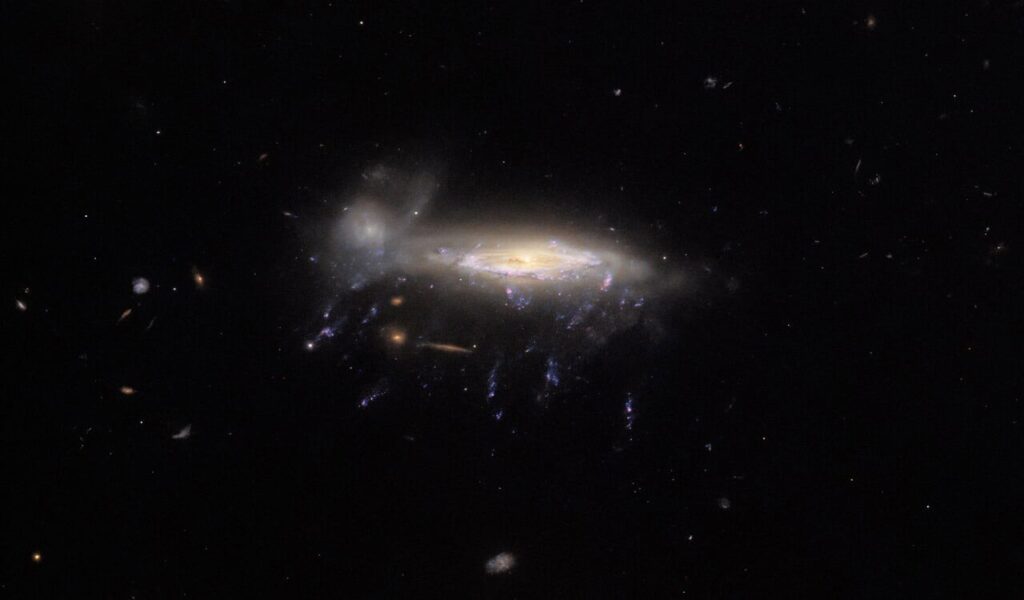
 JO204, another ‘jellyfish galaxy’ example. Credit: Wikimedia Commons
In the modern universe, dense galaxy clusters are famously hostile environments, often filled with old, red, “dead” galaxies that have completely stopped making stars. Astronomers have long suspected that phenomena like ram-pressure stripping help kill off these galaxies by robbing them of their star-forming fuel. However, finding a jellyfish galaxy at a time when the universe was only about a third of its current age is highly surprising.
“The first is that cluster environments were already harsh enough to strip galaxies, and the second is that galaxy clusters may strongly alter galaxy properties earlier than expected,” Roberts noted in a statement.
“Another is that all the challenges listed might have played a part in building the large population of dead galaxies we see in galaxy clusters today. This data provides us with rare insight into how galaxies were transformed in the early universe.”
Because this discovery marks the most distant confirmed ionized gas tail, researchers now hunt for more examples to determine their cosmic rarity. For now, astronomers are seeking more telescope time to sharpen their view of COSMOS2020-635829 and search the cosmic depths for others of its kind.