
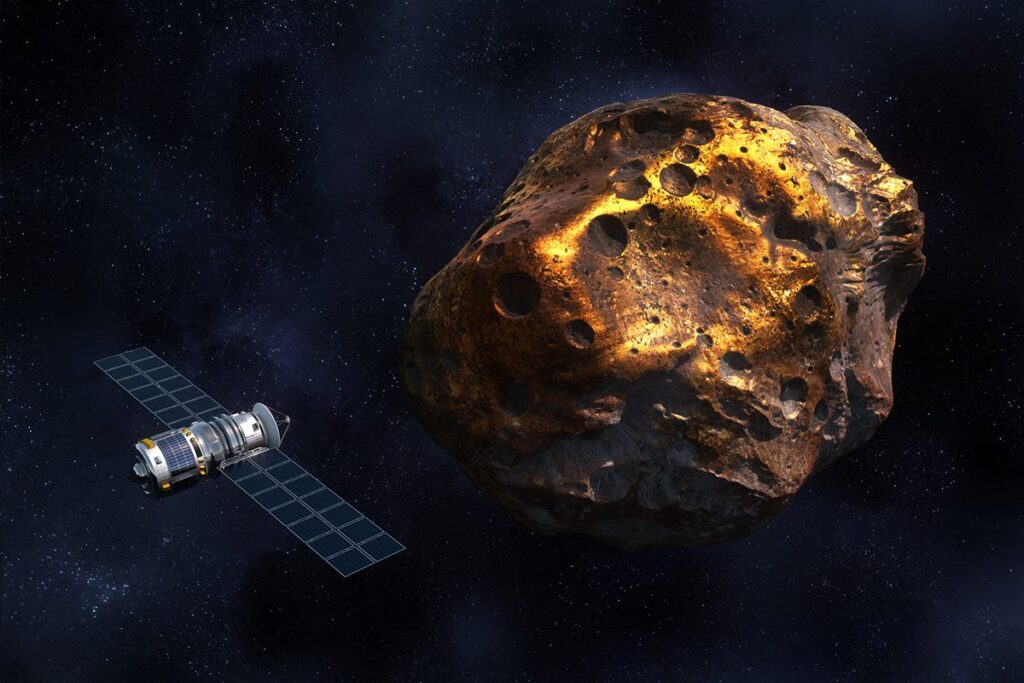
Comet 3I/ATLAS is an immensely interesting object. It was discovered on 1 July 2025 by the Asteroid Terrestrial-impact Last Alert System (ATLAS) survey telescope in Chile, when it was 4.5 AU
from the Sun.
Its hyperbolic trajectory quickly revealed it as an interstellar visitor, only the third ever found – hence its designation 3I.
As it approached perihelion in October 2025, it warmed and became active, developing a coma and a tail of gas and dust.
 Credit: NASA/Goddard/LASP/CU Boulder
Spectroscopic observations revealed water, carbon dioxide and cyanide, typical of comets in the Solar System.
As a visitor from another star system, 3I/ATLAS is a tantalising prospect for astronomers to study before it escapes back out into interstellar space.
But its trajectory makes an up-close mission extremely challenging.
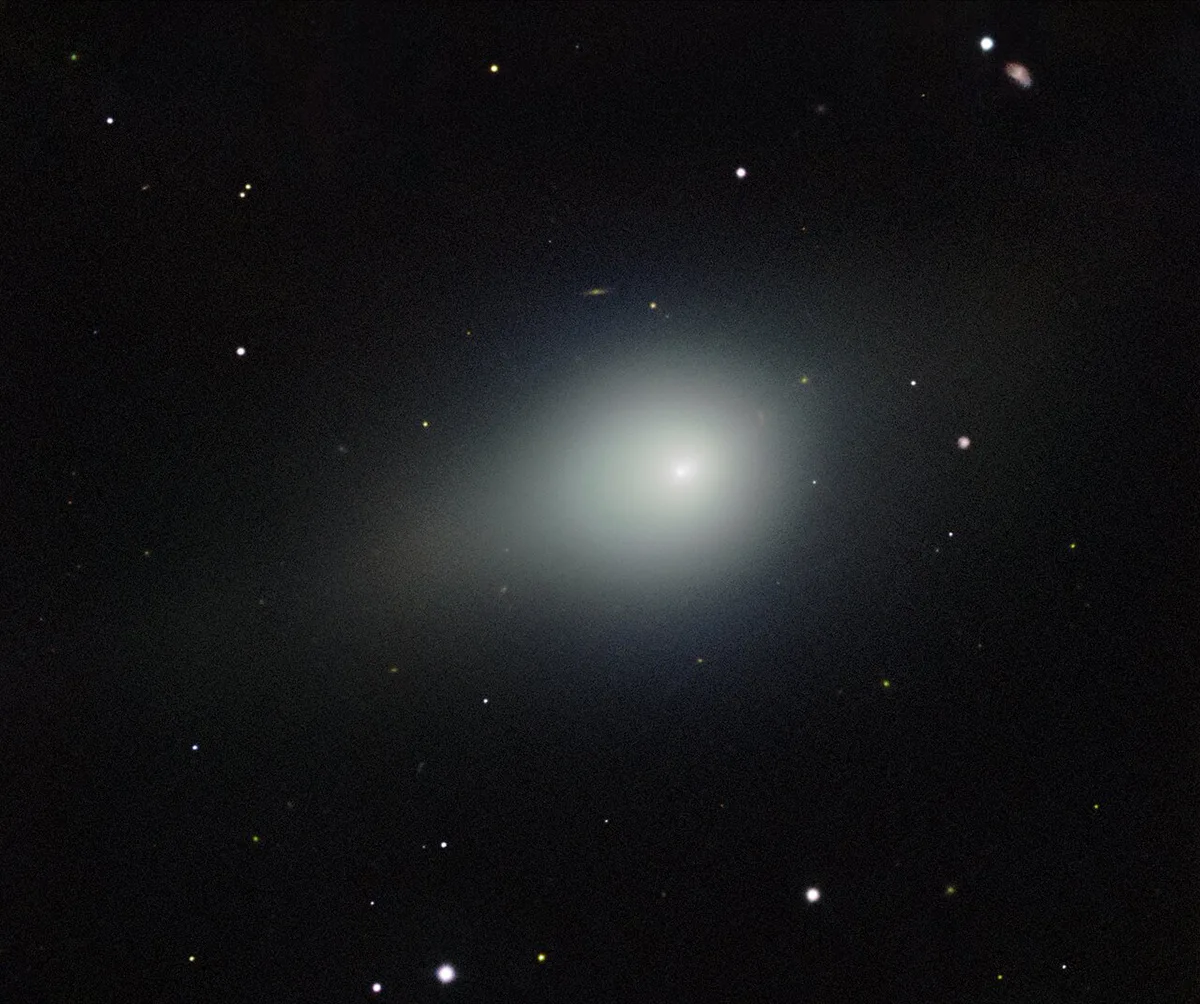 Image of comet 3I/ATLAS captured by the Gemini North telescope, 26 November 2025. This final image has been processed to correct streaking background stars. Credit: International Gemini Observatory/NOIRLab/NSF/AURA/B. Bolin. Image Processing: J. Miller & M. Rodriguez (International Gemini Observatory/NSF NOIRLab), T.A. Rector (University of Alaska Anchorage/NSF NOIRLab), M. Zamani (NSF NOIRLab)
3I/ATLAS is zooming out of the Solar System
3I/ATLAS is blisteringly fast – over 60km/s (216,000km/h or 134,000mph) – and on a retrograde path (in the opposite direction to the orbit of the planets).
This makes a rendezvous mission – as we saw with Rosetta, which matched the speed of comet 67/P to fall into its orbit in 2014 – impossible.
Only a fleeting fly-by would be remotely feasible.
Sending a probe on a direct path to catch up with it is also impossible, because by the time 3I/ATLAS was discovered, it was within the orbit of Jupiter and the necessary launch date had already passed.
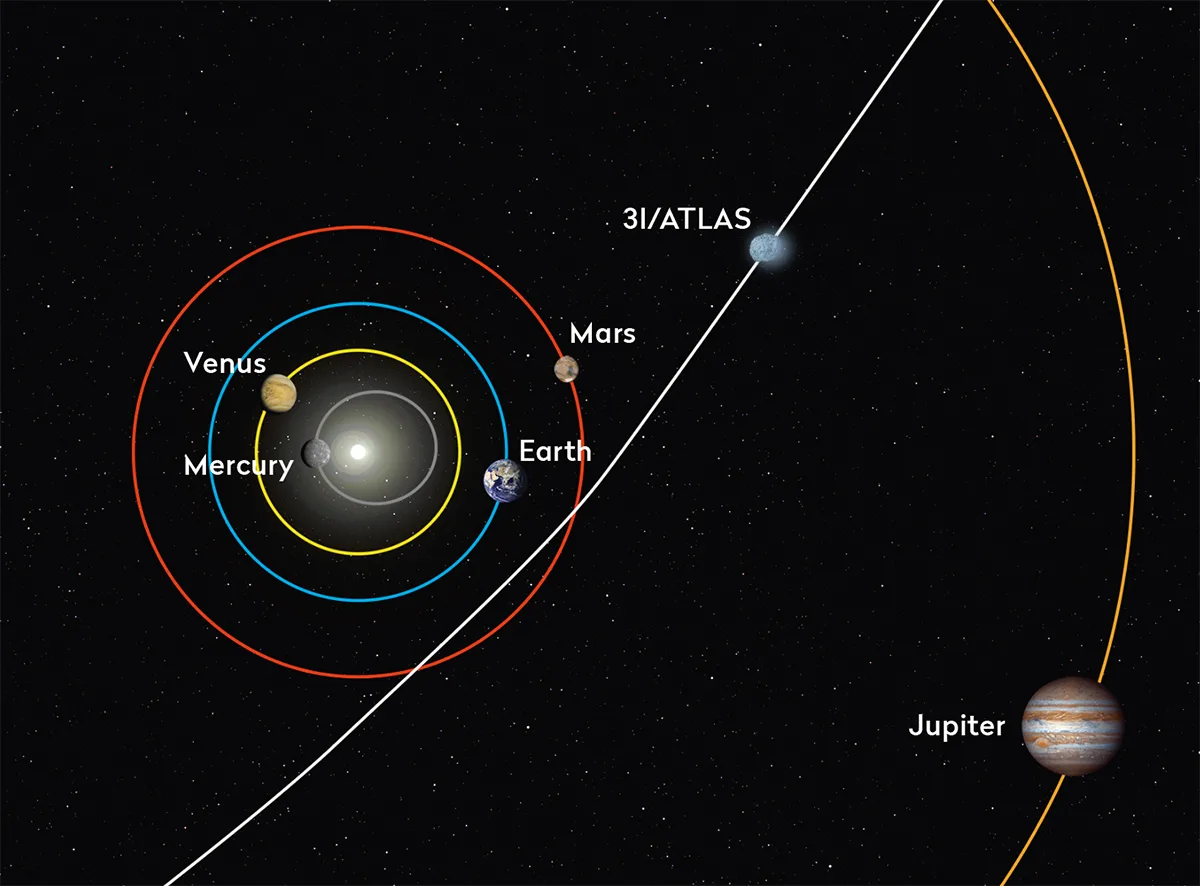 Diagram showing the orbit of comet 3I/ATLAS. Credit: NASA/JPL-Caltech
How to catch 3I/ATLAS
Adam Hibberd at the Initiative for Interstellar Studies in London, along with T Marshall Eubanks at Space Initiatives Inc, Princeton, have proposed a bold mission to use what’s known as a solar Oberth manoeuvre.
This exploits the fact that a spacecraft’s rockets boost its velocity much more effectively when it’s deep within the gravity well of a massive object – in this case, the Sun.
 Observations of comet 3I/ATLAS by NASA’s SPHEREx mission in December 2025 reveal organic molecules within its coma. Credit: NASA/JPL-Caltech
Hibberd has developed code he calls Optimum Interplanetary Trajectory Software (OITS) to calculate a spacecraft trajectory that could feasibly catch up with 3I/ATLAS.
To gain maximum acceleration from the Oberth effect, any probe would (paradoxically) need to be initially slowed down, so Hibberd and Eubanks propose launching a probe first towards Jupiter.
From there, it will fall towards the centre of the Solar System for an extremely close pass of the Sun, when it will use all of its rocket fuel in one intense burst.
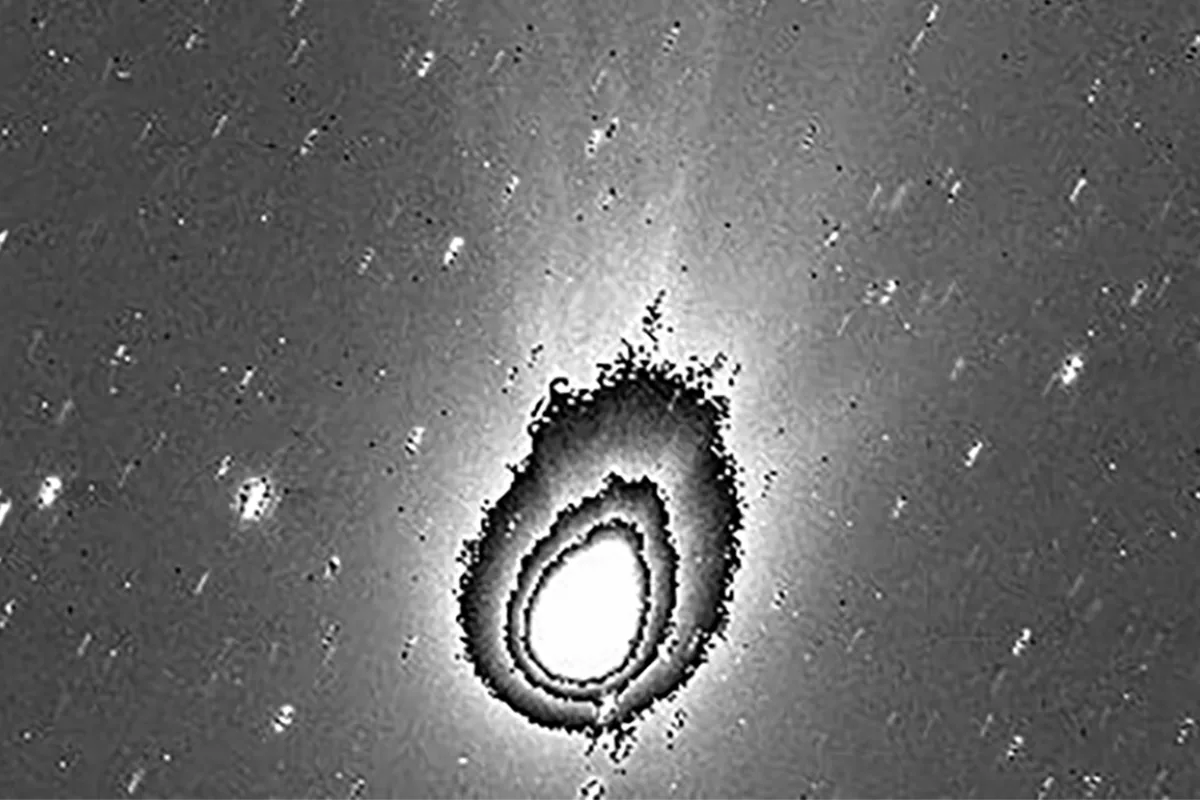 Image of comet 3I/ATLAS on 6 November 2025, captured by ESA’s Juice spacecraft’s JANUS science camera. Processed to reveal the structure of the comet’s coma. Credit: ESA/Juice/JANUS
They calculate that the best launch window will be 2035 and the mission would require a SpaceX Starship Block 3 upper stage refuelled in low Earth orbit (a capability yet to be demonstrated).
Swooping just 15 million kilometres (93 million miles) from the searing surface of the Sun (four times closer than NASA’s Parker Solar Probe in 2024) would require an advanced heat shield.
The manoeuvre would accelerate the probe to over 350km/s (1.26 million km/h or 783,000mph) – but even so, it wouldn’t catch up with 3I/ATLAS for at least 35 years.
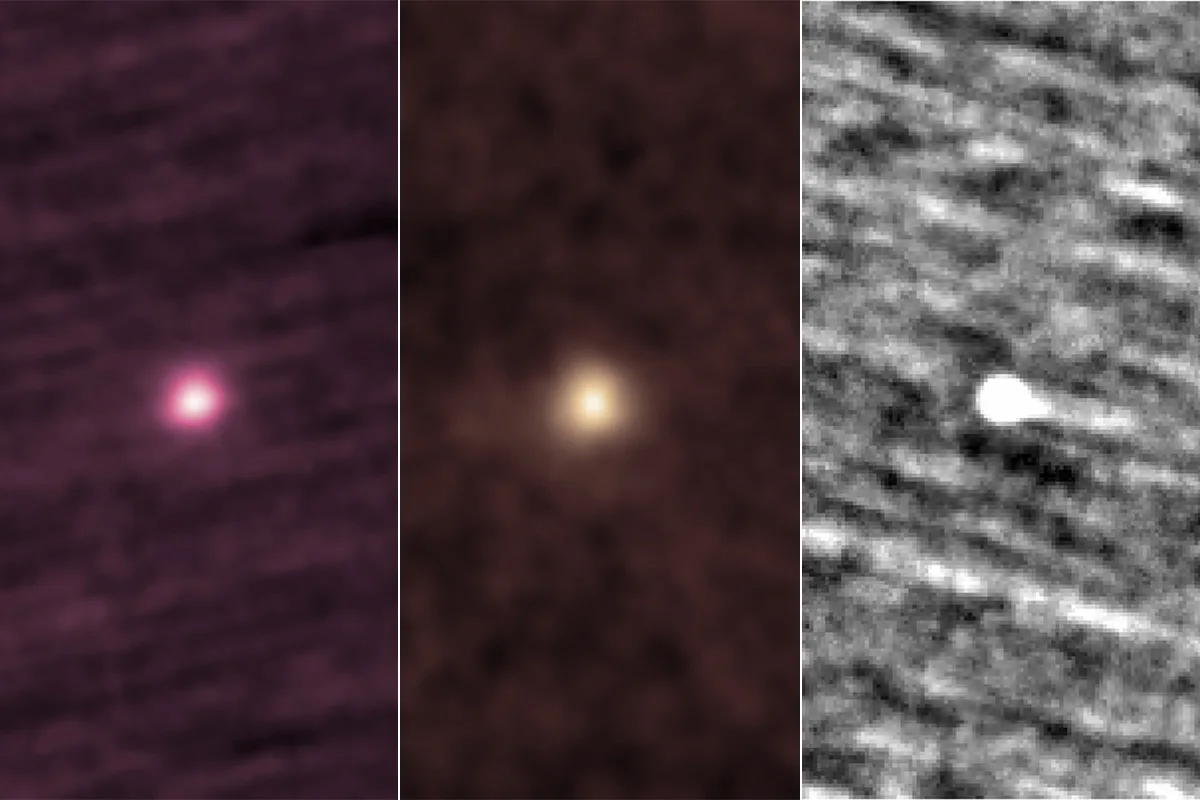 Images of comet 3I/ATLAS as seen by, left to right, NASA’s STEREO-A spacecraft, ESA/NASA SOHO spacecraft, NASA’s PUNCH spacecraft, September/October 2025. Credit: NASA/Lowell Observatory/Qicheng Zhang; NASA/Southwest Research Institute
So it’s fair to say that while a probe to 3I/ATLAS is just about feasible, there are still huge challenges.
But for me, this almost ludicrously ambitious proposal is the epitome of Theodore Roosevelt’s quote: “to dare mighty things, to win glorious triumphs.”
And such a solar Oberth manoeuvre may well prove to be just the ticket for visiting the next interstellar object to be discovered.
Lewis Dartnell was reading Catching 3I/ATLAS Using a Solar Oberth by Adam Hibberd and T Marshall Eubanks Read it online at: arxiv.org/abs/2601.02533