
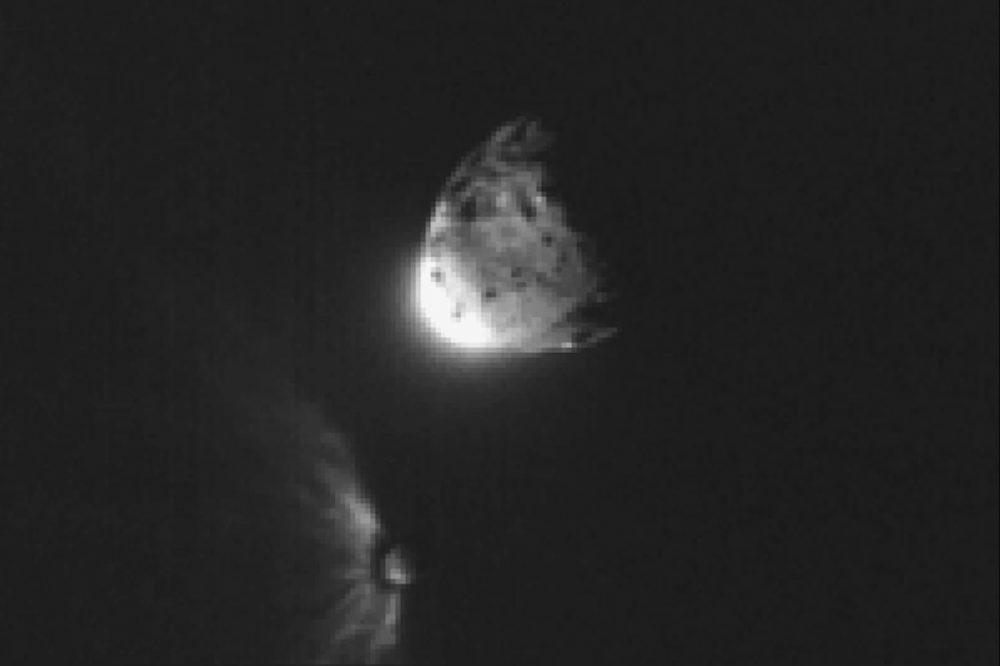
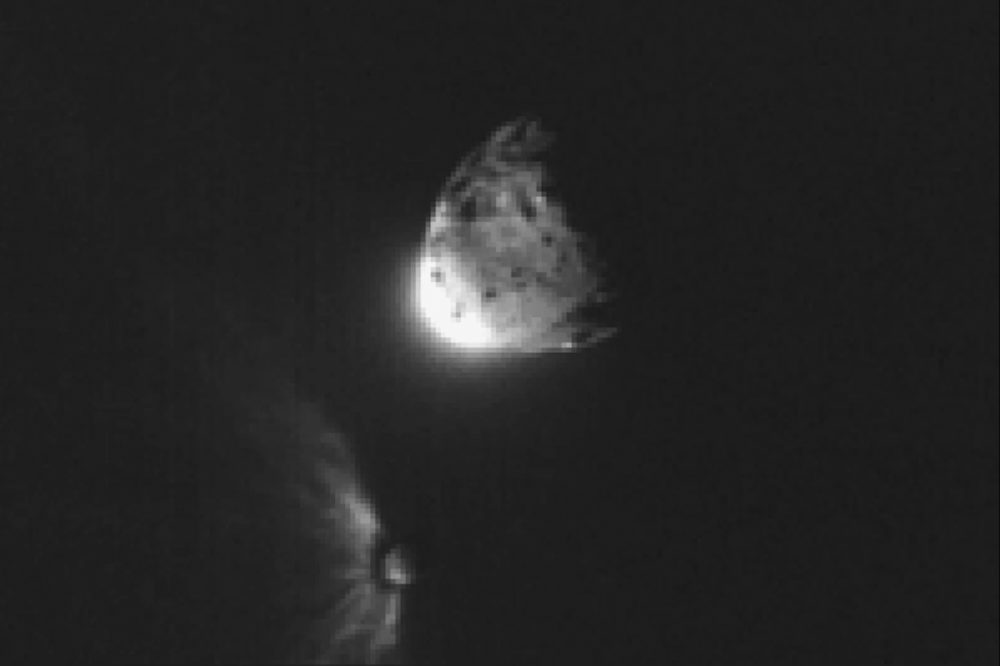
Scientists confirm that NASA’s DART mission successfully changed an asteroid’s orbit around the sun for the first time in history. The spacecraft deliberately crashed into asteroid Dimorphos in 2022, slightly altering its path as a test for future planetary defense against potentially dangerous space rocks.
Scientists have confirmed that NASA successfully altered an asteroid’s path around the sun during a groundbreaking planetary defense experiment, marking the first time humans have deliberately modified a celestial object’s solar orbit.
Researchers announced Friday that the DART spacecraft’s intentional collision with asteroid Dimorphos in 2022 successfully shifted the space rock’s trajectory, demonstrating a potential method for protecting Earth from future asteroid threats.
“This study marks a notable step forward in our ability to prevent future asteroid impacts on Earth,” the international research team wrote in Science Advances.
The modifications were minimal but significant – cutting the asteroid system’s two-year journey around the sun by just one-tenth of a second and reducing their 300-million-mile orbit by approximately 2,360 feet. Despite appearing insignificant, these small changes could prove crucial over time.
“Even though this seems small, a tiny deflection … can add up over decades and make the difference between a potentially hazardous asteroid hitting or missing the Earth in the future,” explained lead researcher Rahil Makadia from the University of Illinois Urbana-Champaign.
Makadia emphasized that successful planetary defense doesn’t require dramatic last-minute interventions. “The key isn’t delivering a huge shove at the last minute. The key is delivering a tiny shove many years in advance,” he noted.
The DART mission, launched in 2021 as humanity’s first planetary defense trial, intentionally crashed into Dimorphos, which circles a larger asteroid called Didymos. NASA quickly confirmed the 2022 impact shortened Dimorphos’s orbit around its companion, but worldwide observations were needed to verify the effect on their solar path.
The collision’s debris played an unexpected role in the mission’s success. Scientists discovered that rocks and dust ejected from Dimorphos during impact provided equal momentum to the spacecraft itself, effectively doubling the deflection force. Previous estimates suggested 35 million pounds of material were launched into space.
Despite the orbital change, Earth remains completely safe from these asteroids for the foreseeable future – precisely why this debris-filled system was selected for testing, according to NASA’s Jet Propulsion Laboratory scientist Steven Chesley.
“While it is just a single experiment, it is nonetheless an important data point that will be relevant to any future asteroid deflection missions,” Chesley stated.
Additional insights await when the European Space Agency’s Hera spacecraft reaches the asteroid pair in November. Unlike DART’s collision course, Hera will conduct months of detailed surveys while deploying small probes to attempt surface landings.
Dimorphos measures 525 feet across, while its rapidly rotating partner Didymos spans 2,560 feet in diameter and contains 200 times more mass than the smaller asteroid.