

Researchers affiliated with the Hobby-Eberly Telescope Dark Energy Experiment (HETDEX), including Dr. Shun Saito, an associate professor of physics at Missouri S&T, have made the largest and most accurate 3D map yet of light emitted by excited hydrogen 9 billion to 11 billion years ago in the early universe.
This form of light, called Lyman alpha, is emitted in large quantities when hydrogen atoms are exposed to a star’s energy. That makes it a tool for finding bright galaxies in the past that experienced a burst of star creation.
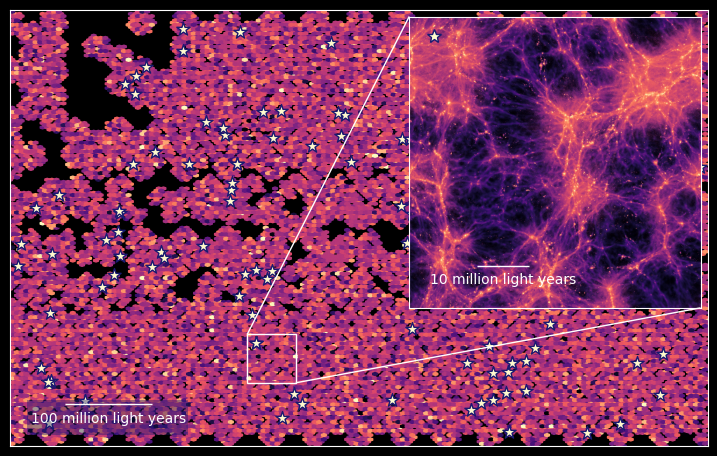 Section of the line intensity map created by charting the distribution and concentration of excited hydrogen. Image credit: Maja Lujan Niemeyer/Max Planck Institute for Astrophysics/HETDEX, Chris Byrohl/Stanford University/HETDEX.
Using a technique called line intensity mapping, the new map pulls these objects into view, adding shape and nuance to this era of the universe. Saito, who also chairs HETDEX’s Cosmology Science Working Group, and his co-authors, recently published the findings in The Astrophysical Journal.
Saito says line intensity mapping charts the distribution and concentration of specific elements across an entire region, rather than observing objects one-by-one. Although this mapping isn’t a new technique, he says this is the first time it’s been used to precisely chart Lyman alpha emissions on this scale.
 Dr. Shun Saito, associate professor of physics at S&T. Photo by Missouri S&T.
To create the map, the HETDEX group, which is led by the University of Texas-Austin, developed programming and used supercomputers to sift through data. The group then used the location of bright galaxies already identified by HETDEX to calculate the location of fainter galaxies and gas glowing nearby.
“We can use the location of known galaxies as a signpost to identify the distance of the fainter objects,” says Dr. Eiichiro Komatsu, a HETDEX scientist, scientific director at the Max Planck Institute for Astrophysics and a co-author on the paper. “The resulting map brings the regions around bright galaxies into greater focus and adds detail to the stretches in between.
“We have computer simulations of this period,” continued Komatsu. “But those are just simulations, not the real universe. Now we have a foundation which can let us know if some of the astrophysics underpinning those simulations is correct.”
Saito says his research group’s data analysis for the project will be beneficial for future studies of galaxy formation in the early universe.
“The signal we detected is theoretically insightful since it is not consistent with previous similar studies using quasars but consistent with what we predict from numerical simulations for galaxies,” says Saito.
Moving forward, Saito says team hopes to compare their map with others that overlap the same region of the universe and focus on different elements.
Other HETDEX researchers who collaborated on the project include Maja Lujan Niemeyer, Julian Muñoz, Karl Gebhardt and Taft Armandroff.