
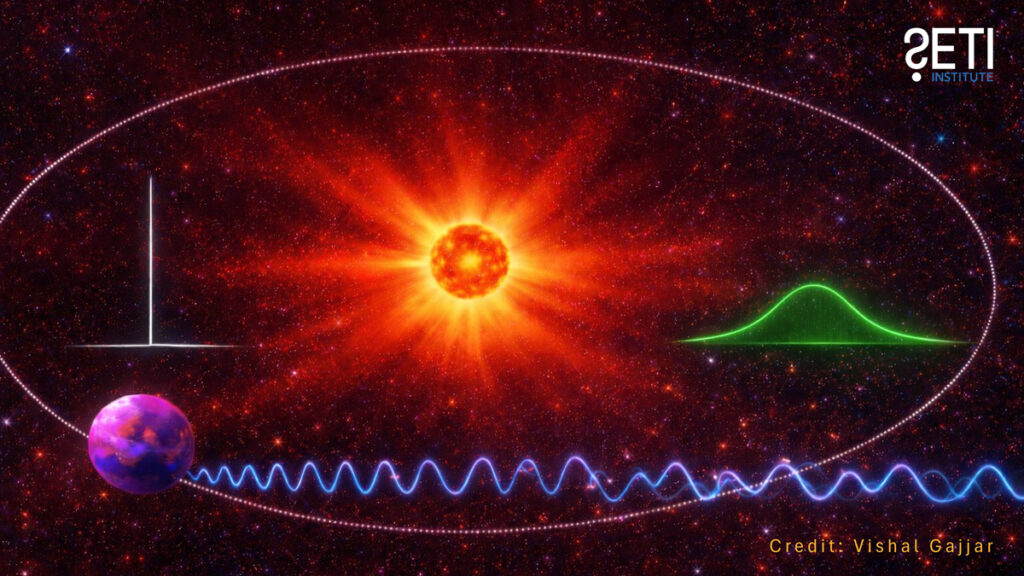
March 5, 2026, Mountain View, CA – — A new study by researchers at the SETI Institute suggests stellar “space weather” could make radio signals from extraterrestrial intelligence harder to detect. Stellar activity and plasma turbulence near a transmitting planet can broaden an otherwise ultra-narrow signal, spreading its power across more frequencies and making it more difficult to detect in traditional narrowband searches.
For decades, many SETI experiments have focused on identifying spikes in frequency—signals unlikely to be produced by natural astrophysical processes. But the new research highlights an overlooked complication: even if an extraterrestrial transmitter produces a perfectly narrow signal, it may not remain narrow by the time it leaves its home system.
In most technosignature searches, scientists account for distortions that happen as radio waves travel across interstellar space. This study focuses on what can happen closer to the source. Plasma density fluctuations in stellar winds, as well as occasional eruptive events such as coronal mass ejections, can distort radio waves near their point of origin, effectively “smearing” the signal’s frequency and reducing the peak strength that search pipelines rely on.
“SETI searches are often optimized for extremely narrow signals. If a signal gets broadened by its own star’s environment, it can slip below our detection thresholds, even if it’s there, potentially helping explain some of the radio silence we’ve seen in technosignature searches,” said Dr. Vishal Gajjar, Astronomer at the SETI Institute and lead author of the paper.
To quantify the effect, the team built on something we can measure directly: radio transmissions from spacecraft in our solar system. Using empirical measurements from solar system probes, they calibrated how turbulent plasma broadens narrowband signals and then extrapolated those measurements to a wide range of stellar environments.
The result is a practical framework for estimating how much broadening could occur for different types of stars and observing frequencies—especially in the “space weather” conditions expected around active stars. The work points to a strong implication for target selection and search design. M-dwarf stars,which constitute about 75% of stars in the Milky Way, have the highest likelihood that any narrowband signals will get broadened before leaving the system. The authors argue that this motivates search strategies that remain sensitive even when signals are not perfectly razor-thin.
“By quantifying how stellar activity can reshape narrowband signals, we can design searches that are better matched to what actually arrives at Earth, not just what might be transmitted,” said Grayce C. Brown, co-author of the study and research assistant at the SETI Institute.
This project exemplifies the type of high-risk, high-impact research supported through the SETI Institute’s STRIDE program (Support Technology, Research, Innovation, Development, and Education), which enables SETI Institute researchers to explore emerging questions and develop novel tools and techniques to test them. STRIDE is funded by the Franklin Antonio Bequest, created to accelerate breakthrough science and education efforts at the SETI Institute.
DOI: 10.3847/1538-4357/ae3d33.
Paper: https://iopscience.iop.org/article/10.3847/1538-4357/ae3d33
About the SETI Institute
Founded in 1984, the SETI Institute is a non-profit, multi-disciplinary research and education organization whose mission is to lead humanity’s quest to understand the origins and prevalence of life and intelligence in the Universe and to share that knowledge with the world. Our research encompasses the physical and biological sciences and leverages expertise in data analytics, machine learning and advanced signal detection technologies. The SETI Institute is a distinguished research partner for industry, academia and government agencies, including NASA and NSF.
Contact information
Rebecca McDonald
Director of Communications
SETI Institute
[email protected]