
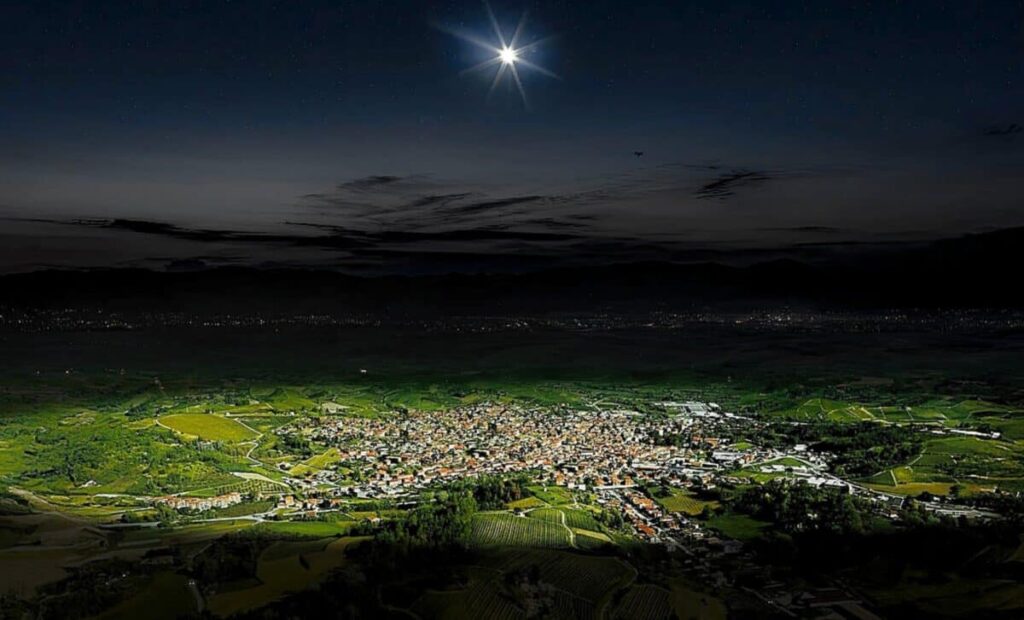
Cities usually fade into darkness within minutes after sunset. Streetlights switch on across neighborhoods while construction crews shut down equipment for the night. Solar farms stop producing electricity as the final sunlight slips below the horizon. For most of human history, that transition from daylight to darkness has followed the same predictable rhythm everywhere on Earth.
Yet the sky above Earth has been changing. Thousands of satellites now travel through low Earth orbit, and long-exposure images of the Milky Way frequently show bright streaks crossing telescope photographs. Astronomers have begun tracking how these spacecraft affect observations of faint stars and distant galaxies. The growing number of satellites has already reshaped parts of the night sky.
A California startup now wants satellites to play a more active role after sunset. The company, Reflect Orbital, is developing spacecraft equipped with large mirrors designed to redirect sunlight toward the ground. The concept would allow specific locations to receive extra illumination even after darkness begins.
Early plans describe a constellation of thousands of satellites reflecting sunlight toward Earth for short periods. The idea is to extend useful daylight for certain activities, including solar power generation or nighttime operations. While the technology remains experimental, the proposal has already drawn attention from astronomers and environmental researchers.
Reflect Orbital Proposes Thousands of Sunlight-Reflecting Satellites
The plan from Reflect Orbital centers on launching a constellation of satellites carrying large mirrors. Early proposals describe as many as 4,000 satellites operating in low Earth orbit. Each spacecraft would use a reflective surface to redirect sunlight toward a targeted region on Earth. The mirror would tilt and rotate to control where the light lands.
Future versions of the mirror could reach about 55 meters across. When sunlight strikes the surface, the spacecraft would angle the reflector so the light travels toward the ground. The system focuses on areas that have already entered nighttime while the satellite itself remains illuminated by the Sun. In that position, the spacecraft can redirect daylight downward for a short time.
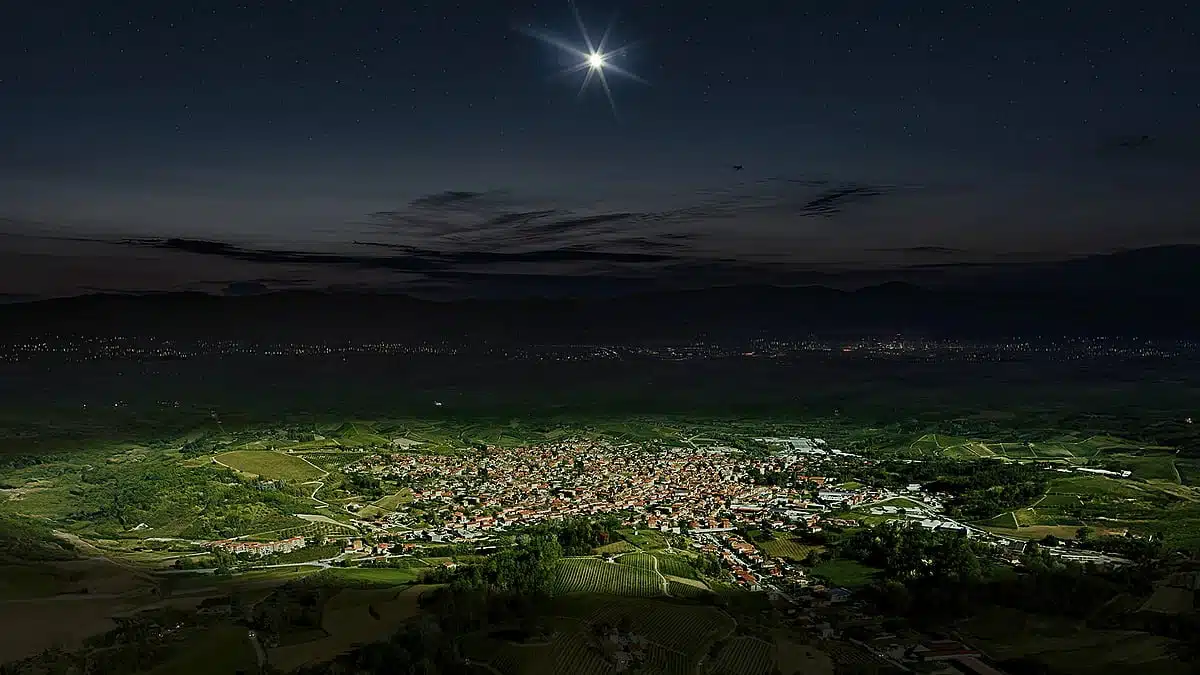 Future versions of the mirrors could reach about 55 meters across. When sunlight strikes the reflective surface, the satellite angles the mirror so the light travels toward Earth. Credit: Reflect Orbital
The first step toward testing the idea is a demonstration mission called Eärendil-1. The spacecraft is designed to deploy a square reflector measuring roughly 18 by 18 meters after reaching orbit. The satellite would operate at an altitude of about 600 kilometers above Earth. During each pass, it would redirect sunlight toward selected locations for several minutes.
Engineers plan to use the mission to test how precisely the mirror can aim reflected light. Sensors on the ground would measure brightness and coverage during each illumination attempt. These observations would help determine whether the system can reliably target a specific region. The results would guide future development of the technology.
How Reflected Sunlight Would Reach the Ground
The proposed system relies on a path known as a sun-synchronous orbit. Satellites in this orbit travel along the boundary between the illuminated and dark sides of the planet. Because of this positioning, the spacecraft can remain in sunlight even when the ground below has entered night. This geometry allows the mirrors to redirect sunlight toward dark areas.
The reflected light would not form a narrow spotlight. Because the Sun appears as a disk in the sky, the reflected beam spreads while traveling through the atmosphere. This spreading creates a wider illuminated patch instead of a concentrated beam. The result would be a brief brightening across part of the landscape.
Early models suggest the illuminated region could span roughly 5 to 6 kilometers across. People inside that area might notice the sky brighten as the satellite passes overhead. The brightness could exceed natural moonlight during the reflection period. However, the effect would last only a few minutes before the satellite moves along its orbit.
According to Reflect Orbital, the mirrors would rotate away from Earth after each pass. This step is meant to prevent unwanted reflections once the illumination period ends. The company says the control system would limit stray light outside scheduled operations.
Astronomers Warn About Growing Satellite Brightness
The proposal has raised concern among researchers who study the night sky. Even ordinary satellites can interfere with astronomical observations. Sunlight reflecting off spacecraft surfaces sometimes creates bright streaks in telescope images. These streaks can cross the entire field of view during long exposures.
A study led by Dr. Alejandro S. Borlaff at NASA Ames Research Center examined how satellite constellations affect telescope data. The research, published in the journal nature, measured how reflected light from satellites contaminates images collected by sensitive instruments. Astronomers often search for extremely faint objects in deep space. Even brief reflections can disrupt those observations.
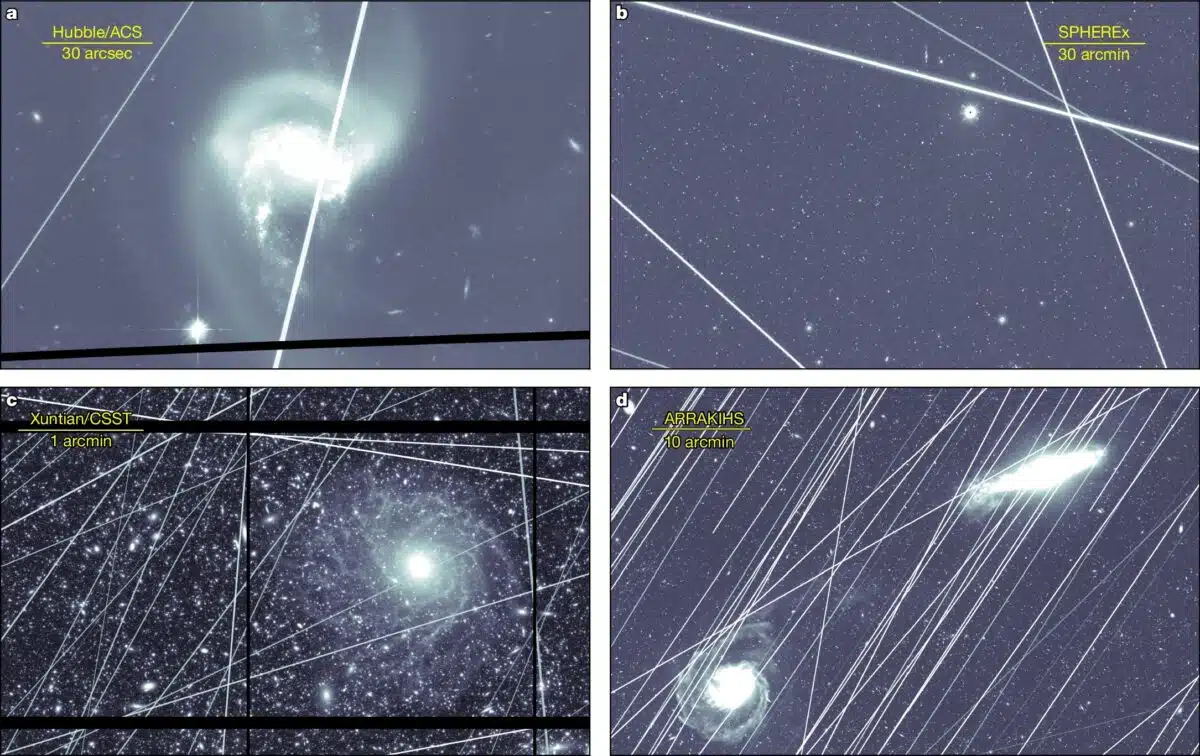 Simulated effects of satellite trails in Hubble, SPHEREx, Xuntian and ARRAKIHS. Credit: Credit: NASA / Borlaff, Marcum, Howell (Nature, 2025)
Satellite numbers have increased quickly in recent years. Around 2,000 satellites were active in orbit in 2019, but estimates suggested roughly 15,000 by 2025. Long-term projections indicate that hundreds of thousands of satellites could eventually occupy low Earth orbit. Scientists are already studying how this growth affects observations.
Researchers warn that satellites designed to reflect sunlight could intensify these challenges. Some calculations suggest a large mirror satellite might appear several times brighter than the full moon when directly overhead. Reflections of that intensity could raise background brightness across large sections of the sky.
Concerns Extend Beyond Astronomy
Artificial light at night can also influence ecosystems. Many animal species rely on natural darkness to guide behavior such as migration or feeding. Environmental researchers have documented how bright nighttime lighting disrupts those patterns. Additional orbital light sources could increase global light pollution.
Organizations such as DarkSky International monitor how artificial lighting spreads across the planet. Scientists studying nighttime illumination also examine its effect on human circadian rhythms, which regulate sleep cycles and hormone production. Changes in nighttime lighting can therefore affect both wildlife and human health.
Another concern involves the growing amount of hardware already circling Earth. Thousands of additional spacecraft would increase traffic in low Earth orbit, where satellites share space with fragments of space debris. Even small debris particles travel at extremely high speeds. Collisions can damage satellites or generate additional debris.
For now, the next milestone is the demonstration satellite. If the Eärendil-1 mission launches successfully, it will test whether satellites can reliably reflect sunlight toward Earth during controlled orbital passes. The results will determine whether the Reflect Orbital concept advances beyond its first experimental mission.