
Back to Article List
Our window is now open to observe Comet Wierzchoś in the evening sky, visible for a few hours after sunset.
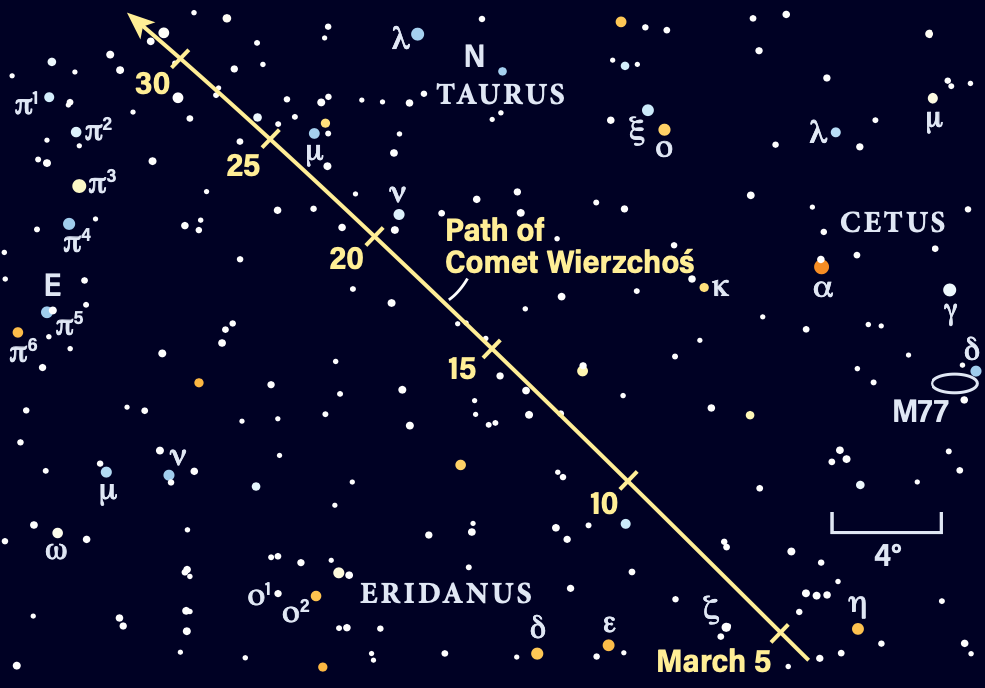
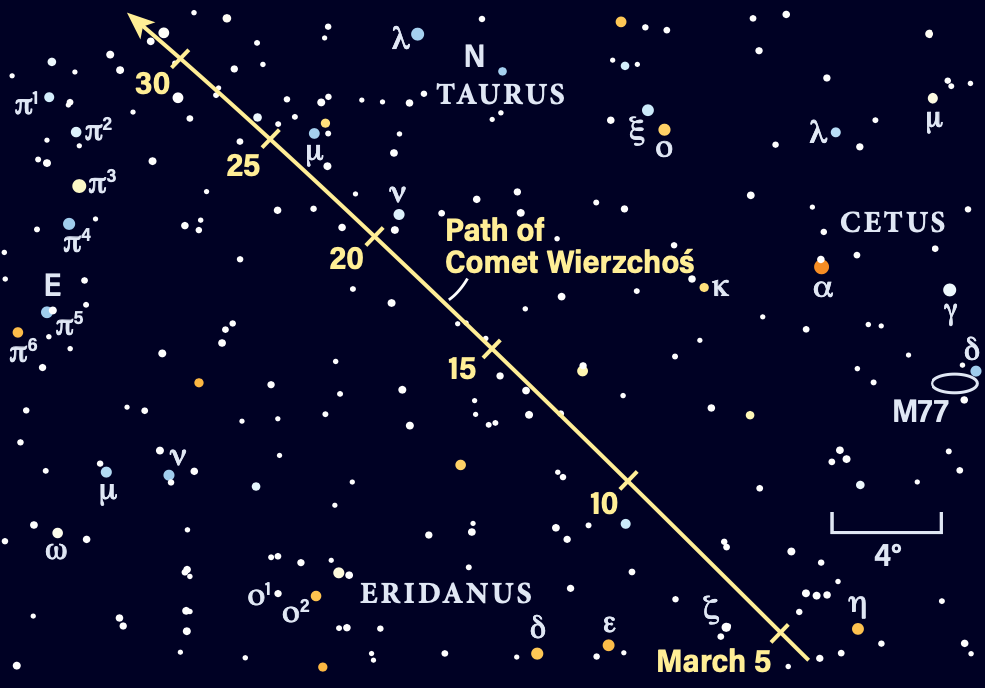
Comet Wierzchoś is moving quickly but can be found with binoculars early in the month. This chart shows the comet’s path starting March 5, when moonless viewing begins. Credit: Astronomy: Roen Kelly
Looking for a sky event this week? Check out our full Sky This Week column.
March 4: Ganymede transits Jupiter
Jupiter’s largest moon, Ganymede, is transiting the gas giant’s disk early this morning, ending around 2:48 A.M. CST, as Jupiter is setting in the Midwest.
Observers along the West Coast can catch the start of the moon’s shadow transit, which begins around 2 A.M. PST, as Jupiter is very low in the Mountain time zone (although observers there at higher altitudes might be able to watch the shadow appear as well). Jupiter sets with the shadow crossing the disk for West Coast observers.
The moonless window for observing Comet C/2024 E1 (Wierzchoś) opens tonight. You’ll find it this evening after sunset in the southwest, slowly sinking toward the horizon. Two hours after sunset, Wierzchoś is still 20° high, located in the large constellation Eridanus. Tonight it’s relatively easy to find, just 2.9° east of 4th-magnitude Eta (η) Eridani. Note the comet’s asymmetric shape — its northern flank should be much more defined than its softer southern side.
While your attention is in this region, skim your view northwest to central Cetus, where the “wonderful” variable star Mira (Omicron [ο] Ceti) has been brightening as it approaches peak brightness early this year.
Mira is a long-term variable whose brightness changes over the course of roughly a year (332 days). And that brightness changes significantly, swinging from 2nd magnitude all the way to 10th magnitude — completely out of the range of naked-eye visibility. Now, it’s on the brighter end of that swing, currently observed at magnitude 3.6 — well within range of the naked eye. Early this evening, you’ll find it about 12.7° directly below brighter Menkar (Alpha [α] Ceti) as the constellation sets in the few hours after sunset.
Sunrise: 6:27 A.M.
Sunset: 5:56 P.M.
Moonrise: 8:35 P.M.
Moonset: 7:16 A.M.
Moon Phase: Waning gibbous (92%)
*Times for sunrise, sunset, moonrise, and moonset are given in local time from 40° N 90° W. The Moon’s illumination is given at 10 P.M. local time from the same location.