
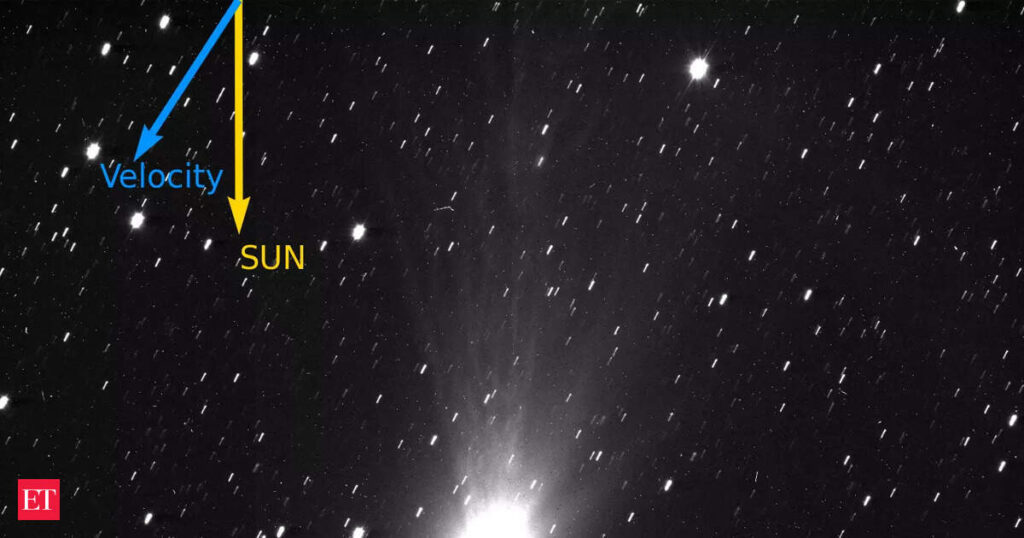
The latest 3i atlas update from the European Space Agency (ESA) has offered fresh insights into the mysterious interstellar comet 3I/ATLAS, with newly released images from the Jupiter-bound spacecraft Jupiter Icy Moons Explorer suggesting that while the object is a rare cosmic visitor, its behaviour appears consistent with that of a typical comet.
The science camera aboard the spacecraft, known as JANUS, captured detailed imagery of the comet in November 2025, seven days after its closest approach to the Sun. The data, now reaching Earth after transmission delays, is being analysed by multiple instrument teams, as per a report by El-Balad.
What did the latest 3i atlas JANUS images reveal?The newly shared image from JANUS shows 3I/ATLAS enveloped in a bright coma, a halo of gas and dust, with a long trailing tail and visible jets, rays and filament-like structures. The comet’s tiny solid nucleus itself is not directly visible, obscured by the surrounding cloud.
ESA described the comet as appearing almost egg-shaped in the processed frame. Arrows added to the released image indicate the comet’s direction of motion and the relative position of the Sun at the time of capture.
Importantly, the agency noted that despite originating from interstellar space, the comet’s outgassing and dust production closely resemble what astronomers expect from a “normal” comet heated by the Sun.
 Live Events
The observations were made when the spacecraft was approximately 66 million kilometres from the comet, allowing a clear but distant view of its activity as it sped through the inner solar system at extraordinary speeds exceeding 150,000 miles per hour during perihelion.
Is the Comet’s Behaviour Abnormal?According to ESA, the answer, at least for now, appears to be no.
“While 3I/ATLAS is a visitor from interstellar space, travelling from outside the Solar System, its behaviour is completely in line with that expected from a ‘normal’ comet,” the agency said.
The object, officially designated 3I/ATLAS, was first detected in July 2025. Its hyperbolic trajectory and extreme velocity confirmed it as only the third known interstellar object to pass through our solar system.
Despite its alien origin, scientists have so far found no evidence of unusual fragmentation, erratic jets or unexplained brightness fluctuations that would set it apart from typical long-period comets formed within the solar system.
However, researchers caution that analysis is ongoing.
Multi-Instrument Campaign: More Than Just a SnapshotThe 3i atlas update is not based solely on a single image. Throughout November 2025, five scientific instruments aboard the spacecraft observed the comet:JANUS (optical imaging)
MAJIS (spectrometry)
SWI (submillimetre wave investigation)
PEP (particle environment package)
UVS (ultraviolet spectrograph)
Each instrument is studying a different aspect of the comet, from its chemical composition and ice content to dust particles and emitted gases.
ESA said the spacecraft was on the opposite side of the Sun relative to Earth during part of the data return phase, forcing it to use a smaller antenna at lower transmission rates. As a result, instrument teams received the bulk of the dataset only recently and have now begun detailed analysis.
3i Atlas update: What happens next?Scientists from the various instrument teams are expected to meet in late March to compare findings and consolidate conclusions. The review will combine JANUS imagery, spectrometry from MAJIS and UVS, compositional data from SWI, and particle analysis from PEP, along with navigation-camera observations.
The coordination meeting is seen as a key milestone in interpreting whether 3I/ATLAS holds clues about the chemistry and structure of distant star systems.
While the comet itself is now speeding away from the Sun and gradually fading from view, the scientific process is only beginning.
3i Atlas update: A Rare Interstellar MessengerComet 3I/ATLAS has intrigued astronomers since its discovery due to its origin beyond the solar system. Travelling through interstellar space for possibly billions of years, it represents a rare opportunity to directly sample material formed around another star.
Its fleeting passage has been compared to “glimpsing a rifle bullet for a thousandth of a second,” underscoring the challenge of studying such fast-moving objects.
For ESA, the observation campaign also highlights the versatility of the Jupiter Icy Moons Explorer mission, which is primarily en route to study Jupiter’s icy moons but has demonstrated its ability to conduct opportunistic science during transit.
FAQsWhat did the latest JANUS images show?The images revealed a bright coma, long tail, and structured jets of gas and dust around 3I/ATLAS, with an egg-shaped appearance in processed frames.Is 3I/ATLAS behaving abnormally?No. ESA says the comet’s activity is consistent with that of a typical comet heated by the Sun, despite its interstellar origin.