
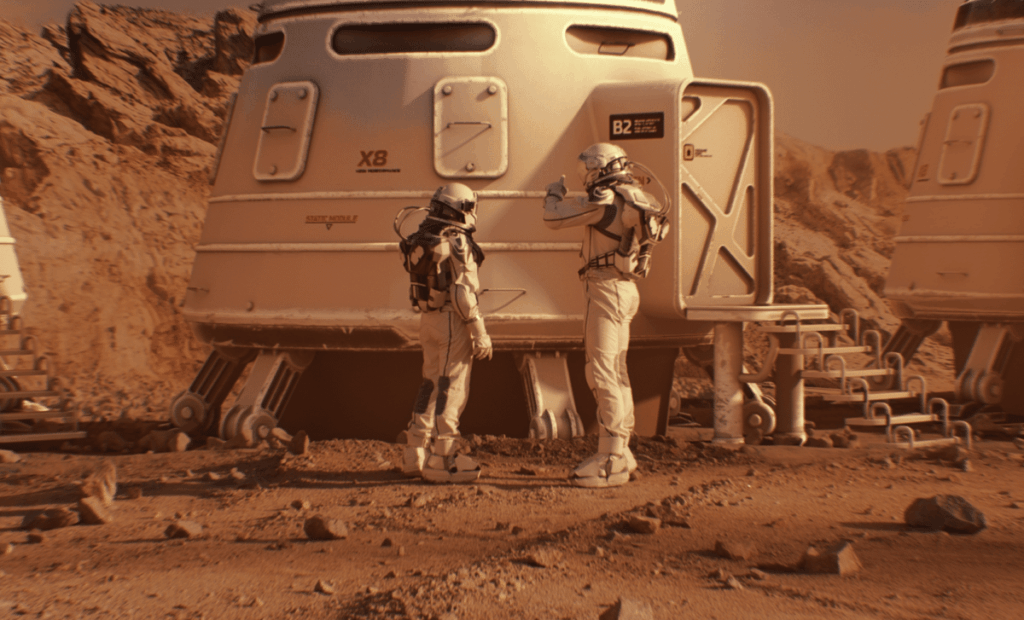
As humanity sets its sights on colonizing Mars, one of the biggest challenges we face is ensuring astronauts can grow their own food. Without fertile soil, sustaining a colony on the Red Planet seems nearly impossible. But what if the answer lies in an unexpected resource, astronaut waste? Scientists are exploring how human sewage, when combined with Martian regolith, could be the key to transforming barren land into fertile soil, allowing crops to thrive on Mars and paving the way for long-term space exploration.
The Role of Organic Waste in Creating Fertile Soil on Mars and the Moon
A major challenge for future space missions is ensuring astronauts have enough food to survive. Earth-based farming relies on fertile soil, but the Moon and Mars do not have this luxury. The soil on both planets, known as regolith, is largely inert and lacks the essential nutrients plants need to grow. As a result, astronauts would need to find innovative ways to make the regolith suitable for agriculture. The recent study led by Harrison Coker of Texas A&M University presents a revolutionary approach by demonstrating how human waste can be used to create nutrient-rich soil.
“In lunar and Martian outposts, organic wastes will be key to generating healthy, productive soils,” said Coker in the study published in ACS Earth and Space Chemistry. The research team explored how organic waste from astronauts, when combined with lunar and Martian regolith, could break down the minerals within the regolith, releasing nutrients essential for plant growth. This process is known as “weathering,” and it could be a vital step in making these extraterrestrial environments more hospitable for crops. The idea is to use waste produced by the astronauts themselves, minimizing the need to transport fertilizers from Earth.
 The secret to making Mars’s uninhabitable surface (pictured here) suitable for plants might be recycled sewage.
NASA/JPL-Caltech/Cornell University/Arizona State University
A Detailed Look at the Experiment: Using Astronaut Poop to Create Fertile Ground
The experiment conducted by Coker’s team involved combining simulated human sewage with regolith simulants that mimicked the soil found on the Moon and Mars. The research team used the Organic Processing Assembly (OPA) at NASA’s Kennedy Space Center, a system designed to process sewage into usable, nutrient-rich effluent. This effluent was then mixed with the regolith simulants and placed in a shaker to simulate weathering. Over 24 hours, the regolith particles began to break down, releasing vital nutrients such as calcium, magnesium, and sulfur.
The team discovered that the lunar simulant released significant amounts of sulfur, calcium, and magnesium, while the Martian simulant also released sodium. These nutrients are essential for plant growth, and the team found that they were made accessible through the weathering process. Coker’s findings suggest that organic waste could be a key to unlocking the potential of regolith for agriculture on the Moon and Mars, reducing the reliance on external resources and making space farming more sustainable.
Challenges in Using Regolith for Agriculture
While the study offers promising results, the process is not without its challenges. The regolith on Mars and the Moon may behave differently from the simulants used in the experiment, and further research is needed to understand the full potential of this method. For example, while the weathering process released several important nutrients, there are still many others, such as iron, zinc, and copper, that are essential for plant growth but were not released in the experiment. Additionally, the current technology for processing sewage and converting it into usable nutrients, like the OPA, is still in its early stages. More efficiency and refinement will be needed for these systems to operate effectively in the harsh conditions of space.
Despite these challenges, the findings of this study offer a glimpse of a future where humans can live and farm on Mars and the Moon without relying on constant resupply missions from Earth. If this process can be perfected, it could be a game-changer for long-term space exploration and colonization.