
In recent months, Ireland became an associate member of Cern, the European Organisation for Nuclear Research. This is a very welcome development for physicists, engineers and computer scientists working in Ireland, and will also be an invaluable resource for students in Stem disciplines in our third-level institutions.
Cern has long been one of the world’s leading scientific laboratories, its particle accelerators providing crucial information on one of the most intriguing questions of science – the fundamental structure of matter and the nature of the forces that bind it together.
Ireland, almost uniquely among European countries, had no formal association with the organisation until now, despite years of campaigning.
Membership of large international scientific collaborations such as Cern is particularly beneficial for small countries. Ireland has benefited greatly from membership of the European Space Agency (ESA) and more recently the European Southern Observatory (ESO).
One reason for this is that membership of such collaborations allow smaller countries with limited research budgets to participate in “big science” experiments that come with a hefty price tag. Another is that it allows scientists and engineers from smaller states to work with the best scientists in the world.
[ Ten great reasons to become a scientistOpens in new window ]
Most importantly, membership of Cern will allow undergraduate and postgraduate students in Irish universities to train at one of the world’s elite scientific facilities.
Another benefit lies in the area of technology. Time and again, the need for cutting-edge technology at Cern has led to remarkable advances in engineering and computing. Famously, the need for thousands of scientists to study data gathered in particle experiments led to the development of the world wide web by Cern scientist Tim Berners-Lee.
To this day, the use of the web involves software protocols developed and maintained by Cern scientists – a precious resource that the world enjoys free of charge.
Other technological spin-offs include key advances in microelectronics and medical imaging. Until now, high-tech companies in Ireland were at a disadvantage in competing for contracts associated with the development of such technologies at Cern.
By the 1950s, it had become clear that high-energy particle accelerators offered a powerful tool for studying the fundamental structure of matter at the subatomic level. However, the cost of building large accelerators was prohibitive for individual countries, and it was decided to build a pan-European facility in Geneva.
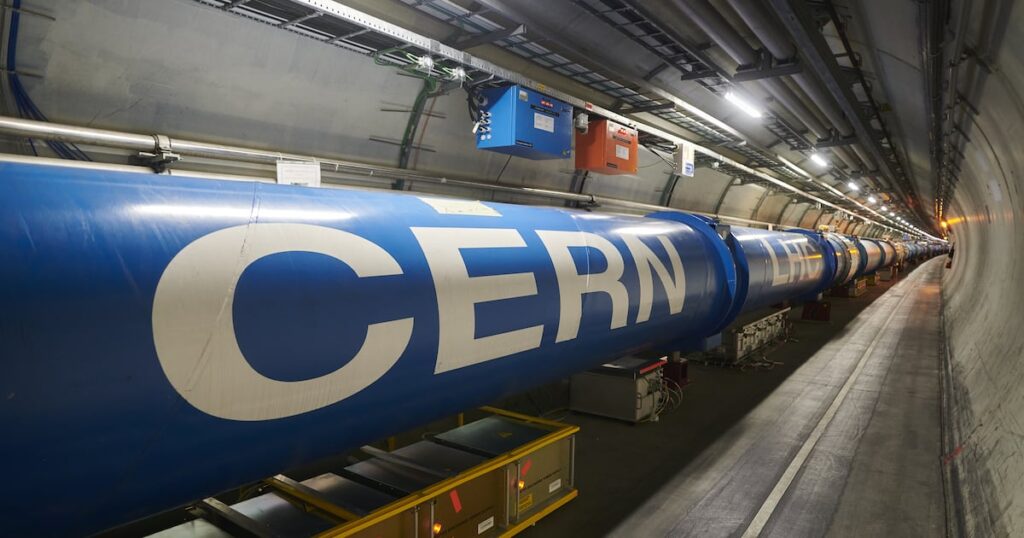
Since then, many ground-breaking discoveries have been made using Cern accelerators, establishing Cern as a world leader in the field. The most notable of these was the detection in 2012 of the Higgs boson in experiments at Cern’s Large Hadron Collider (LHC) – a landmark device that provided the missing piece of the Standard Model of particle physics. This is the theory underlying most of our understanding of how matter forms.
[ Give Me a Crash Course In … the Cern rebootOpens in new window ]
As with any field of science nowadays, experimental particle physics has its critics. A common complaint is that the costs of building further accelerators are not justified, as there has been little sign of new physics beyond the Standard Model to date.
I disagree with such criticisms, as the history of particle physics is littered with examples where breakthroughs occurred when they were least expected. From an economic perspective, international collaborations have been shown time and again to be much more cost-effective than costly experiments by individual states. There is plenty of exciting physics to be explored at higher energies.
For example, one fascinating experiment at the LHC is the study of subtle differences between matter and antimatter, an investigation that may one day explain why our universe came to be dominated by matter. Indeed, a research group at the School of Physics at University College Dublin has long played a prominent role in this experiment at Cern.
More generally, the extremely high energy density achieved in accelerator experiments mimics the conditions prevalent in the early universe. Thus, experiments at the LHC offer a window on the infant universe, and may shine a light on outstanding cosmological questions such as the nature of dark matter and dark energy.
My own concern is whether our membership of Cern will be matched by research funding at national level. At present, there are very few funding schemes in Ireland for research into fundamental areas such as particle physics. This situation must change if Ireland is to take full advantage of its membership of international collaborations such as Cern and the ESO.
Dr Cormac O’Raifeartaigh is a senior lecturer in physics at the South East Technological University in Waterford, and a fellow of the Institute of Physics